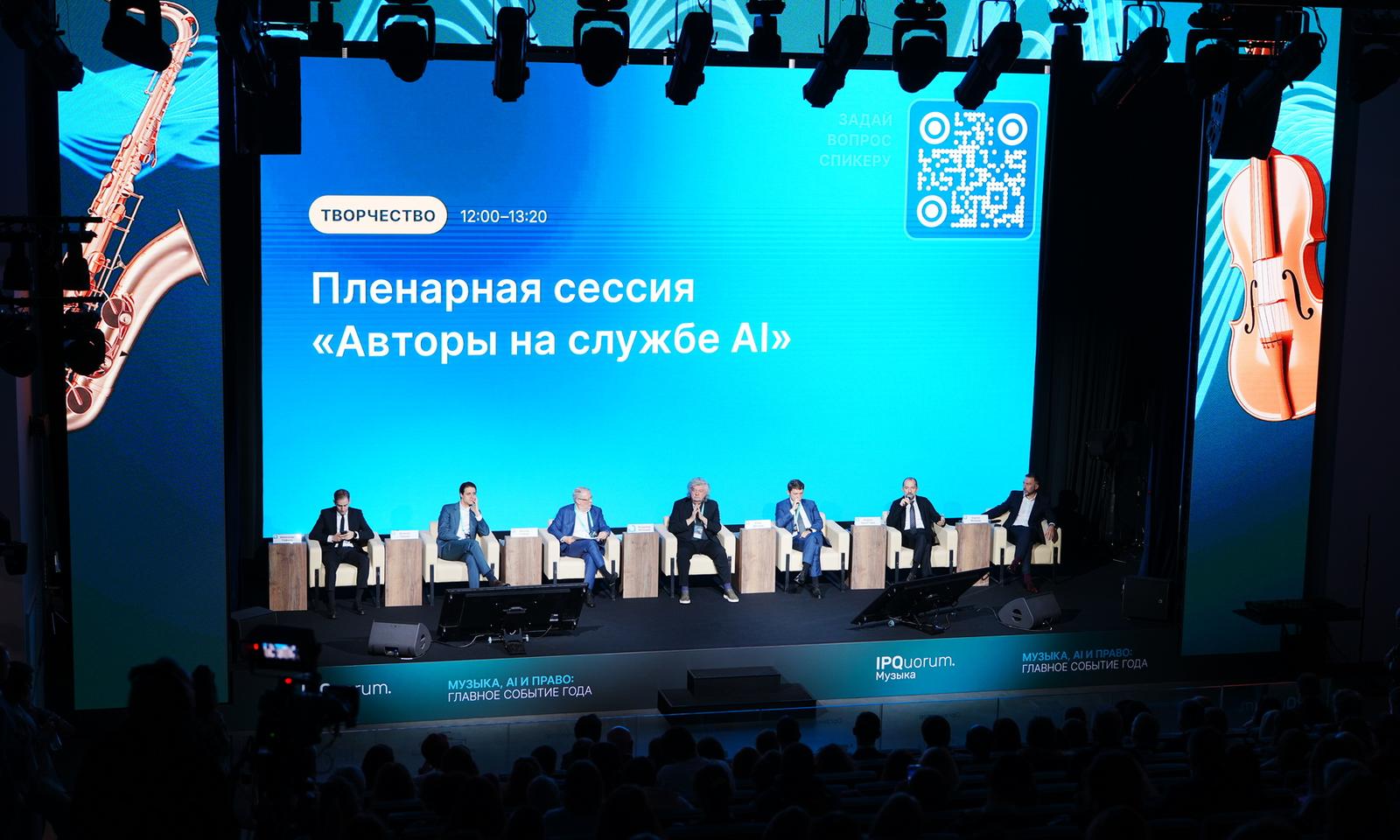
The International IPQuorum.Music forum hosted a key discussion on the impact of artificial intelligence (AI) on creative industries. The focus of the discussion was a study by the Higher School of Economics (HSE), which for the first time quantitatively assessed the damage to authors from the use of their works in training neural networks.
According to a report by the Institute for Statistical Studies and Economics of Knowledge (ISSEK) at the Higher School of Economics (HSE), by 2030, authors and copyright holders will be short more than 1 trillion rubles. The main reasons are the reduction of author's commissions and the replacement of original content with "synthetic" works: music, texts, graphics, and design. Annual losses are approaching 250 billion rubles.
The IT sector (542 billion rubles) and the marketing and advertising industry (169.85 billion rubles) will suffer the greatest financial damage. The music sphere and literary creativity will lose 48 billion rubles each, and photographers and artists will lose 31 billion rubles. At the same time, Russian neural networks ("Shedevrum", GigaChat) account for only 0.2% of global traffic, which means that the main profit from replacing human creativity will go to other jurisdictions.
The study revealed a differentiation of risks by industry:
- in high-risk segments (translators, linguists, writers, journalists, musicians, composers, singers), the share of generative content will reach 28-30% by 2030;
- in moderately vulnerable areas (artists, photographers, actors, dancers), the replacement will be 9-12%;
- in relatively stable areas (directors, choreographers), the share of AI content is expected to grow from 3.9% in 2025 to 9% by 2030.
Key business challenges identified by forum participants:
- Lack of compensation mechanisms: according to Igor Drozdov, Deputy Chairman of VEB.RF, AI systems are trained on protected works without the consent of the authors and payments. This is directly related to the reduction of author's commissions and the displacement of human content from distribution.
- Redistribution of income: IT companies profit by displacing creators from the market by replacing their work with generative objects.
- Lowering the entry threshold: as noted by Leonid Gokhberg, Director of ISSEK HSE, the growth in the number of non-professional participants and new institutional players (including IT companies) increases competition for consumer attention and leads to a redistribution of income not in favor of creators.
Experts suggested the following solutions:
- introduction of a "technological rent" - special deductions in favor of authors from companies using AI to generate content (RCIS initiative). According to Andrey Krichevsky, Chairman of RCIS, this should be "one form or another of fair remuneration" for authors;
- development of clear legal frameworks for the use of copyrighted objects in training neural networks;
- creation of specialized government bodies to monitor compliance with the rights of creators.
As noted by Andrey Krichevsky, Chairman of RCIS, the task is not to stop progress, but to "create a framework for such destruction" in order to preserve the foundation of civilization - culture. At the same time, according to composer Vladimir Matetsky, the goal is to ensure that "AI is at the service of authors," and not vice versa.
Despite the risks, the participants in the discussion recognized the inevitability of integrating AI into creative processes. The main challenge is to build a system where:
- authors receive fair compensation for the use of their works;
- the quality and uniqueness of content is preserved;
- technologies act as a tool, not a replacement for human creativity.
Achieving a balance will require a comprehensive approach: from new laws to economic mechanisms that protect the interests of the creative economy.