TISBI College in Kazan has developed and implemented a set of educational methods for students with special needs. These are original developments, ranging from specialized game technologies to adapted workbooks. The new approaches are based on a combination of different types of information perception: visual, tactile, auditory, and kinesthetic.
In the 2024-2025 academic year, the college has a record number of students with disabilities - 35 people, which is three times more than in 2021. They are studying in seven specialties, with the most popular being "Information Systems and Programming" (11 people) and "Law and Social Security" (10 people).
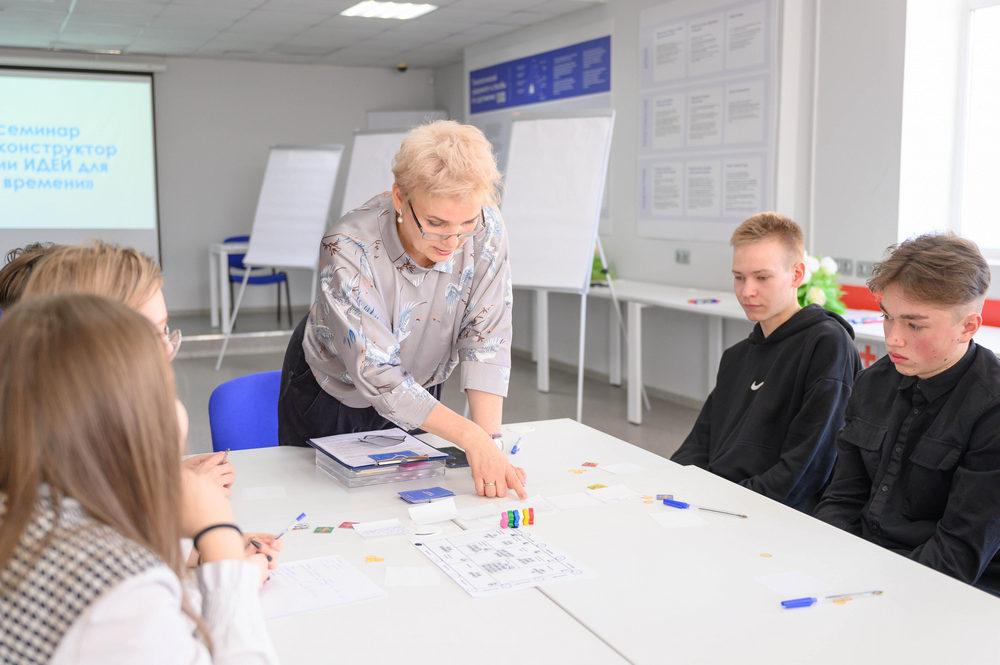
"Our teachers do not just adapt existing teaching methods, but create unique educational tools that take into account the individual characteristics of each student. This allows us to provide quality vocational education for all students, regardless of their health capabilities," notes Tamara Fedorova, Director of TISBI College.
Dina Safina, a teacher of financial disciplines, has developed innovative game methods for studying economics. Her game "EcoCosmos" uses magnetic elements with cosmic images to explain complex financial indicators. The game is complemented by the puzzle "Economic Fifteen", which helps students master the principles of profit and loss formation of an enterprise. According to the developer, special attention is paid to the principle "from simple to complex" with an emphasis on the creative component, which allows each student to develop at their own pace.
Vera Treskova, Candidate of Chemical Sciences, has created a special method of teaching chemistry for visually impaired students and students with cerebral palsy. The approach is based on original workbooks using the kinesthetic method with manual stimulation. The material in the workbooks is structured in a special way: chemical laws are presented through compact formulas and diagrams, the theory is accompanied by vivid illustrations, and the tasks require only brief answers. This format significantly facilitates the perception of information and allows you to use several types of memory at the same time.
Psychological and pedagogical support is provided by a clinical psychologist, a graduate of the Institute of Psychology and Education of KFU, Olga Kislitsyna. In her work, she uses methods of psychodynamic approach and cognitive-behavioral therapy, complementing them with art therapy and metaphorical cards. During her work at the college, the psychologist has created more than 30 original training programs for working with various psychological states.
Of particular interest to students is the psychological game "My Family - My Future" and the art therapy technique "My Portrait" developed by Kislitsyna. The latter is specially adapted for working with students with severe visual impairments. The technique is aimed at increasing self-esteem and improving emotional state, and also helps to develop skills of independent emotion regulation.
The effectiveness of the implemented methods is confirmed by the success of students in professional competitions. At the Republican stage of the VIII National Championship
"Abilympics" in 2023, college students won four prizes. Almaz Alkov became the winner in the "Psychology" competence, and in the "Printing" direction, students took the entire podium: Leonid Sidorov received gold, Rajab Mamedov - silver, and Anna Tulinina - bronze.
College graduates also show high results in various competitions. For example, Vladimir Ievlev, who graduated in "Operational Activities in Logistics", became the winner of the Grand Prix of the First All-Russian competition "Music in Every Heart", took third place at the Deafskills Championship in Ufa in the "Landscape Design" direction, and also won several sports competitions.
Currently, the college has students with various forms of disability: 18 people with somatic disorders, 11 - with disorders of the musculoskeletal system, 3 - with visual impairments and 3 - with hearing impairments. Almost all graduates with disabilities continue their studies at the University of Management TISBI under adapted higher education programs, which confirms the effectiveness of the developed vocational training system.
Photo provided by the press service of TISBI College