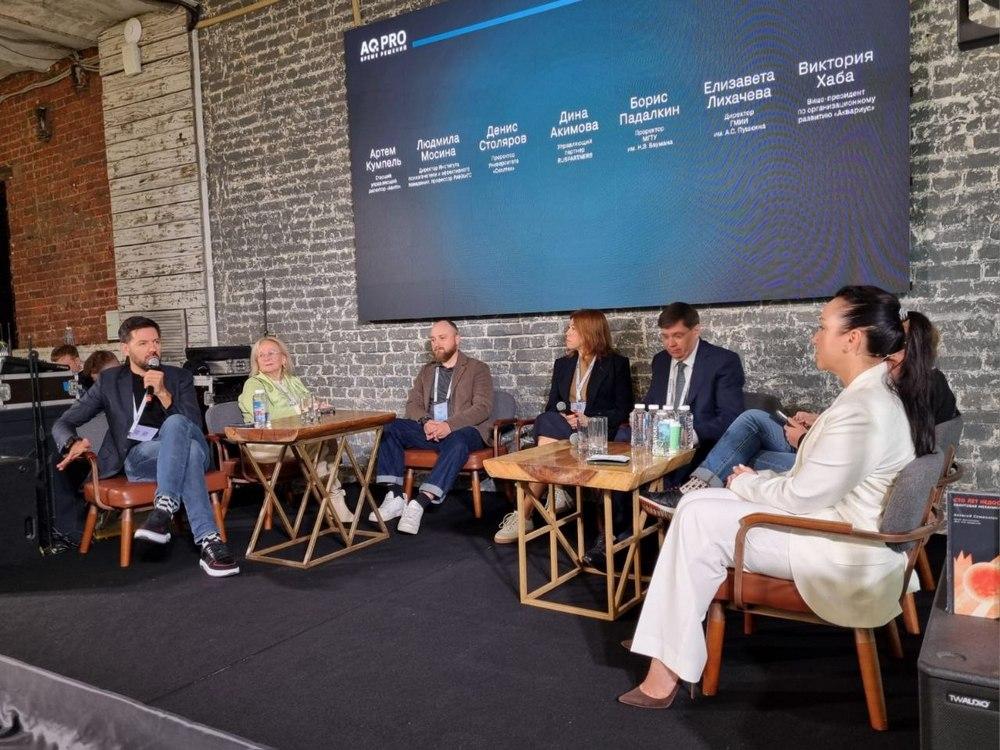
During the open dialogue "PRO People. HOMO DIGITUS," dedicated to digitalization in society, the discussion focused on how digital technologies and artificial intelligence affect the evolution of humans in general and the labor market in particular. The session was moderated by Victoria Khaba, Vice President for Organizational Development at Aquarius.
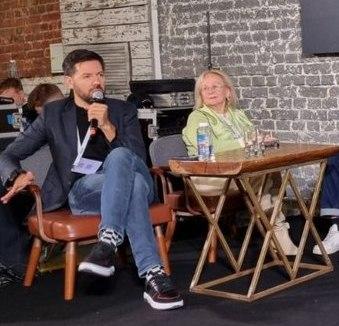
The discussion was aimed at exploring and finding answers to questions about the impact of technology on human cognitive abilities, the likelihood of humans being replaced by artificial intelligence, whether artificial intelligence lives up to its name or is just a technology, and how the labor market will change under its influence in the near future.
Lyudmila Mosina, Director of the Institute of Psychogenetics and Effective Behavior, Professor of RANEPA: "Whoever knows, whoever studies the work of artificial intelligence, digitalization today - he will control those who do not show interest and do not know how it works. People who own this information will get rich.
I am for the fact that it contributes to our evolution, brings animation to our life."
Elizaveta Likhacheva, Director of the Pushkin State Museum of Fine Arts: "Humans have not changed in the last thousands of years. Therefore, I do not believe that the new elite will be people who master artificial intelligence. The elite will be people who can live without artificial intelligence, constantly training their brains. After all, the main danger of artificial intelligence, like any other technology that has appeared in the last 100 years, is human laziness, because if we have the opportunity not to do something, we do not do it. Artificial intelligence has no needs, it basically cannot do anything beyond what it already knows, unlike humans. The paradox of humans is that they can go beyond their logic at some point. And this is our absolutely amazing quality, which is not threatened by anything. Artificial intelligence will simply become another tool for entertainment, reflection, some intellectual assistance, nothing more."
Boris Padalkin, Vice-Rector of Bauman Moscow State Technical University: "During training, it is very important to teach students not to be afraid of mistakes, and digitalization, modern design and modeling tools, if we are talking about the engineering profession, just allow this skill to be developed, because the speed of creating a technical solution has increased. A digital revolution is taking place in engineering: cars are becoming driving computers, in any technology - digital control systems. This leads to an increase in labor productivity, to the possibility of creating such technical devices and systems that could not even be imagined 20-30 years ago. Today we operate with huge amounts of data, which allow us to achieve such perfection, therefore, we must change the content of education and educational technologies."
Denis Stolyarov, Vice-Rector of Skoltech University: "Education should follow the course of the labor market. It is important for universities to give students a fundamental set of skills that will always be useful - to teach not programming, but to teach mathematics, because programming is an applied skill, not a profession. Of course, technology will change our lives - this is normal, it always changes it, this is why scientific and technological progress exists. You should not be afraid to adapt and always stay on the front line of your profession, because a professional in any field will always be in demand."
Artem Kumpel, Senior Managing Director of Avito: "Despite the fact that the value of education continues to grow, in the context of a shortage of personnel, we are seeing employers' willingness to further train or retrain employees with in-demand skills. In the last year alone, the number of vacancies on Avito Rabota, which mentioned such opportunities, has tripled. There is also interest in this trend from job seekers - according to our survey, 49% of working Russians are considering the option of retraining. That is, today business is ready to choose candidates with a high-quality base of fundamental education, and help them with further professional development, developing practical and digital skills, and retraining. And this is a positive trend - so specialists throughout their lives can try themselves in various roles in order to choose the most suitable direction for themselves. According to a study by Avito Rabota, today Russians change their specialty an average of about 3 times in their lives."
Dina Akimova, Managing Partner of Ruspartners: "When talking about Homo digital, you need to talk about Homo himself. What is it like to be him at all and how to teach him to be human? Every day I am engaged in the selection of top management for various large companies. This is the most difficult search. Because the CEO is a person who is at the top of the intellectual pyramid. And all his activity is built only around his personal qualities, what kind of person he is and what values he is driven by."
In conclusion of the discussion, the speakers came to a consensus that the development of technology is an existential process of human development, in which everyone affects everyone: people on technology, and technology on people. Ultimately, the number of modern technologies will eventually lead to a transformation in the quality of personality, and this is a normal evolution.
Illustrations provided by the press service of the company "Aquarius"