Translated with AI from the Russian original.
I have been working (and still playing games, watching movies) on a computer for over 30 years, about 20 of them on a projector. And although during this time the screens of TVs and monitors have noticeably increased in size, their resolution has increased, while they have become much more affordable, the use of a projector remains a priority for me for any tasks. I think you already guessed, the main reason is the desire to maintain healthy eyesight.

Why a projector?
The reflected light on the projection screen is much more comfortable for our eyes than any glowing pixels, no matter what technologies are behind them. Moreover, as technology progresses, the brighter these pixels become, the more intensely they affect the pupil and optic nerve. When we stare for hours at small details on a monitor or smartphone screen, watch TV programs and movies on LCD/LED TVs for a long time, especially in the dark, the load on our vision increases and accumulates. Almost every active user of smartphones/computers by the age of 40-50 starts complaining about vision problems, usually farsightedness (presbyopia). Yes, the process is age-related and almost inevitable, but its progress largely depends on how you work/play on the computer.
Try spending all night, for example, in World of Tanks on a top-end gaming monitor - in this game, the pupil is constantly focused on the sight, small details - and spend the next night playing on a regular Full HD projector with a large projection screen. You will never want to go back to the monitor! And the issue is not the size of the picture, because playing on a large LCD TV will tire your eyes even more. The point is that with a projector, your vision will REST! Safe reflected light, comfortable distance to the screen, good detail of a large "picture", while the pupil really constantly moves, covering it from edge to edge. In addition, you will involuntarily sit correctly, leaning back in a comfortable chair and placing the keyboard and mouse on a suitable stand/table. The same sensations arise when working - with tables and text. I am writing these lines now after a hard working day in the office... and my eyes are resting.
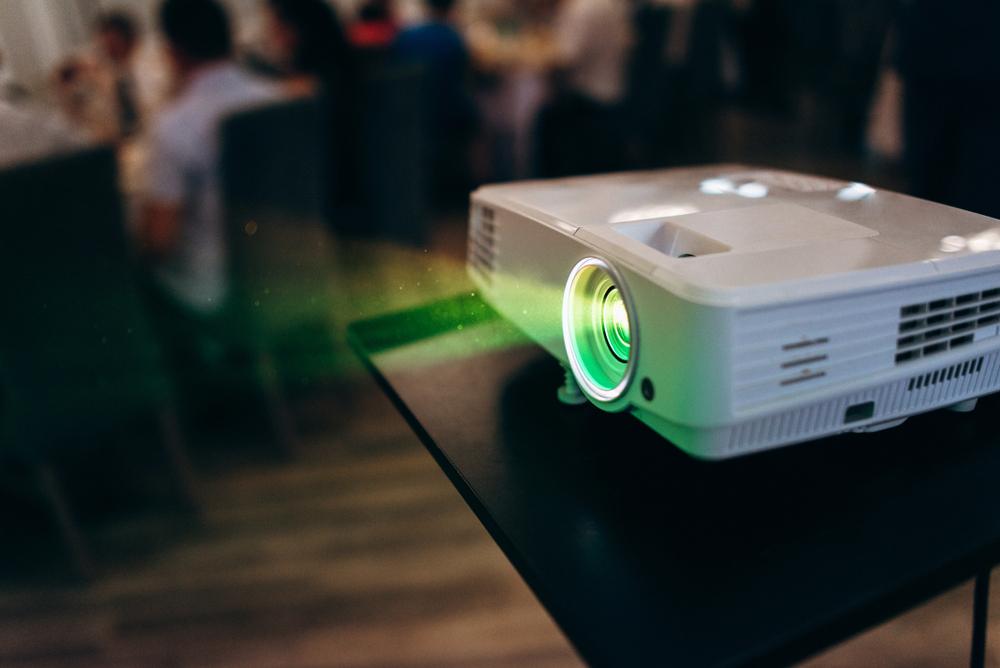
Our children spend even more time with smartphones and tablets, while their vision has not yet fully formed - they are clearly at risk. Parents reasonably try to limit "gaming" time, but this is not always possible to the proper extent. Switching a child to using a projector for games and watching movies will not only open up to him the magical world of "real big" CINEMA, but also provide at least partially diversity of "picture" and focal length, allowing the eyes to sometimes rest from "bright pixels". Elderly people - believe me - will also be grateful for such an experience. Sanitary rules prohibit the use of displays in preschool institutions, only projectors. They try to install them as much as possible in schools.
So the question is not the price, not the desired screen size - the essence of choosing a projector is the long-term "quality" of life, preserving the comfort of your eyes.
What is important to know when choosing a projector
THROW RATIO
The indicator determines the possible sizes of the projected image. For example, with a ratio of 1.5:1, the projector must be installed at 1.5 meters from the wall or screen to get a picture width of 1 meter. Models with "vario" lenses provide optical zoom (for example, 1.3X optical zoom), allowing you to adjust the image accordingly. Models with a fixed lens will have to be placed more accurately relative to the screen. In any case, to get the desired image size (or rather, adjust it to the size of the existing projection screen), you need to place the projector at the appropriate distance. Therefore, if possible, always start by choosing a projection screen, its size and location in the room - and then select a projector based on these initial data.
The projection ratio in devices equipped with a vario lens is usually indicated in a certain range, as far as its adjustments allow (for example: 1.2 - 1.5 for a standard medium-focus model or 0.7 - 0.8 for a short-focus model). It is important to remember that you have access to projectors of several types:
Long-focus. As a rule, these are professional models with interchangeable lenses, designed for large halls.
Medium-focus projectors are optimized for operation at a distance of 2-3 meters from the screen, and are most often used in home and office environments. If the projector is planned to be "hung" from the ceiling "upside down", then make sure that its settings understand such positioning.
Short-focus. Provides the desired picture already at a distance of up to 1 meter from the screen (wall). Due to the more complex optics, they are usually more expensive, but they simplify the configuration of the room with the projector placed on a table/nightstand next to the screen. They are usually used in meeting rooms.
Ultra-short-throw (UST – Ultra Short Throw) projectors, which are placed under the screen at all. Now the UST trend is gaining popularity, and, for example, HiSense divides them into two groups in its range: Laser Cinema projectors, and projectors complete with a special screen – Laser TV. In fact, this is one technology, but in different positioning.
In recent years, there has been a boom in inexpensive portable multimedia PICO LED/LCD projectors, which are attractive as a toy for a summer house, but not interesting for full use due to limited functionality and low brightness. Therefore, I will leave them "behind the scenes" of this review.
BRIGHTNESS (luminous flux)
The American National Standards Institute (ANSI) suggests projecting a completely white image onto the screen, dividing it into nine equal parts, and then measuring the level of illumination in the center of each segment, averaging and multiplying it by the surface area in feet. The resulting value is the brightness of the projector in ANSI lumens. In the characteristics of cheap Chinese models, another unit of measurement is found - "peak" lumens. The brightness of such devices is determined by the level of illumination of the center of the screen, so the difference with ANSI lumens can be 5-10 times. Given the importance of this parameter for consumers, manufacturers often "interpret" it in their own way through various alternative measurement methods, such as ISO (International Organization for Standardization) or CVIA (Chinese Video Electronics Association) lumens. I went to Ozon, and I was convinced that the brightness in lumens indicated there is not checked for correctness at all, and depends only on the degree of conscientiousness of the manufacturer/supplier – I am still smiling, remembering the impressive characteristics (sometimes up to 6000-8000 lumens of brightness) of some popular budget projectors of some Russian brands. You should not naively chase after numbers, it makes sense to trust companies with an established reputation and clearly indicated comparative parameters of models.
The shorter the distance to the screen, the brighter the image becomes. This is one of the advantages of short-focus models over long-focus models. For comfortable work on a screen with a diagonal of more than 100 inches (projecting an image from about 2 meters) in a small darkened room, a minimum of about 1000 ANSI lumens is required. For a bright meeting room or school classroom you will need a brightness of 3000 ANSI lumens. The more light in the room, the higher the brightness of the projector should be. One of the recognized leaders in this segment is LG (with a brightness of up to 7000 ANSI lumens), their top models are often used in museums and various installations.
And here developers have to solve the main question - the higher the brightness, the worse the color reproduction and the depth of black. Do not rush to put top models with the highest brightness in your home theater! To achieve an optimal balance in this extremely controversial task, developers are constantly improving technologies, modifying algorithms and developing new media processors and matrices. It would seem that everything is simple: LIGHT SOURCE + MATRIX/PROCESSOR + OPTICS, and there is no limit to improvement. Users only benefit from a greater variety of solutions.
By the way, my inFocus, purchased in 2013, still works perfectly and still pleases (the lamp has worked 4500 hours, without degradation of brightness). At that time it was a high-quality budget Full HD model. How beautiful and perfect they are now.
TECHNOLOGIES
Portable multimedia PICO projectors with a single LCD matrix are the easiest to manufacture and are inexpensive. In budget configurations, LED is used as a light source. The maximum "honest" brightness in ANSI is declared at the level of 500, although subsequent instrumental tests reveal much lower parameters. Wishing to achieve greater brightness, the Chinese often bring the "hardware" to extremes, due to which the cooling system (fan) is very noisy, and the matrices and processors overheat, sometimes burn out. Color reproduction evokes memories of old VHS tapes for videotape recorders, repeatedly rewritten - but for its price it is an acceptable compromise, especially if you watch cartoons and stream news from the Internet. But with proper adjustment, LED lamps are able to work almost forever, and the projectors themselves are surprisingly compact and cute.
I would like to note separately that such portable projectors, although they are intended, logically, for operation in various conditions, including the street - but are often not protected from dust at all. Dust is a big problem for LCD matrices. And again in excessive volume provokes overheating of the entire structure. You have to monitor the cleanliness of such devices.
In 3LCD projectors, the image is formed through three LCD matrices, due to a full combination of red, green and blue colors (RGB) relative to a white light source. This technology provides an excellent color palette with equally high brightness for all colors, as they are projected simultaneously and constantly. In 3LCD projectors, the pixel structure of the image may be noticeable, in DLP the image is smoother using the technology. 3LCD provides the most natural image for human vision and brain. However, 3LCD potentially loses out in contrast to DLP technology.
DLP technology from Texas Instruments is a kind of color "carousel" (wheel) through which light hits a chip with a matrix of millions of controlled micromirrors - as a result, the image is formed sequentially by each of the colors (RGB), and is perceived by us as a single whole due to the frame rate. We get a compact, low-noise projector, with a good margin of contrast, but potential nuances in color reproduction and display of fast scenes (rainbow effect around bright objects). In reality these nuances rarely bother anyone, and over the decades of evolution, DLP projectors have become the most attractive to the people in terms of price/quality ratio. In the top segment there are more expensive 3-chip models, theoretically capable of transmitting up to 35 trillion color shades.
The "true" 4K image (8.3 million pixels) is now produced by projectors with LCoS technology (Liquid Crystal on Silicon), the most well-known are SXRD models from Sony, and D-ILA models from JVC. Epson achieves a 4K picture through 4x pixel-shifting, although it is difficult to find fault with its quality, and the ProCinema LS12000 laser 3LCD projector is loved by many professionals. The most popular 4K technology has become the DLP XPR (eXpanded Pixel Resolution) solution from Texas Instruments, the essence of which can be defined as a 4x pixel shift (from a 0.47” DMD chip with a native resolution of 1920x1080), when the 4K picture is divided into 4 x Full HD frames, displayed at a speed of 240 frames/s with the corresponding shift. As a result, we get back a 4K image at a fixed 60 frames per second. There may be nuances with non-standard frequencies (24, 25 and 50 frames/s), but they are usually solved by "smart" algorithms for adding intermediate frames. There are also 0.66” DMD chips (resolution 2716x1528), with which the image is shifted twice diagonally – they usually achieve a more clear 4K picture. Expensive Barco models use a new 0.9” DMD chip (5K UHD, 5120 x 2160 pixels), and in top-end configurations (Barco Freya/+) a certain “Native 4K DLP chipset” from Texas Instruments is declared.
LIGHT SOURCE
High-quality UHP lamps with high light intensity are now the most common. Theoretically, they gradually degrade in brightness, assuming a service life of 3000 to 5000 hours. Longer service lives are usually claimed with some nuances, such as operation in eco-mode with reduced brightness. De facto, even 3000 hours is more than a thousand movie viewings or game sessions, that is, from 5 to 7 years of operation for the average user. I have already mentioned my InFocus from 2013, which has worked for 10 years for 4500 hours without replacing the lamp, and continues to serve faithfully. So there is no need to be particularly afraid of lamps.
LED lamps have limitations in brightness and light output quality, but are easy to manufacture and operate - so they are often used in the budget segment. They are reliable, with an impressive lifespan of up to 50,000 hours. More complex 4LED/DLP configurations with brightness of up to 3000 lumens are gaining popularity lately, capable of competing in the mid-price segment with laser models.
Projectors with a laser light source are still relatively expensive, but they are developing rapidly. Their service life can be up to 30,000 hours. This technology already deservedly dominates the premium segment. The use of 3 lasers allows you to separate colors into three channels (RGB), and manage them as flexibly as possible. Such configurations provide a decent level of color reproduction and are increasingly certified under Dolby Vision.
CONTRAST
Traditionally, contrast is defined as the ratio of white brightness to black brightness. High contrast is expressed in the display of "deep" black with maximum brightness. Low contrast turns black into gray, and white acquires dull beige shades. "Improvisations" with contrast parameters in specifications are even more common than with brightness. In fact, brands proudly inform us about some theoretically achievable dynamic contrast (up to infinity), taking into account various methods of its enhancement (automatic aperture, adaptive adjustment of lamp brightness or laser intensity, etc.). The most objective in this case are measurements of full On/Off contrast, when black and white levels are measured alternately, without the influence of "enhancement/improvement technologies". For the human eye, Full On/Off contrast in the region of 1000:1 is already close to ideal. This data can often be found in professional reviews, and top-end projectors rarely claim Full On/Off contrast more than 2000:1. Of course, a lot depends on the type of screen, room configuration , etc.
RESOLUTION
Modern budget models start with SVGA (800x600, 4:3), while having excellent specifications — decent brightness and contrast, rich functionality for configuration. It must be admitted that for their price, such projectors are able to perfectly handle most applied tasks: presentations in the office and school, high-quality streaming from the Internet, cartoons or a football match. But most customers, of course, want to have a "reserve" in resolution, although not always will use it. Let me remind you that (as a rule) projectors are able to play video that exceeds their "native" resolution by adapting (downscale), as a result, 1080p or even 4K movies on an SVGA projector will look quite decent. However, if you want an "honest" picture, then carefully study in the online specifications of marketplaces – what is the hardware resolution of the projector you are interested in.
XGA (1024x768, 4:3) and WXGA (1280x800, 16:10) models represent that very "golden" compromise between price and functionality, which is now maximally exploited in offices and education.
Full HD (1920x1080, 16:9) models remain the most popular for home theaters and games. In this segment, you will find an abundance of offers of high-quality DLP- and 3LCD-projectors with UHP lamps, at the "right" price. If you look more expensive, then interesting offers of projectors with laser and 4LED sources of light already appear.
The 4K (4096x2160) and 4K UHD (3840x2160) segment remains relatively expensive. And technologically, for projection "hardware", such resolutions are still represent many challenges. Top three-matrix "cinema" Sony models for 7—8 thousand dollars claim with all their perfection an honest brightness of 1500 lumens. In the budget segment, you can find "optimistic" 3000 - 4000 lumens with HDR and all sorts of marketing "goodies" cheaper than $2000… It is clear that the final 4K "picture" will be somewhat different.
Conclusions
For almost any office and educational tasks, it makes sense to first take a closer look at XGA and WXGA models, they are good in terms of functionality and price/quality ratio. Full HD models are justifiably more expensive, and have also practically reached perfection, while due to fierce competition prices are becoming more affordable. 4K remains an expensive segment so far, with a significant premium in price relative to functionality — all technological progress is concentrated here now, the hardware is changing rapidly. Laser and 4LED light sources are more durable than UHP lamps, but may have nuances in color reproduction — as a result, they tend to be more expensive configurations. Models on UHP lamps, on the other hand, are as "rolled out" and refined as possible by 101%. 3LCD technology is theoretically better for the eyes, but DLP is simpler and more reliable in implementation.
Regarding the functionality of Smart TV, it is important to note that it is still better to use separate (external) TV set-top boxes with the projector, they are now affordable and are supplied in good configurations (it is optimal to take 4/64 GB of RAM or more). Manufacturers often save on modules built into projectors, installing cheap processors and less memory (2/16, or even 1/8 GB). Even the top Smart filling is likely to become obsolete much faster than the projector itself.
#projectorselection #projector #laserprojector #DLP #LCD #3LCD #LED #3LED #4LED #LCoS #projectorbrightness #projectorcontrast #lumens #ANSI #CVIA #ISO #UST #shortthrow #longthrow #PICO #pocketprojector #SmartTV #smartprojector #homecinema #hometheater #dolbyvision #ALPD4 #ALPD
Alexander Kurilo,
journalist, expert in A/V technologies