Event by "Agat-RT", a Russian manufacturing company that develops innovative solutions for automating all telephony issues. Program: • Digital PAGA systems and their main areas of application; • Integration with communication systems; • Examples of implementation for integration with IP PBX "Agat".

Today's event was started by Sergey SIDOROV, Head of Sales Department, "PROMTREYD" company. Our company offers fruitful cooperation with us as a manufacturer of two-way loudspeaker communication systems. Sound quality, audibility - this is important.
But it is also important precisely in the context of alerting areas, territories, taking into account safety, taking into account the technical features of the facilities, taking into account the functionality of employees or visitors of clients, of certain facilities that we are going to voice.
The company "PROMTREYD" in this event acts as a partner of the company "Agat-RT". We are their dealer, we supply DVS-21 PAGA systems and act as an integrator, but our main specificity of work is that we act as a domestic factory and manufacturer of the PAGA system. Domestic implies that we are in the register of the Ministry of Industry and Trade. Our software, it is in the register of the Ministry of Digital Development. We have the full right to work in the territory of the Russian Federation, but we also cover the CIS countries. Our company has been on the market since 2016, we have implemented more than 100 projects. Since 2016 years, we have gained considerable experience in interacting with major customers, and with major integrators, with companies that act as contractors. For those, who have projects with loudspeaker communication, we are ready to connect from the very beginning of the project and help you in coordinating technical solutions with the customer, provide expert assessment, present equipment.
And in the event of the start of a project with special project surveys, we connect and begin working together with the integrator and the contractor, developing and then moving on to production and delivery. Because the very last stage is supervision and commissioning, and they depend on how the entire technical solution was worked out.
From the very beginning, we are responsible for all of this. Today I will talk about the system of our production. It is called DVS-21.
Loudspeaker communication systems are a fairly broad concept. They are different, starting with the simplest one-way loudspeaker communication systems, for example, in shopping centers.
One-way communication implies that some dispatcher-operator has a microphone console with one button, when pressed and a voice signal is given, this sound through amplifying equipment and through loudspeakers already voices a particular area and room. One-way communication implies that only the dispatcher can provide voice information to the end opponent. Such systems exist, they are used almost everywhere. Especially given the modern norms of fire safety requirements, for the inclusion of object security.
Regarding integration, I would like to discuss it in the context of industrial two-way operational dispatch loudspeaker communication. Two-way communication implies that in addition to the dispatcher's ability to communicate with the client via loudspeaker communication, there is the possibility of receiving feedback. There are feedback devices. They are represented as with other dispatch consoles, that is, the dispatcher can communicate with the dispatcher, as well as intercom devices, they are used mainly at industrial facilities. And they are used at hazardous technical facilities in large industrial productions. Operational-dispatch implies that communication should be precisely operational. When you press the opponent's call, you should not have to dial a number. This should be a direct connection: by pressing a key on the dispatch console, or by pressing a key on the intercom device. And the speed of communication between the two subscribers should be ensured within 0.5 seconds, which is commensurate with the level of perception of the auditory capabilities of a person. Communication should be fast, this is due to production technological necessity. And the ability to minimize all emergency risks, if they occur in some production. Well, loudspeaker communication should be loud, clear, and intelligible so that people, in the event of a voice signal, can understand it and take the necessary actions.
Industrial operational and dispatch communication, its main functions are to ensure the possibility of quick operational interaction of personnel at a large production facility. If the dispatcher has the task of conveying a particular command of notification and information to the personnel who are in the workshop, this should happen quickly and it should help and contribute to the management of certain technological processes.
It is also extremely important for ensuring safety and minimizing the consequences of emergencies. In the event that something went wrong, the speed with which specific actions are taken to localize the emergency, to shut down equipment and to prevent further damage, depends on both human resources, the health and lives of people, this is the most important thing that any production has, and accordingly, the cost of elimination and repair. This is an important point that, when debriefing, when analyzing, will be raised and it will be analyzed whether loudspeaker notification of personnel was carried out in order to protect people and equipment. Also, to the topic of our today's event, platforms of this level, such as DVS-21. They are practically at any industrial facility are a kind of integration platform that links together various types of communication. This is telephone communication, radio communication, there may be integration with fire alarm, there may be integration with a local alarm system. A system that warns of an accident, it is connected to regional centers of the Ministry of Emergency Situations. Let's see what integration interactions are possible with our system. Areas of application.
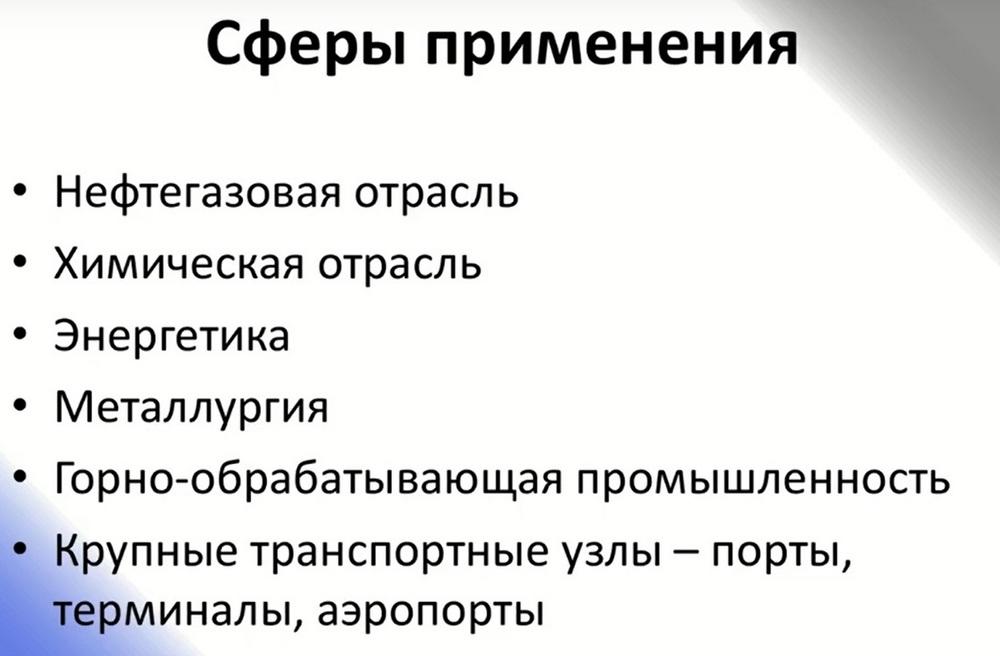
All large hazardous industries, for example, oil and gas, are all equipped with systems of this level. This is the chemical industry, energy, generation. These are thermal power plants, state district power plants, hydroelectric power plants, and so on. Metallurgical enterprises, mining and processing industry. And also our systems are widely distributed in large transport hubs. In airports, terminals. Our systems operate in approximately 20 airports.
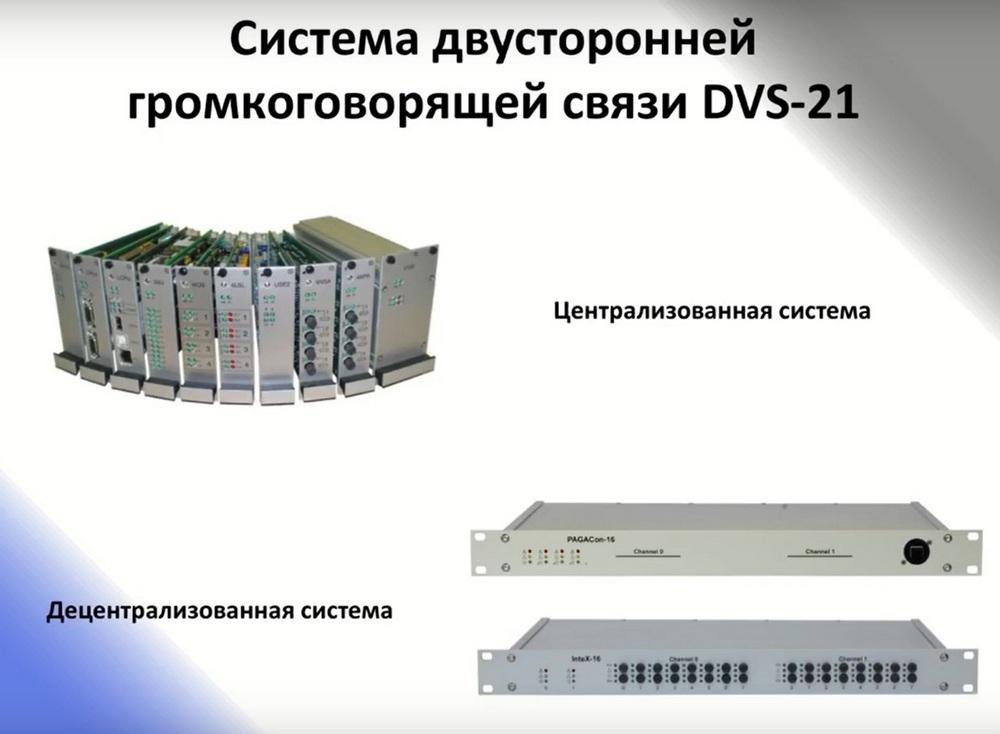
DVS-21 systems, loudspeaker communication systems, can be considered in two planes. These are centralized systems and decentralized. Centralized systems imply that this is often a digital system, and all switching equipment, all end devices, dispatch consoles, intercom devices, loudspeaker feeders are pulled to one single rack. It has a center. A switch, as we call it, is a telecommunications rack that is stuffed, filled with the appropriate equipment, based on the customer's tasks. And a more modern decentralized system that is built on the basis of IP technology. This is already the next evolutionary stage in the development of DVS systems. That is, everything started with analog systems, then everything switched to digital. Now, due to the development of network infrastructure, greater priority is given to decentralized systems, but although there are those who, roughly speaking, are for digital systems as more reliable, there are also those who are for IP systems. And we, as a manufacturer, offer both solutions to the customer's choice.
And the advantage of our system is that they are integrated with each other. You can even build a system in pieces, cover one part with digital, the other with IP, and they will be linked together and work as one whole.
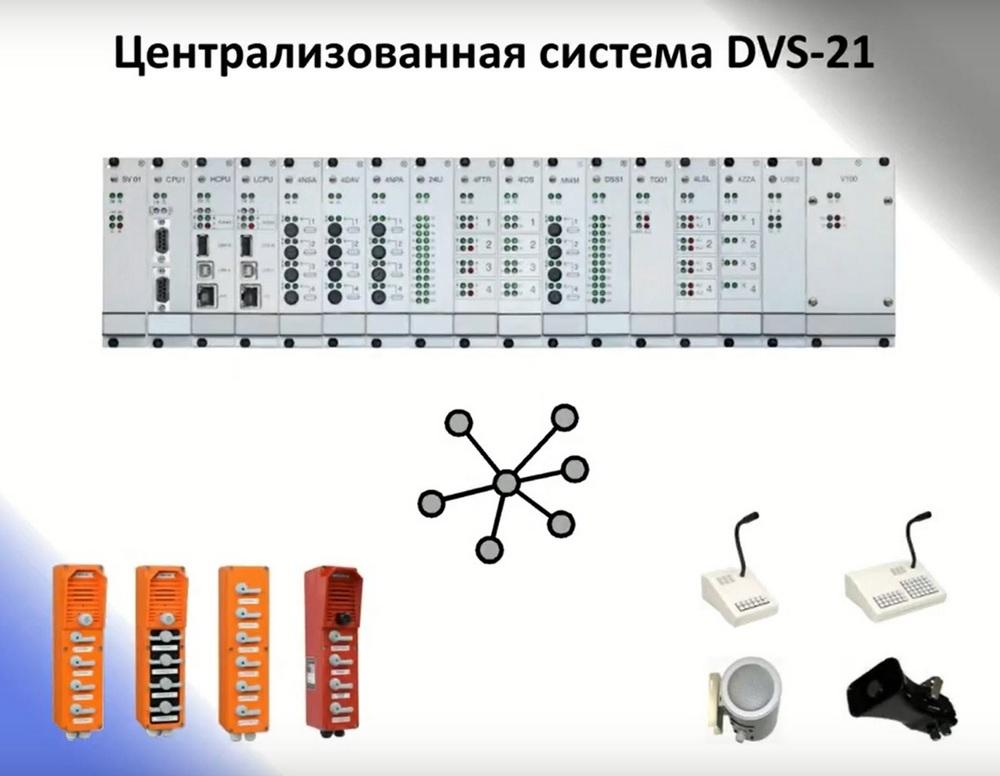
The centralized DVS-21 system is digital. It is a modular filling. There is a central chassis, a basket that is filled with modules. They are presented on the slide here. The convenience is that each module is responsible for a particular functionality. There are two critically important modules - the processor module, in which the configuration is stored. It can include up to four types of different configurations. Configuration in this case is understood as a communication map, if very simply, it is software that determines that when you press the key of a particular console, a call to a particular subscriber should occur or access to the loud notification zone of a particular object or part of an object should be provided. That is, you can store different configurations. If, for example, it is necessary to use one method of voicing during the day, and another in the evening, it is possible to switch. These are two important nodes and there is the possibility of their full 100% redundancy. When ordering the corresponding basket, these modules can be duplicated and in Standby mode, replace each other in case one of them fails. The system, no matter what happens, in the event of even an incredible event, so that the processor module or the power module of the processor and the basket, they switch and these requirements are important, including for critical infrastructure facilities.
Also here at the bottom of the slide you can see the end devices. These are dispatch consoles on the right with a microphone. Loudspeakers are presented below, which here symbolize just such loud notification zones. And in the lower left corner are intercom devices.
And if dispatch consoles are usually located in the control room, then intercom devices are in the most difficult aggressive zones. And they are designed to withstand all these impacts and provide operational communication.
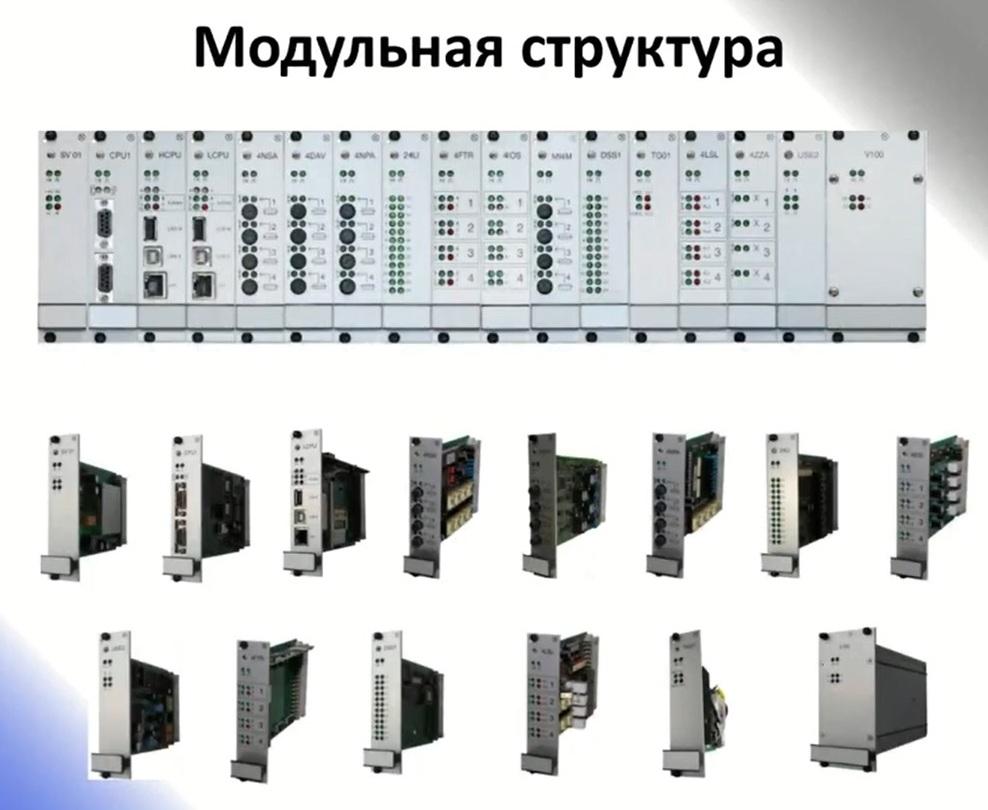
Modular structure. We can complete the basket with modules according to the task as we need. If we need to add 4 intercom devices, we simply add one more module (see slide), without changing much else in the system. And all these modules can work in hot-swap mode. Without turning off the system itself, we can change modules, we can carry out some maintenance work.
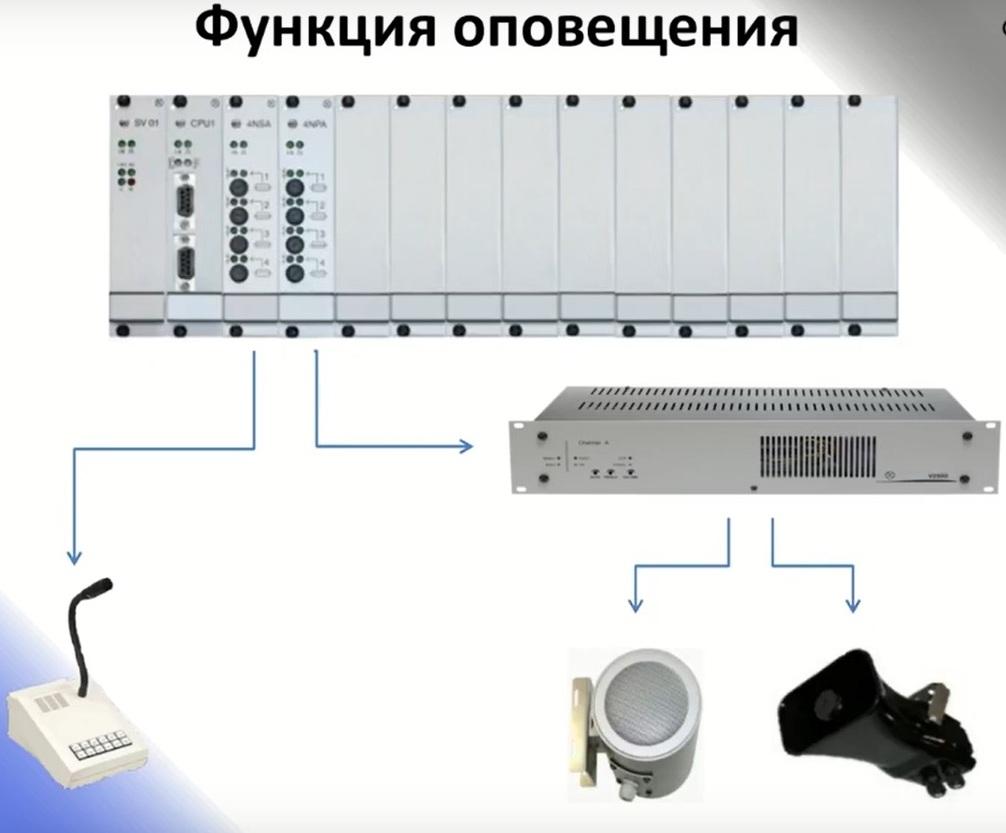
Regarding notification. In our digital system, it is implemented as follows. We assemble a central basket, where there is necessarily a processor module and a power module for the processor and the entire basket. And the 4NCA module is responsible for connecting dispatch consoles, each of which allows you to connect four dispatch consoles. If you need to connect 20 dispatch consoles, we use 5 4NCA modules. If the dispatcher says something into the microphone, it is converted according to the digital protocol of the system and enters the 4NCA analog interface module, after which it is fed directly to the amplifier. You can use both our amplifiers and other amplifiers that operate on a 100-volt line. The loudspeakers that are presented here can also be any. You can use the existing one that is already on the object, you can buy more for specific requirements from a particular object, they can be selected at the design stage to cover the necessary area and provide the necessary volume level.
The sound signal in analog form enters the amplifier, where it is amplified and approaches the loudspeaker via a 100-volt line. Amplifiers are single-channel, two-channel, four-channel, depending on the number of loud notification lines that need to be connected and how many of them should be independent. Independence implies that two different dispatchers can send two different signals to two zones simultaneously. At the same time, the channel is not occupied, and both signals reach the subscribers. It is important, especially for industrial enterprises, that the loudspeaker communication system has a function for monitoring the integrity of loudspeaker lines.
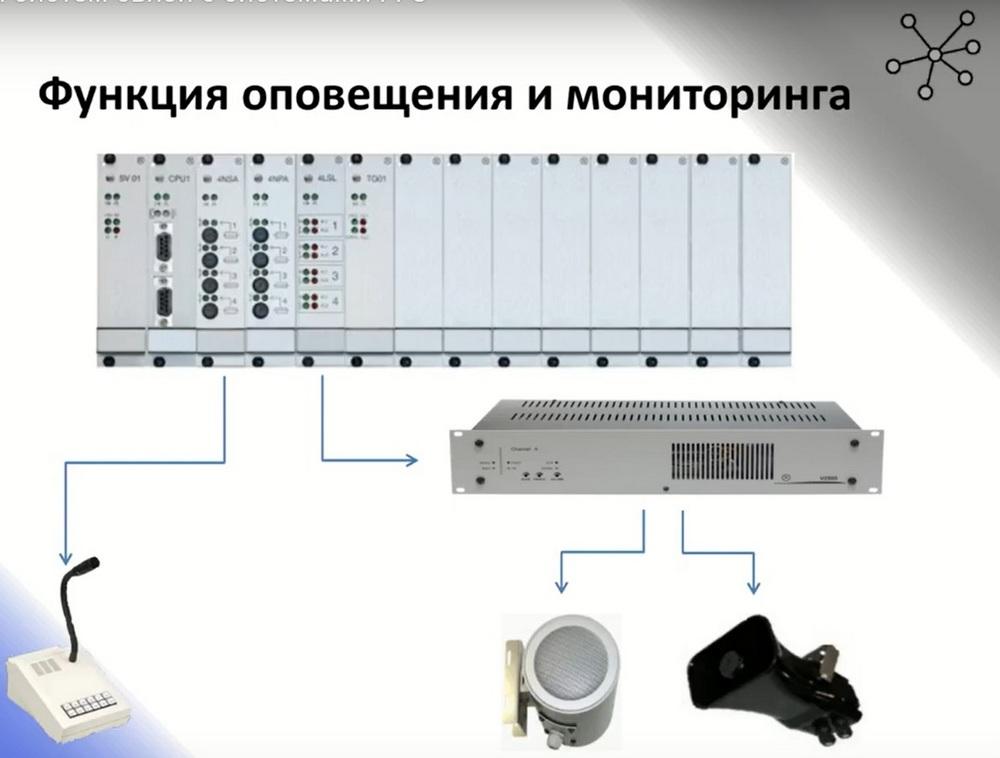
Because, as it often happens, something happens in a workshop or production site, repair work begins, a tractor cuts a cable, something happens, and we lose the line on which all the horns or loudspeakers are hanging. And an unpleasant situation occurs when the dispatcher, pressing a key, sends a voice alert. But, of course, the subscriber does not hear it because the line is broken. And the dispatcher is not aware that he was not heard. Therefore, a monitoring function is necessary, which in the event of a break, grounding, or short circuit of the line will signal to the dispatcher and operating consoles that something has happened to this line. And this indication is given to the dispatch console. The dispatcher sees that the signal did not pass, the corresponding key is highlighted. This is also given to the ARM operating personnel, and they take action to eliminate these problems as soon as possible and restore the integrity of the line. In our system, this is implemented in both digital and IP versions. Customers usually pay attention to this.
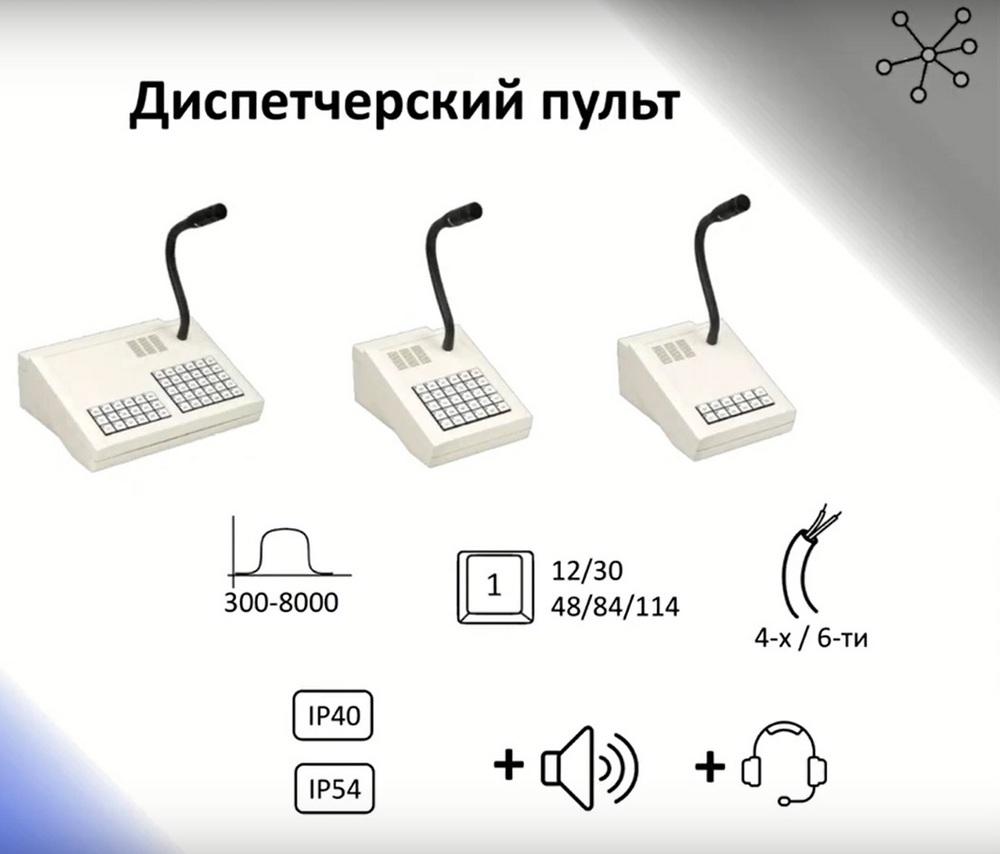
Dispatch consoles. Digital dispatch consoles are presented here. They can have a different number of keys. They can be very small, with 13 keys, up to a maximum of 114 keys. There are 30 keys, and the most popular are 30, 48, and 84-key consoles. And to understand, each key here represents a specific algorithm.
That is, pressing a key launches a pre-programmed action algorithm. This can be an exit to a specific public address zone, it can be a call to another dispatch console, it can be a call to an intercom. Another mechanism can also be programmed.
Sometimes it is necessary to start signaling with optical flash lamps on conveyor lines. This is a warning that the conveyor line will start moving now. This can also be done by pressing keys. You can add additional functionality, for example, program the rotation of a video surveillance camera that displays an image on the engineer's monitor. But it is important here that each key is programmed for a specific task, depending on the number of tasks required, we calculate the number of keys on the console. The consoles in this design look a little flimsy, but they are specially made this way to be as resistant as possible to any impact. They have a very high MTBF for pressing keys. They are made so that the microphones are not damaged. Yes, a person can damage anything and then fix anything. But it is better to think about all these points in advance.
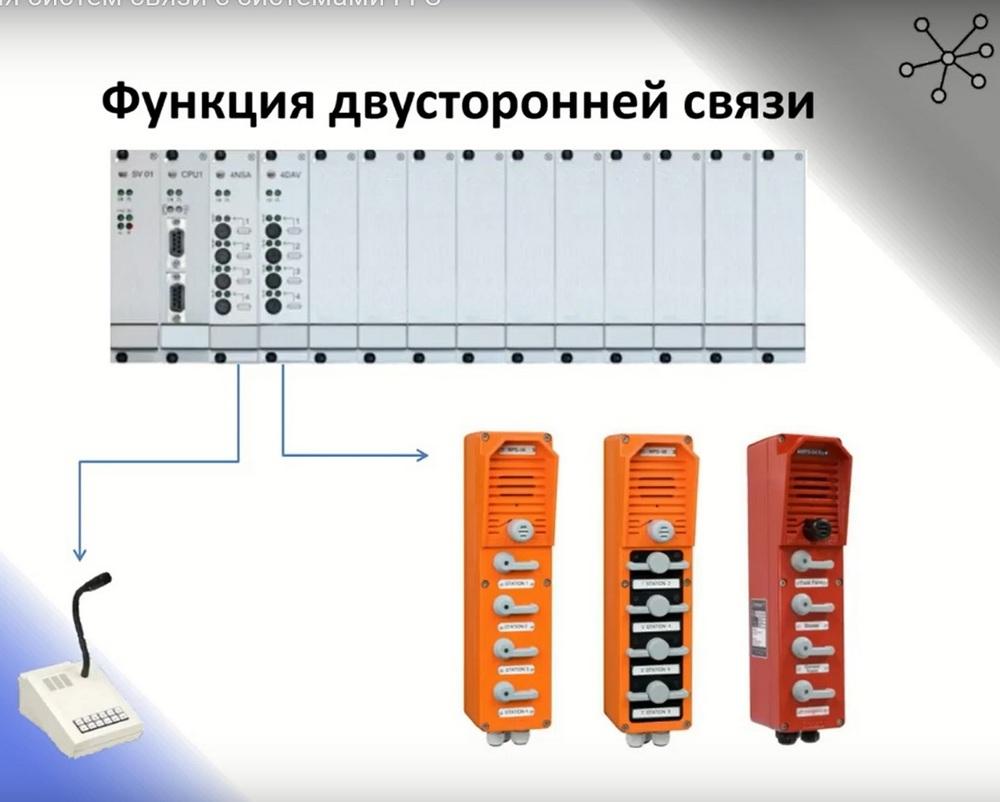
Two-way communication function. When calling a subscriber in some production facility in the workshop, the dispatcher gives the command "Mikhalych, close the plug." This information is sent to the feedback intercom. If it is a noisy room, it can go through loudspeakers. If it is a very noisy room, the intercom can be placed in a soundproof booth or hood that reduces external noise, and additionally signal with a flash lamp that a call is in progress.
After Mikhalych closes the plug, he approaches the feedback device, presses the corresponding button from which the call came, and informs the dispatcher that the work is done. Just like on the dispatch console, intercoms can have from 4 to 8 keys and have expansion modules. In practice, expansion modules are not used so often in the console, because employees directly on industrial sites do not have as much functionality as the dispatcher.
Intercoms can communicate with each other, communicate with the dispatcher, and can also go to public address zones. For subscriber devices within our system and within other systems similar to ours, only Russian-made devices are used due to the fact that the system uses its own internal proprietary protocol.
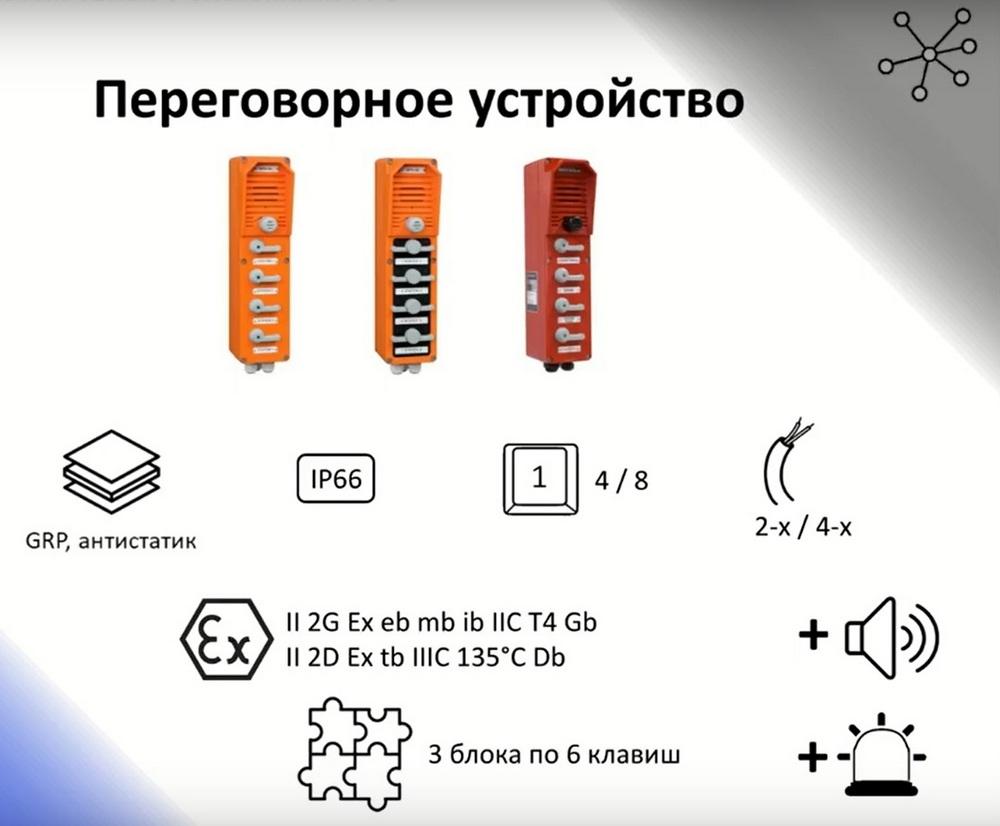
Intercoms can be both weatherproof, with a housing protection degree of IP-66, and explosion-proof. Weatherproof devices are weatherproof because they can be located both indoors and outdoors. Yes, they are indoors because they are dust and moisture resistant and operate in a wide temperature range, from -50 to +70 degrees.
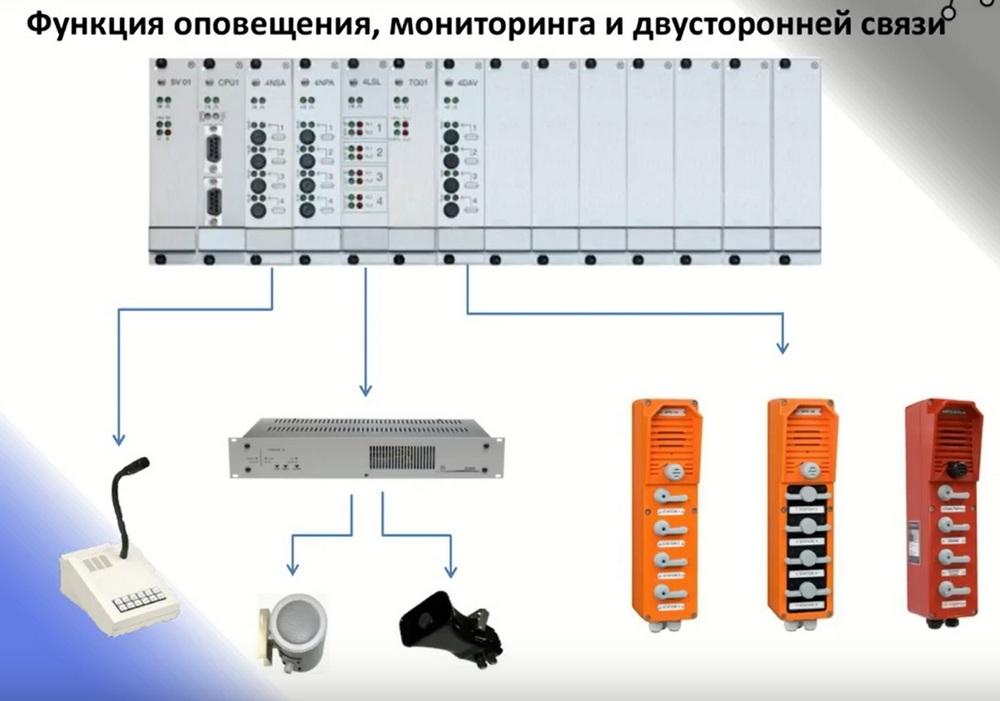
Expansion units simply add the necessary functionality if more communication is needed. This slide shows a mix of the system. The function of alerting, monitoring and two-way communication - all within the same system. As a rule, these are complex systems that imply that there are dispatchers who use all the necessary functionality to organize communication with two-way intercoms from the public address zone, plus many integration points within this system are linked.
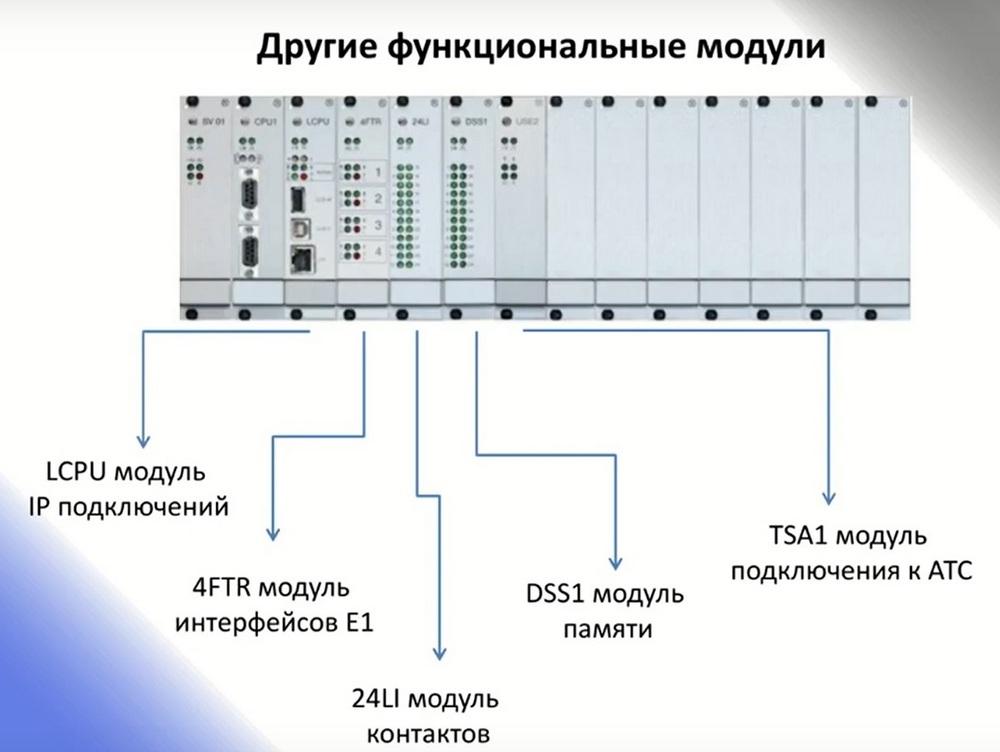
Other functional modules. The system is digital, but there is an LCPU module that allows you to organize a connection via the IP protocol. There are 4FTR modules, which are submodules for E1 streams. Each module can be "charged" with up to 4 streams.
And this is also mainly used to organize construction sites with each other. 24Li modules are dry contact modules, which contain 24 such contacts and are mainly used for integration with systems, and the action of the algorithm is activated by closing the dry contact. That is, an analog channel is launched, information is transmitted from one system to another, if it is an analog connection. The DSS module is a module for storing pre-recorded messages. Pre-recorded messages are required in order to turn on the emergency signal, eliminate the human factor, in case a person may lose the gift of speech, and it is necessary to urgently notify everyone to leave the premises. A specific voice is recorded for each case. And they are all programmed so that on a specific key.
There is a TSA module, a module for connecting to an PBX, a module for connecting analog telephone sets directly to the PA system itself.
Analog telephone sets in this case begin to act as dispatch consoles. There are cases when this is really convenient, when it is not possible to place a large number of telephone sets and dispatch consoles on one table. You can combine these devices and, in principle, go to public address zones and communicate with public address subscribers.
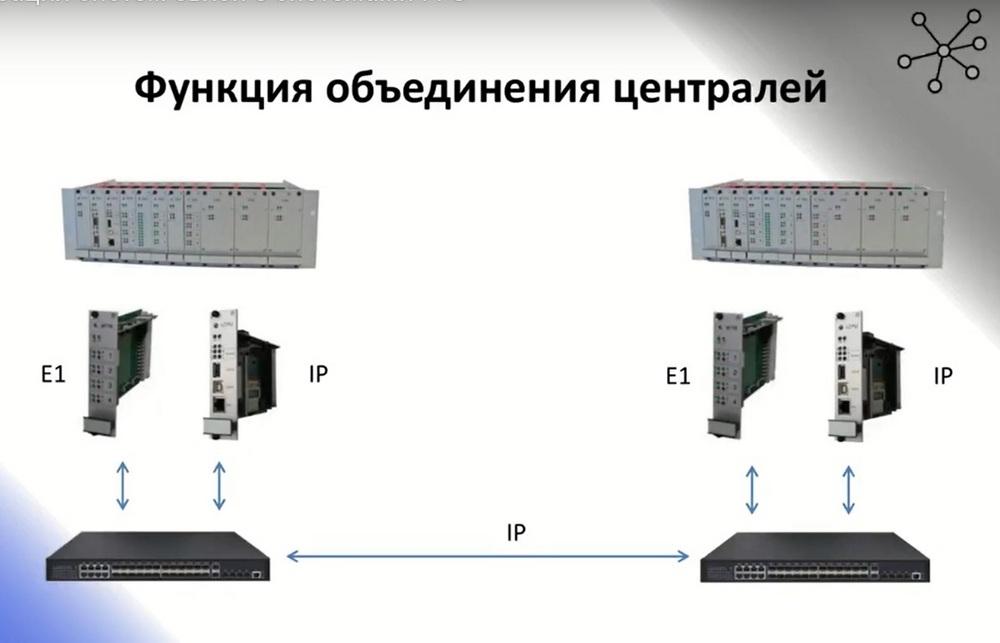
Central office merging function. Merging central offices implies that if you have a large object, you may have several telecommunication racks that cover their specific production workshops. And the merging can be either via IP or via E1 streams. They use either an existing or a designed transport line. This can be either via copper, fiber optics, or Ethernet network, using the appropriate media converters.
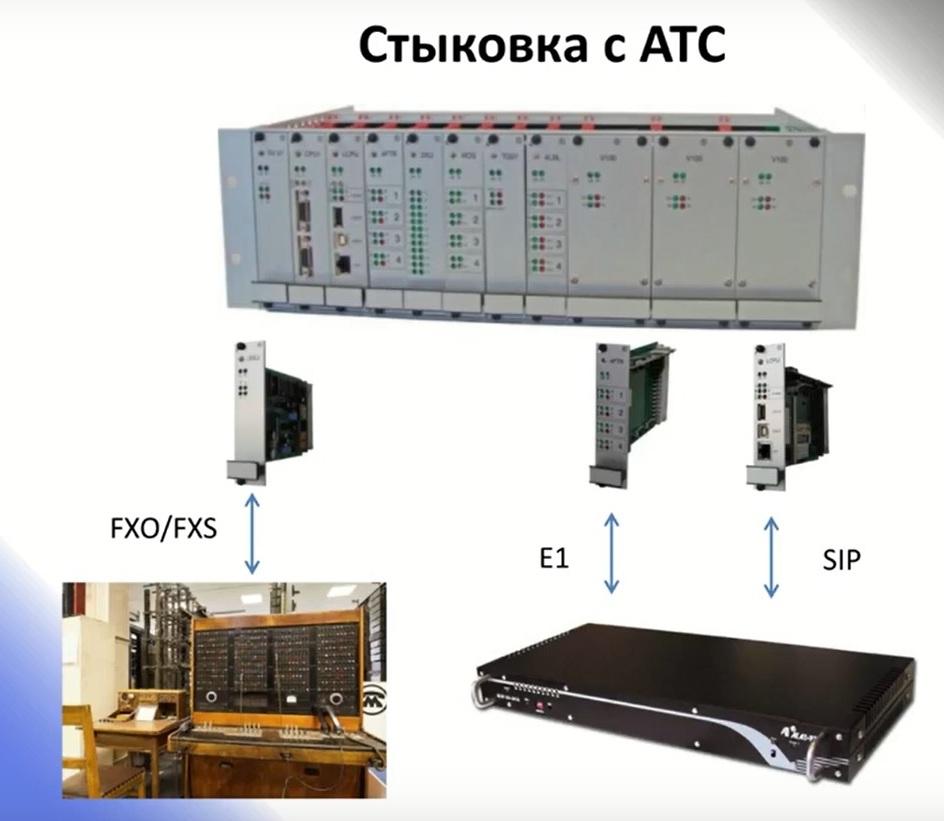
TSA modules are used in the analog interface. The connection to the PBX can also occur in various ways. And thanks to our partners, AGAT-RT, we successfully implement connections to PBXs in our projects. We use AGAT-RT equipment to use it as a gateway when connecting to other systems existing at customer sites. You can connect via analog, via E1 stream, or via SIP. In order to ensure continuous communication, to ensure constant availability of subscribers, especially important personnel, this must be done.
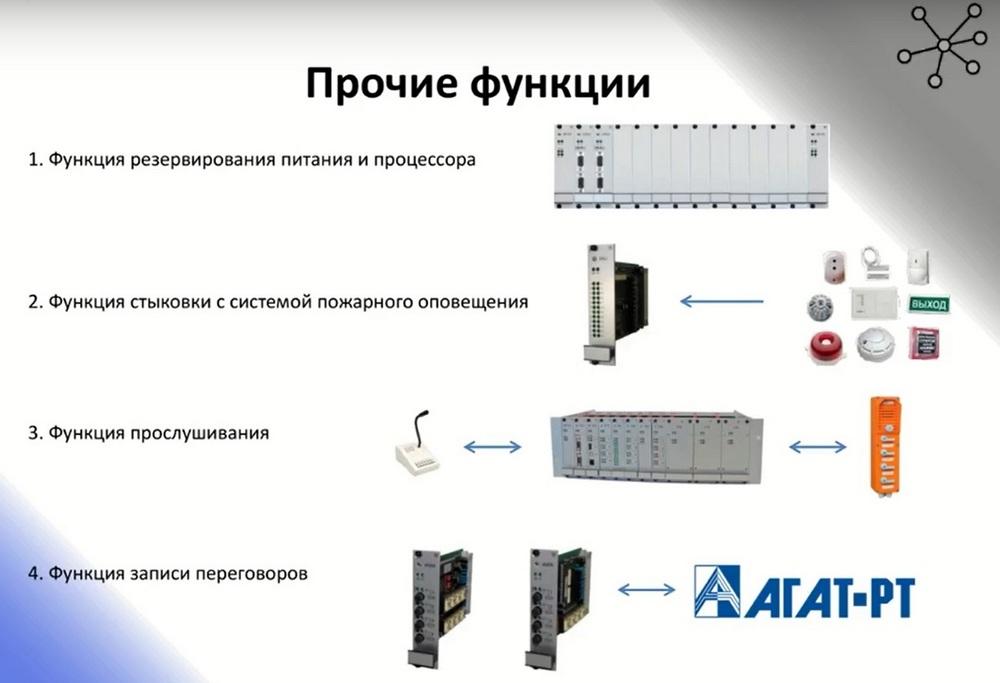
Power and processor redundancy function, connections to fire alarm. By the way, our system is certified. There is also a fire certificate. We have permission to use these connections with the fire system. We have a rather specific listening function. We can pre-program and use the intercom as a listening device to help the dispatch console. That is, we can activate the "intercom" by pressing the keys, and it will broadcast to us all the sound accompaniment that is happening around it.
And this is relevant not only so that the boss wants to hear what is happening in the smoking room, but, for example, if these are remote objects, and to determine its operability by the sound, by the noise of the equipment, so that there is no need to run or drive there every time, this is also useful. For the function of recording conversations, here we use third-party devices, as a rule, these are again our partners - AGAT-RT and its Sprut systems.
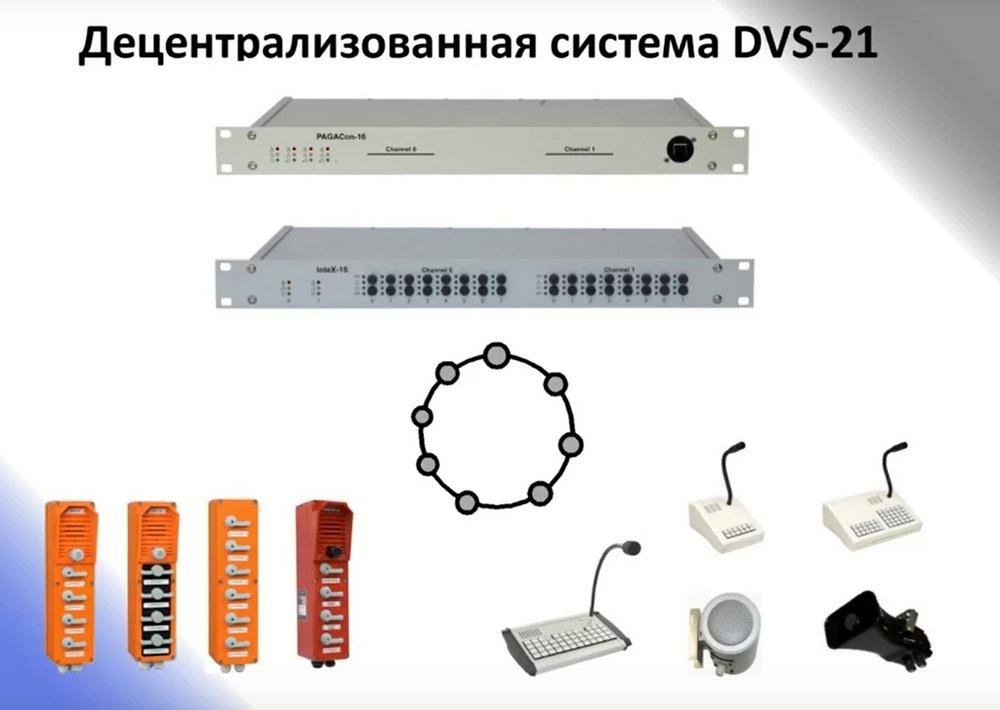
Decentralized DVS-21 system. In this case, the entire system can be briefly represented by two leading modules. One module is responsible for organizing the public address zone, it is called PAGAcon-8,16,32 by the number of output lines that it can create. And a device for providing two-way public address communication for connecting digital intercoms is Intex 8, Intex 16. That is, we can connect 5 intercoms and 3 DTA-type dispatch consoles to one Intex 8. Also, within this system, there are fully IP subscriber devices. IP dispatch consoles, C46, they are for 46 keys, can be either without a display or with a display. And also IP weatherproof and explosion-proof intercoms. They can also be with an internal amplifier for connecting an external horn and with a relay for connecting a flash lamp. In this case, our task is to ensure the connection of one or another IP device, an existing or designed network, which is created for this project at the design stage together with us and together with the integrator contractor.