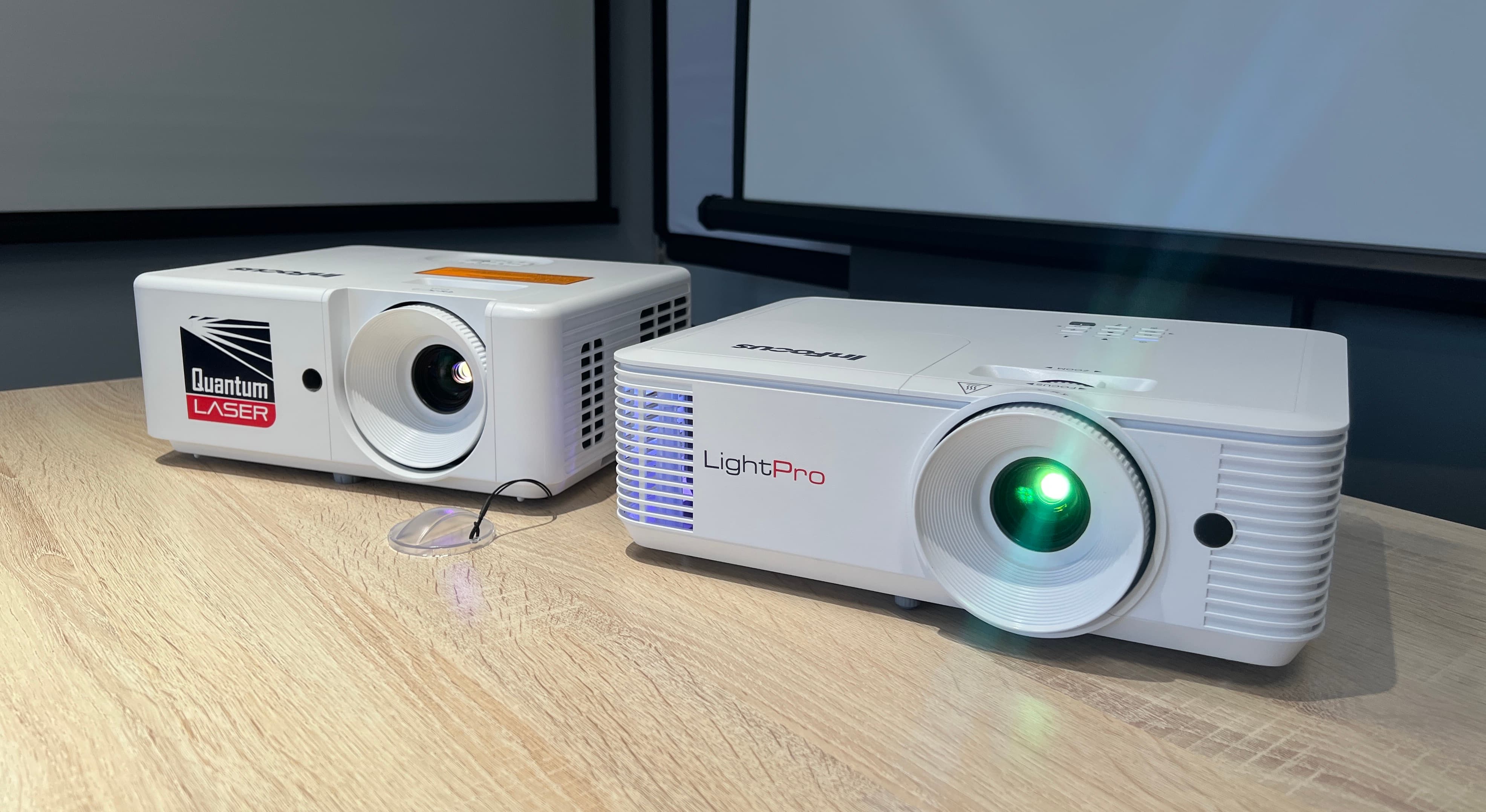
We test using typical configurations of the Genesis IV (IN0028SL) lamp projector and the Nemesis I (IN1008SL) laser projector from InFocus.
Projectors for home and office today, in 2026, surprisingly have not lost ground, and are still thriving. It seems to many that large displays should have replaced them several years ago, but in reality, projectors remain relevant because they have advantages that large displays are unlikely to quickly overcome.
Projectors are clearly more convenient and versatile in many cases, but most importantly, they are significantly cheaper relative to the resulting image size. And if the price issue is clear—just take a look at large TVs and professional displays—the convenience and versatility of projectors raise questions or even rejection among some audiences. After all, it seems like: what could be more convenient than a modern TV—connect the Internet, insert a flash drive—and watch anything! However, this is what those who have not encountered the installation of really large displays, say, 80 inches diagonally, think.
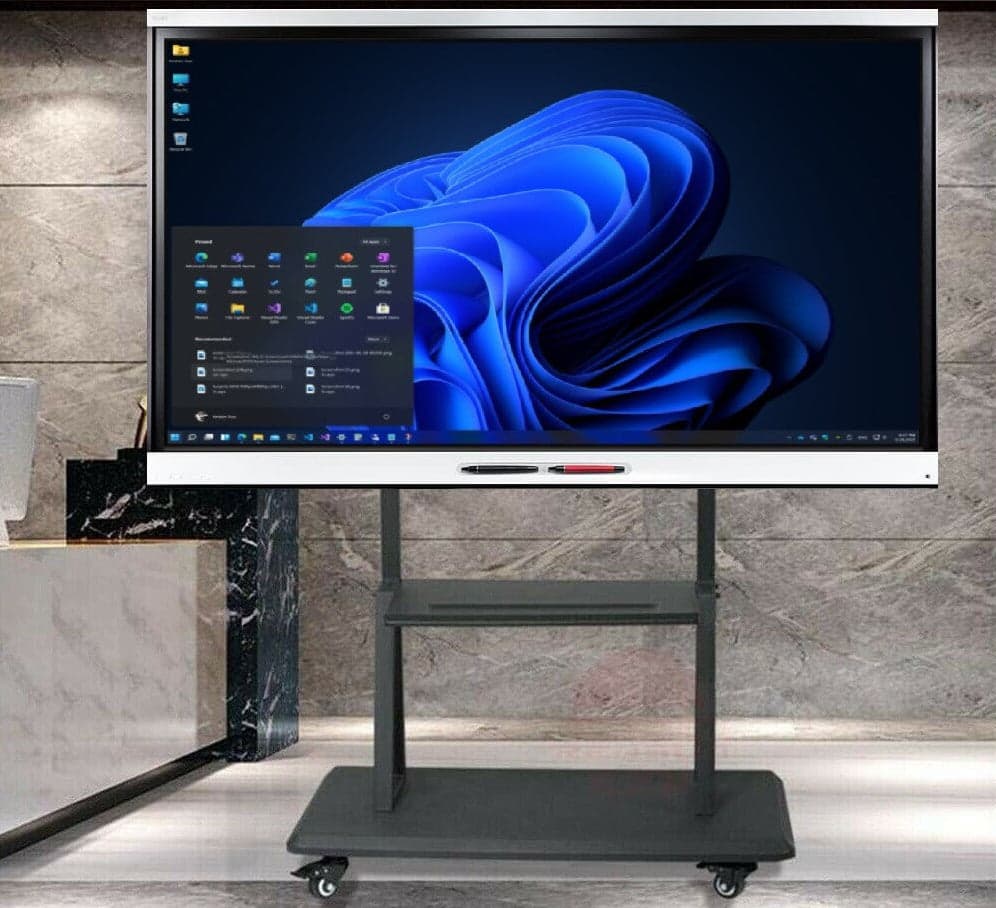
Smart-board in advertising. Note the massive wheeled stand
Such a display cannot be placed in 90% of cases in an inhabited apartment, a ready-made office, and especially a classroom, without a global rearrangement of furniture. Moreover, comfortably positioning such a display even during initial design is also a non-trivial task. And in classrooms, large displays, by and large, begin to compete mainly for space on the main wall with the traditional school board. That is why so-called electronic smart boards have appeared on the market, on which you can write and draw with a stylus and even with your hands, but they can hardly be called universal video devices.
Advantages of projectors
Projectors look like lifesavers in this regard. Yes, they require some understanding of how to properly position them in space and connect them to content sources and an acoustic system. They preferably need at least some dimming, although this problem is increasingly finding more interesting and relatively inexpensive solutions today - special screens with amplification and prevention of parasitic illumination have appeared, which we will discuss in detail in the next article. For the most objective result, we tested lamp and laser projectors from this review on different surfaces – white, matte, and gray canvas with a 2.5 gain coefficient.
Otherwise, projectors have only advantages. First of all, they are more compact. To get a spectacular picture of 80-130” or more, they are easy to move, easier to install both temporarily and permanently. Rod or tripod, shelf or nightstand - anywhere, simply because of their size.
Screens for them, although they are a necessary additional element, are also more convenient than bulky large displays. Depending on the model, they can be folded or rolled into a tube, some (nylon) can even be carried in a small bag. You can install a retractable screen on the wall or ceiling so that it covers furniture, openings and windows, and school boards when needed. At the same time, projection screens are more resistant to physical impact, after which high-tech displays are quite capable of breaking.
Another important "feature" of projectors, which is absent in various displays around the world, is that they create a "healthy" image from reflected light on the screens. I'm sure you've heard more than once that reflected light is perceived more naturally than direct radiation, but most people perceive this as talk from the "warm tube sound" series, because we all look at monitors, TVs, smartphones, and no one has died from this yet. Meanwhile, the essence of the naturalness of reflected light is simple to the extreme: everything we see besides monitors and festive garlands is reflected light. For millions of years of evolution, our vision has developed to perceive reflected light, and televisions and especially smartphones with ultra-bright pixels have appeared quite recently, so their impact has simply not yet had a serious impact on human health. But people with sensitive vision and those who can afford to work and generally watch anything with a projector unanimously say that it is noticeably more pleasant to do so. So if caring for your eyesight is of some importance to you, for example, for teachers dealing with the younger generation, then choosing a projector will be logical.
The essence of choice
After all, the initial question was what is better in projectors as a light source, a lamp or a laser? Most people today do not see a dilemma in this question - of course, a laser! There are several reasons for this. Many have already managed to enjoy the image in the best cinemas, including IMAX, because that's where cool laser projectors are installed. At the same time, few people realize that the light sources in such super projectors from Christie and Barco have nothing to do with what is in inexpensive models labeled as laser. The ban on the sale of lamp projectors in Europe this year due to the mercury content in the lamps also played a significant role in perception. Therefore, lamps are perceived by many as some kind of outdated technology, and laser - on the contrary. But in reality, the situation looks different. Light sources based on laser diodes have completely replaced lamps only in the most powerful projectors, because they are easily scalable in performance, while lamps, as their power increased, became more delicate and short-lived, so they had to be duplicated or even put four pieces in one device. Lasers have also replaced lamps in the most expensive projectors for home theaters - buyers of such devices always demand the very best, and they are not deterred by the high price.
Lamps still lead
But in the segment of relatively affordable projectors for both home and office, lamps still lead by a huge margin. 8 out of 10 projectors sold today in the range up to 200 thousand rubles are lamp models.
Why is that? First of all, lamp projectors and the lamps themselves have not been banned worldwide. In the USA, and in Asia, including Japan, especially in other countries with Russia together, lamps are not even thinking of banning - there are no such plans. But the main thing is that lamp technologies continue to develop. If earlier the service life of a lamp did not exceed 2000-4000 hours, today it reaches 7000, and in economical mode up to 15,000 hours! That is, earlier the difference with lasers in terms of service life was fivefold, and now it is less only 2-2.5 times. At the same time, replacing the lamp was a relatively simple action, and it remained so, while replacing the laser light source is either impossible at all, or so expensive that it is easier to buy a new projector.
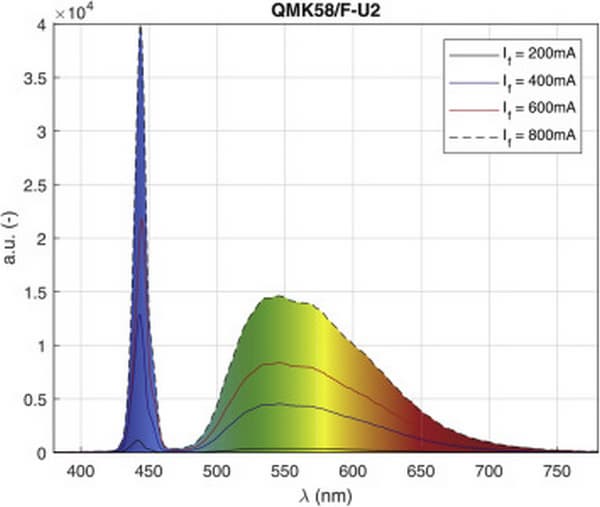
Spectrum of a laser-phosphor light source. Blue clearly stands out against the background of all other colors
Lamps, in comparison with relatively inexpensive laser light sources, have a spectrum close to the solar one, which makes the image of lamp projectors look more natural. And this is visible not by measurements, special tables, or the eyes of professional experts, but to any unprepared viewer who does not even know what to pay attention to - it is enough to show a few photos or run a couple of excerpts from films, and not demonstration ones, but the most ordinary ones.
Finally, lamp projectors in principle do not emit coherent radiation through the lens that is dangerous to the eyes, which is inherent in laser light sources. Looking into the projector beam is generally not useful, regardless of the type of device, but in the case of laser DLP projectors, this is completely critical. Therefore, it is better to keep curious children away from laser projectors. Anticipating questions, it must be said that ultra-short-throw (UST) laser projectors, which have become very popular in recent years, have special protection - when trying to look into the lens, they simply turn off the lasers. And laser installations in modern car headlights do not emit coherent radiation to the outside thanks to a special design, as, by the way, some LCOS projectors do.
Laser advantages
To be fair, laser, or rather laser-phosphor projectors, of course, also have advantages. The first thing that immediately wins everyone over is the many times longer service life of the light source. Many do not use the projector 24/7, so the 20,000 - 30,000 hours that laser projectors can work are perceived by most people as infinity. They will replace the device itself faster than its service life ends.
Another clear and undeniable advantage is the high reliability and resistance to overloads of laser-phosphor light sources. Simply put, they are not as delicate as lamps and require less time to cool down after switching off. And they start much faster than lamps. With the exception of three-laser devices for commercial cinemas like IMAX. Light sources in inexpensive projectors, called simply laser, in fact consist of an assembly of blue laser diodes and a so-called phosphor wheel, in which, if we speak correctly, multicomponent phosphors are used.
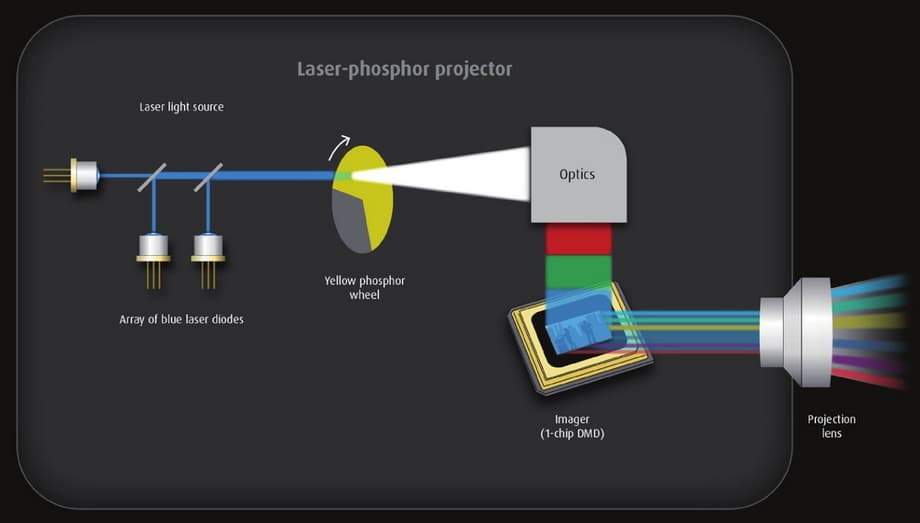
Diagram of a laser-phosphor projector
Laser diodes are responsible for forming the blue part of the spectrum and make the phosphors glow, which in turn form the rest of the spectrum from green to red. At the same time, the diodes shine only on a small part of the wheel, and in order for the phosphors not to burn out, the wheel rotates quickly and thus cools down. When the projector is turned off, it continues to rotate by inertia and, accordingly, cools down. Therefore, the projector ventilation turns off only a couple of seconds after pressing the button. After communicating with ordinary, that is, lamp projectors, such an advantage of lasers is so captivating that some of them "turn off" simply by cutting off the power. You should not do this - turn off any projector only through an intermediate Standby.
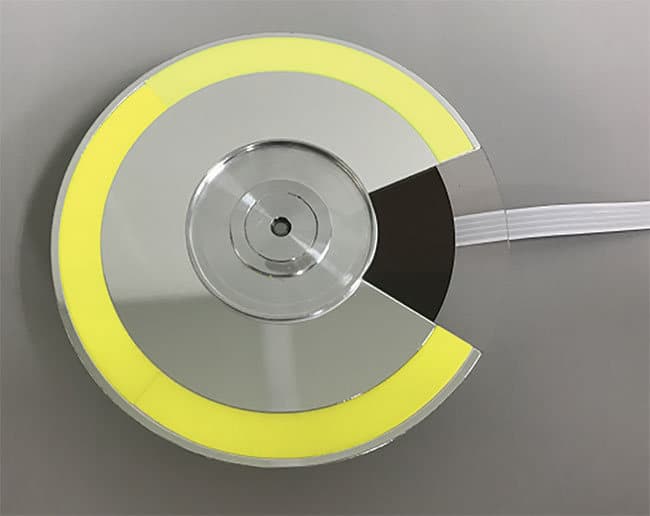
Phosphor wheel of single-chip DLP projectors. Through the transparent sector, coherent laser light passes directly to the matrix and into the lens
The method of forming colors in laser-phosphor projectors also determines their color reproduction. In mass models, to improve energy efficiency, which has become a cornerstone in certification today, lasers shine directly through a transparent sector in the phosphor wheel, and the number of phosphors is reduced to increase efficiency. As a result, the number of shades in the color palette decreases - thanks to the environmentalists.
Two projectors: lamp vs laser
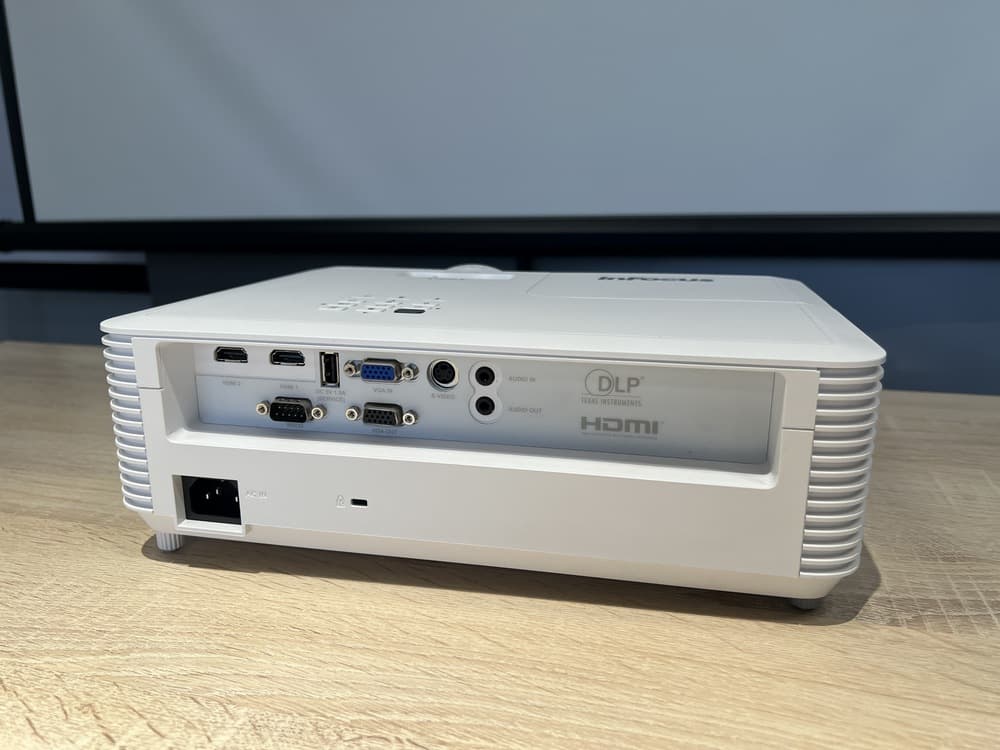
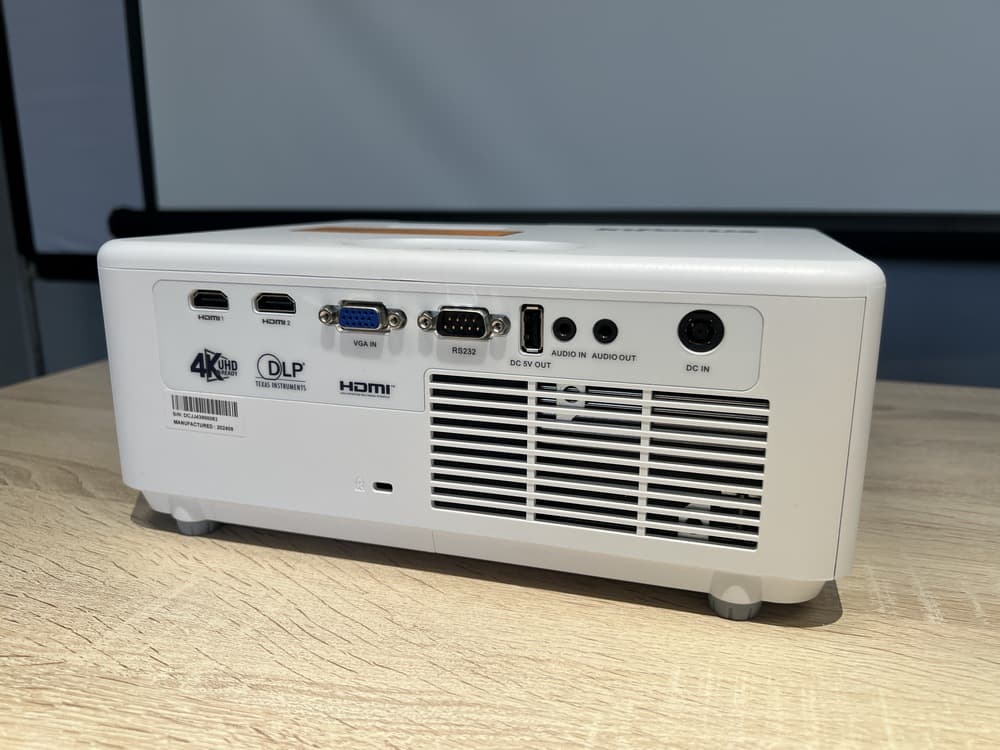
To see this for yourself, for a correct comparison, you need to take two projectors with similar characteristics and price: lamp and laser. It is not easy to find such ones - companies usually separate lamp and laser models into different sectors of the model range. We managed to find suitable models from InFocus. These are InFocus IN0028SL Genesis IV with a lamp and InFocus IN1008SL Nemesis I with a laser-phosphor light source, respectively.
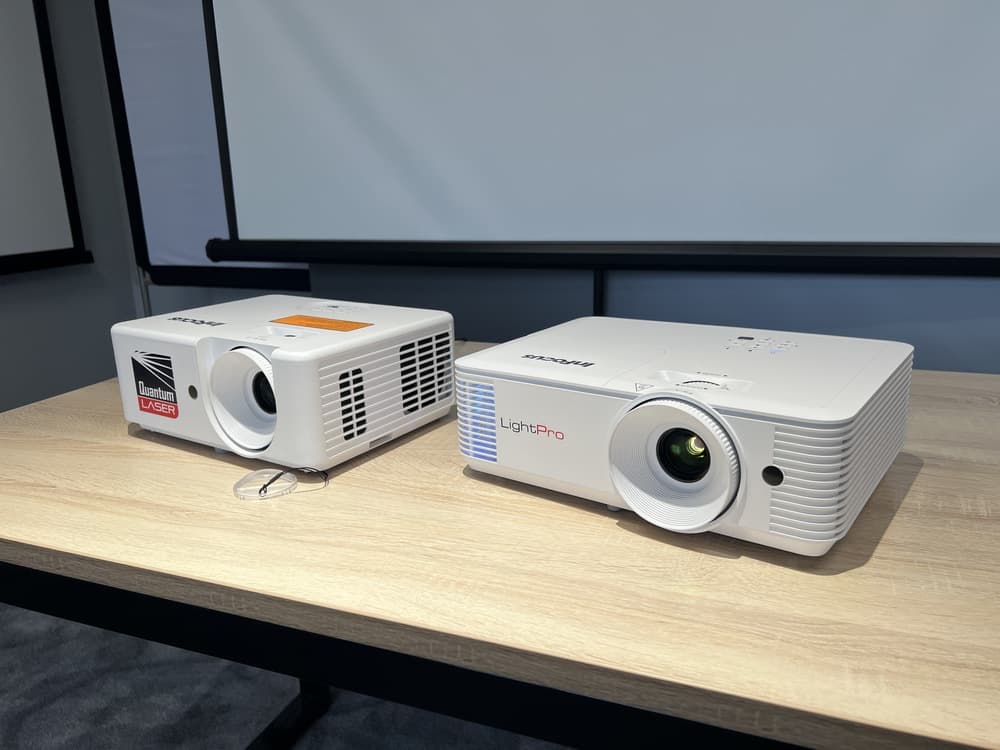
Both are built on the basis of DLP technology with one 0.47-inch chip, have a "native" resolution of 1920x1080 pixels and a similar level of brightness (luminous flux): the "lamp" IN0028SL has 4000 lm, and the laser IN1008SL has 4500 lm. They have similar dimensions. 40x34x17 cm for the lamp IN0028SL and 40x28x16 cm for the laser IN008SL. The weight is the same - 2.9 kg, that is, both will easily fit into a small bag or backpack. Even the projection ratio is relatively similar: 1.48-1.62 for the laser model, 1.94 – 2.16 for the lamp model. Both have a high-quality optical Zoom of 1.1X to adjust the image size. That is, to get an image 2 meters wide, they need to be placed at a distance of about 3 meters from the screen surface.
In fact, these are typical, most universal projector models - designed for everything: office presentations, training or demonstration of video in unprepared rooms. They do not have a built-in player on board and the ability to show video directly from the Internet - this is the prerogative of small LED models and short-throw models with special optics, but they are easier to install thanks to automatic correction of the image from the trapezoid when placed at an angle to the screen, which was not the case in the old "classic" models.
And more about versatility. We deliberately chose models with Full HD resolution, although the InFocus range also includes 4K models and various options with lower resolutions. Full HD remains the current standard for mass laptops, desktop PCs, and media players.
Movies, games and most content on the Internet are still optimized for Full HD. All programs are designed for a resolution with an aspect ratio of 16:9. In general, 1920x1080 can be called, perhaps, the most universal and fully relevant, despite the many years of presence of 4K in the media sphere. Finally, the Full HD resolution will allow you to more correctly compare the above projectors in relation to your favorite movie.
Comparison
Before proceeding with the comparison, it is worth immediately stipulating the conditions. No special settings were made in the projectors: no color temperature calibration, no brightness and contrast adjustment. We simply chose the same factory image modes, and the image was projected onto screens of the same size, initially onto popular white matte screens with a diagonal of 100 inches without amplification. Later we compared the resulting image on different types of projection screens – but that's another story.
The first thing anyone will pay attention to is the difference in the time it takes for the projectors to start working. The "lamp" InFocus IN0028SL takes about 10 seconds for this, which is very little compared to a typical home theater device, but the laser IN1008SL starts in 3 seconds!
If you display tables, graphs, videos, and generally any other material on both projectors, it immediately becomes noticeable that the laser InFocus IN1008SL is brighter, and in every sense. The difference of 500 lm is visible to the naked eye, which is expected. But the main thing is that the greater brightness of colors, especially blue and all shades with yellow, immediately catches the eye. This looks more impressive on graphs and diagrams, which, of course, is a plus. But on video and especially movies with a natural, not cartoonish color palette, this "bright" feature of the laser is perceived ambiguously.
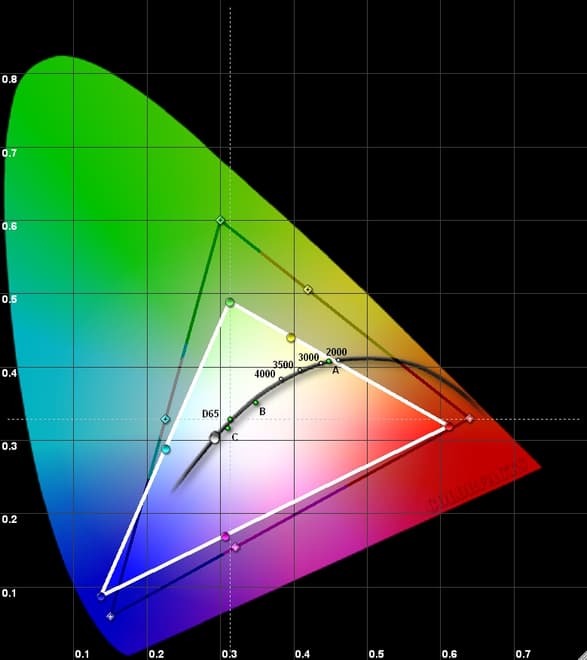
Color gamut of the laser InFocus IN008SL. The shift to the blue area is clearly visible
On the one hand, there is a lot of blue - seascapes look good, on the other hand, all dark details go into blue, and other colors are muted, although the color balance according to measurements is set up almost perfectly by InFocus engineers, we must give them credit.
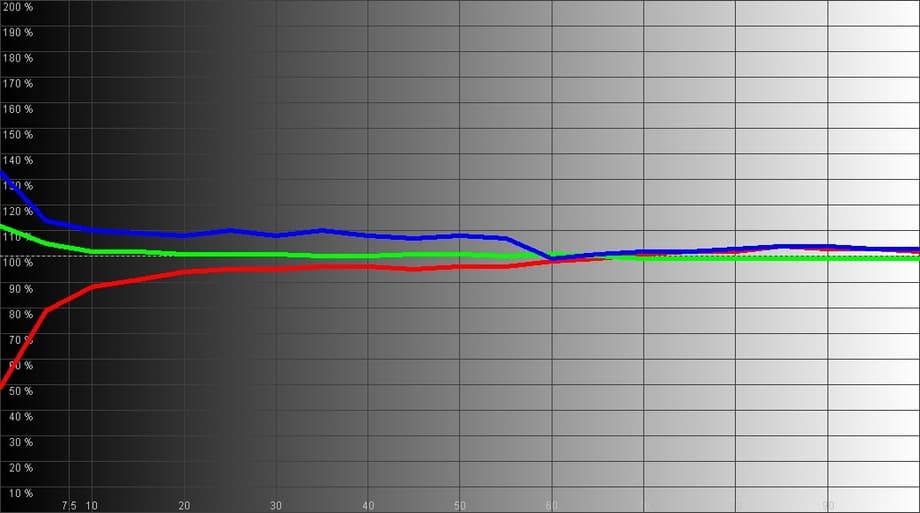
The color balance of the IN008SL is not perfectly even, but it is well balanced
The "lamp" InFocus IN0028SL displays tables naturally not as brightly (remember the 500 lm less flow), but there is no feeling of paleness, the colors are saturated, just the blue is not so aggressively bright. And video and especially movies look drastically different.
The most appropriate definition of the nature of the image is naturalness. The colors, of course, are not like the best cinema models for several million, but they look comfortable and balanced: with natural vegetation in natural landscapes, normal skin tones in people... Although according to measurements, the color balance of the IN0028SL is shifted to cold shades, the color temperature is 7600K, and not the ideal 6500K, as in the laser IN1008SL, but it is perceived the other way around - in the lamp IN0028SL, dark details do not give off blue at all.
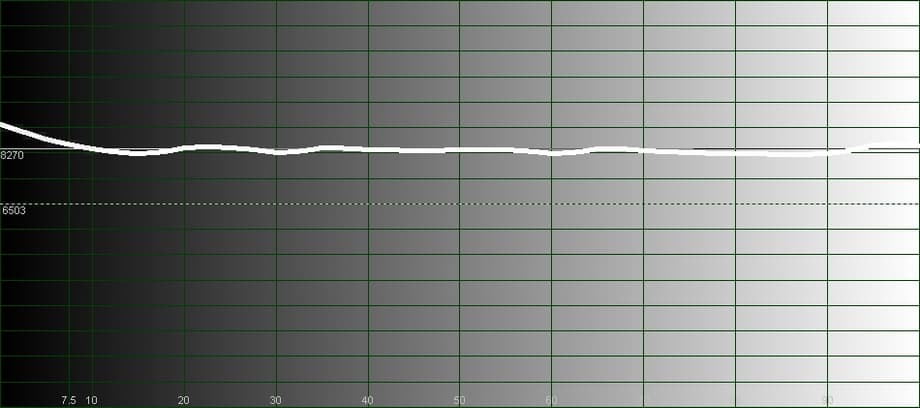
The whole point is in the spectrum of the lamp. There are no dips in it, it is continuous, that is, there are more shades in the color palette, while in inexpensive laser-phosphor installations, even with the naked eye, the separation of blue and all other shades is clearly visible.
But the shutdown time of the lamp IN0028SL takes 15 seconds, and the laser IN1008SL - two seconds!
Conclusions
Both lamps and lasers in projectors, apparently, will be used in projectors in parallel for a very long time. Each type of light source definitely has its advantages and disadvantages. Therefore, the choice in favor of each is determined by the priorities in using the projector.
If it will be used often and mainly for presentation tasks, especially in the presence of parasitic illumination, then it is better to choose models with lasers. Such a projector starts quickly, turns off almost instantly, and can survive a sudden power outage. But it is better to keep children away from it.
If the projector is purchased for episodic demonstration of a wide variety of content, including movies, and especially if it is planned to show this content to children, then it is better to choose a model with a lamp. Fortunately, replacing it is easy and relatively inexpensive.
Vladimir Smirnov


Now on home