The Aquarius Group of Companies has been on the market since 1989 and recently celebrated its 35th anniversary. Aquarius has come a long way from an OEM company to a developer and manufacturer of domestic IT equipment on motherboards of its own design and production. Now Aquarius is a systemically important enterprise of the Russian economy. It has three development centers in the country and two own production complexes: in Shuya and Tver. It provides a full production cycle of high-tech equipment, including surface mounting, component soldering and device assembly.
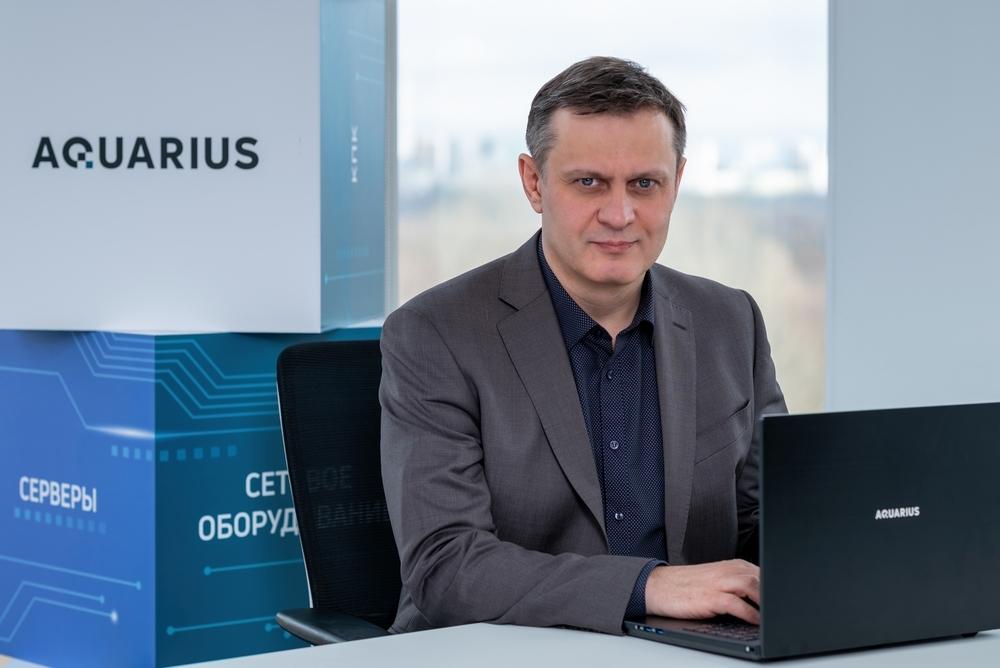
All Aquarius products are developed in our own Development Centers, which employ about 400 talented engineers. Oleg Oleinik, Director of the Technical Directorate and Head of the Development Center of the Aquarius Group of Companies, told the iXBT.pro analytical department about what new devices the company plans to release this year, in which cities it attracts new development teams, and why Russian engineers are among the best.
What are the strategic goals of the Aquarius Development Center now?
Strategic goals for us now are expressed in creating world-class equipment on which the digital infrastructure of our country will be built. Our goal is to fully provide Russian customers with high-tech digital products, the development and production of which are carried out in Russia. Today, the key users of Aquarius products are government authorities, state-owned companies, the financial sector and commercial companies for which it is important that the equipment is developed and manufactured on the territory of our country.
Aquarius strives to develop the IT and microelectronics industry in the country through the development of new devices, the development and launch of new business areas. We try to maximize development on our own and localize the production of our devices, thereby contributing to the technological independence of the Russian Federation.
What devices are you currently developing and creating?
The company's management constantly invests a large part of its profits in the development of new devices. And already this year, these investments are being implemented in the mass production of a new generation of servers, PCs, monoblocks, monitors, laptops, smartphones and tablets. In the coming months, we will update the entire line of our products. Of course, in parallel, we are developing products for several years ahead - this is a large joint work of various teams. Now Aquarius has taken a high pace of development, and my task as the head of the Development Center is to follow it with the help of effective project management, automation of all types of our activities and process optimization.
In addition, we are actively developing the microelectronics direction. We are developing a BMC (Baseboard Management Controller) chip based on the RISC-V architecture. The BMC chip is an important component of any server; it is necessary for remote monitoring of its operation. In parallel with the development of the chip, we are creating a new BMC firmware based on the open source technology OpenBMC. Together, this will give us a completely Russian BMC chip and will allow the group of companies to become independent from third-party manufacturers, and thereby improve the manageability and security of Aquarius servers. We plan to integrate a new chip of our own production into our servers as early as 2026.
What is the peculiarity of the devices you are developing?
First of all, we develop and manufacture all our devices in Russia, and this is a full-cycle production: from idea and design to production and testing of finished equipment. Secondly, this is trusted production and built-in security elements from our partners, which allow us to use our equipment, including for building segments of critical information infrastructure.
Security is the fundamental principle of developing all Aquarius devices - from the development of motherboards to testing and certification of our products. Thirdly, the company has extensive experience in the IT market and understands the needs of the Russian market, which is taken into account and implemented in all our developed devices. We offer the market completely ready-made solutions that include hardware, OS, installed applications and services for comfortable and efficient operation.
Who in your company makes decisions about expanding the model range of products?
Our large team of the product directorate is engaged in the development and production of new devices. They create a product plan for several years ahead, develop the design of the future device, work out the technical features of the products together with specialists from the Development Center, determine the pricing policy of the product, and much more. There are few such specialists in Russia, we have them and they are a special pride of the company.
Do you plan to obtain patents for your developments?
As any technologically mature company, we take care of protecting intellectual property for our developments, and during our work we have received more than 100 patents, certificates of state registration of programs for our devices and trademarks.
Do you share your know-how on technologies with other Russian manufacturers to create relevant products?
I am sure that the development of competitive advanced devices and solutions occurs at the intersection of technologies and in partnership with leaders from related fields. A striking example is the joint work of Aquarius with Baikal Electronics.
At the end of 2022, we released a large batch of PCs of our own design based on Baikal-M microprocessors. It was the first mass production of products with this microprocessor. Together with our partner Baikal Electronics, we jointly carried out the entire range of work: from the inclusion of the first boards to the necessary modifications and the addition of a number of necessary options. Expectedly, we encountered difficulties that are inherent in all new products, when it is required to "befriend" a new board, microprocessor and system software. The work in the technical part was quite intensive, in the context of tight deadlines for the delivery of final devices, registration of the program for our devices and trademarks.
But the main thing is that both companies coped with the tasks and challenges and gained unique experience. Experience that I am especially proud of, because there are not so many teams in the world that know how to do such end-to-end debugging of equipment. Our cooperation with Baikal Electronics continues, because now we are working together on devices based on processors of the next generation - Baikal-S.
I know that interns come to work for you in the company, including the Development Center, you have been successfully implementing a program to attract young specialists to work for the company for several years. Can you tell us a little more about this?
The team of interns of the Development Center is our special pride. Every year, about 40 interns come to us for internships at the Development Center. We invite talented senior students from leading universities: MIREA, MEPhI, MSTU named after Bauman, MIPT, MAI, MISIS and others. The guys receive theoretical training and have the opportunity to apply the knowledge gained in practice in their equipment development, microelectronics, and information security technology teams. Each intern has a mentor - one of the leading specialists of the Center.
After completing the internship, we invite talented guys to continue working with us. Thus, we create conditions for starting a career and development for yesterday's graduates, stimulate the realization of the creative and engineering potential of young people. We also popularize interest in engineering specialties and create positive feedback between the education system, the company's development centers and real production.
In which cities of Russia are your development teams based and what do they do?
We have opened development offices in Nizhny Novgorod and St. Petersburg. In Nizhny Novgorod, we started working with a team of 25 people. By the end of 2024, a significant increase in the number of engineers in the center and the attraction of new employees in the field of equipment development, performance and energy consumption research are planned. The group in St. Petersburg has unique world-class experience in automating software testing. Both teams are our seeds of growth in large technological centers of the country. We continue to expand teams in those cities where our production complexes are located: in Shuya and Tver. We plan to grow further.
How many employees work in your Development Center?
The Development Center of the Aquarius Group of Companies in Moscow has been in existence for more than 30 years, today it employs more than 400 people. These are developers of microelectronics, circuit engineering, specialists in software and industrial design development, topologists, designers, a team for testing equipment and software, architects and information security specialists. I have worked with engineers from different countries of the world and I am sure that Russian engineers are among the best. In addition, the Aquarius Development Center has a clear vision of the product and an experienced project management team. As a result, our specialists solve the most complex technical and technological tasks.
I will not say that the work consists only of creativity, we also have a clear plan for entering the market with new products, which must be adhered to. However, the management culture in the Development Center is aimed at creating a reasonable balance between the technological creativity of development and the obligations to make a competitive product on time. Admittedly, so far the balance is shifted towards deadlines, because we have a very busy product plan for the coming years.
How many employees do you have involved in researching architecture and technologies, in which areas do they work?
More than 50 engineers conduct such research. These are developments in the field of using more deeply localized components, solutions aimed at improving the manageability of devices and integrating information security tools. We also conduct research in the field of microelectronics and the application of the RISC-V architecture.
We have created an industrial design studio where research and development will be conducted to improve the user experience of Aquarius products. But a special pride is the development of products based on Russian CPUs, for example, Baikal from Baikal Electronics and Elbrus from MCST. Our vision is related to increasing the use of the number of equipment and software components developed and manufactured in Russia, including and above all - Russian CPUs and microcontrollers.
What new development areas have emerged in your Development Center in the past year?
Aquarius has strengthened its position in the domestic data storage market by acquiring a controlling stake in Aerodisk, a leading manufacturer of data storage software. We also recently announced the launch of a new line of Wareus data storage systems. This is a new unique technology developed in our Development Center. In October, we launched a line of telecommunications equipment, which we developed from scratch in almost a year.
For several years, Aquarius has been developing smartphones and tablets for corporate clients based on the Aurora OS. With the arrival of a large team of developers in Nizhny Novgorod, the direction of corporate mobility has received an additional impetus, and in 2024 we are preparing to release new mobile devices with a large number of applications and services developed taking into account information security requirements and without untrusted connections to foreign cloud infrastructure.
Do you perform equipment diagnostics at all stages of development and production?
We strive to create equipment of the highest quality brand. This means that the products developed by our team must meet the highest requirements of functionality, user experience and quality. Therefore, Aquarius equipment testing takes place at all stages of its life cycle. Each device undergoes acceptance, validation, certification, determination, and output tests. In software development, we follow the practices of continuous integration and code testing.
Automation is our key to improving quality and overall development efficiency, so we try to automate as many processes as possible. For example, for our Baseboard Management Controller (BMC) server management systems, we have created a set of automatic tests in Python that ensure the verification of all developed features of BMC software used in several software interfaces: Redfish, IPMI, WebUI and on several of our server platforms. It is simply impossible for an employee to conduct such a test manually in a reasonable time.
How exactly do you conduct testing?
Continuous quality improvement is one of the key principles of Aquarius, aimed at all aspects of activity: from documenting processes according to the ISO 9001 standard to testing during development and at the output of production. Throughout the entire product life cycle, we measure different aspects of quality, analyze data and constantly improve our processes, since the quality of the product is determined by the quality of the processes of its creation.