Joint event of OCS and N3COM, a supplier of carrier-class network telecommunications equipment. During the meeting, participants were able to learn about the company, the partner program, and available products for building corporate communication networks, broadband access networks (broadband), and industrial solutions.

The event was opened by Sergey Zhuravel, Business Development Director of N3COM. He began his story about the company.
N3COM is a Russian brand of integrated network equipment of carrier class. Currently, customers are divided into three fronts. Some continue to buy only through parallel imports, others buy only exclusively Russian-made equipment or equipment of a Russian brand, and still others buy both.
We operate as a classic vendor in the Russian Federation, and we also supply our equipment to the Republic of Belarus, Kazakhstan, and Armenia.
Our equipment is equipped with software and hardware. We write everything we can ourselves, and what we can’t, we currently acquire as OEM, but this does not prevent us from being called a Russian brand. We provide a range of services to customers in the market: communication network design, commissioning, construction and installation work, supervision and extended warranty. Our standard warranty is 12 months, and we can extend it up to 5 years. The quality of all our products is tested in our test laboratories. We are not a company that resells equipment from the Chinese market.
From the product line, we traditionally offer, first of all, spectral compaction equipment with DWDM capacity, which is the transmission of traffic over fiber optics.
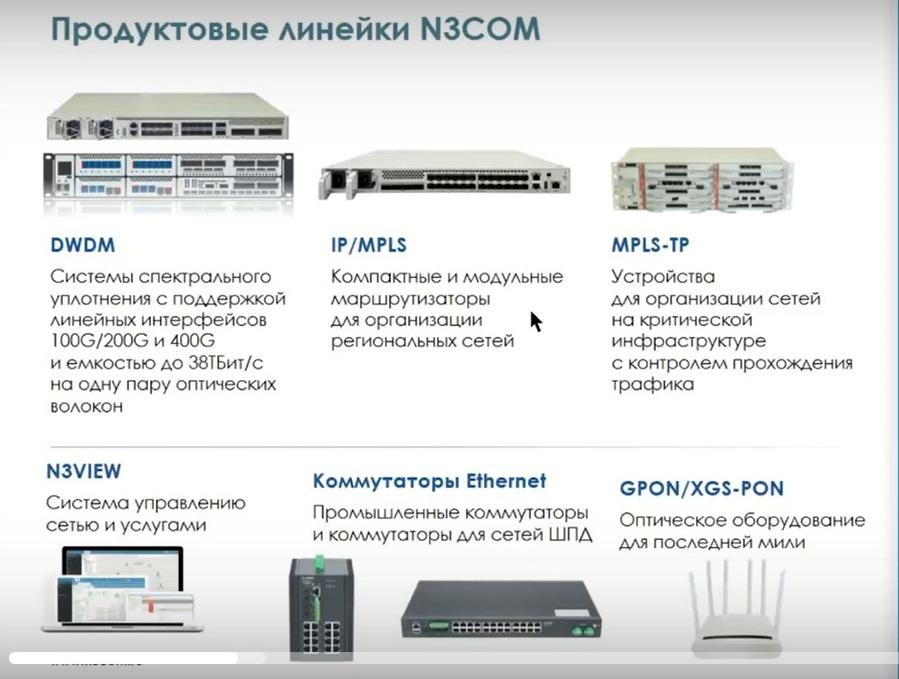
We have solutions for both long distances and so-called DCI (Data Center Interconnection), when we connect two data centers to each other, or maybe more, if the topology is in the form of a star or tree, with a traffic transmission system over a distance, in large capacity and without delays. We also have equipment, this is IP/MPLS, IP router and TP routers. First of all, these are IP routers that are used in the network of telecom operators, mobile operators.
MPLS-TP is a router that is designed for the energy sector, where TDM traffic is still used, where many different peripheral interfaces are needed. Ethernet switches - our line, the equipment portfolio is expanding.
Also in Ethernet switches in this range there are industrial switches.
Our line includes GPON last mile broadband equipment. And all this is managed by a single N3VIEW management system. We pay special attention to the unified management system. We are now making efforts to ensure that this management system is included in the register.
What do our resources look like in Russia within our company?
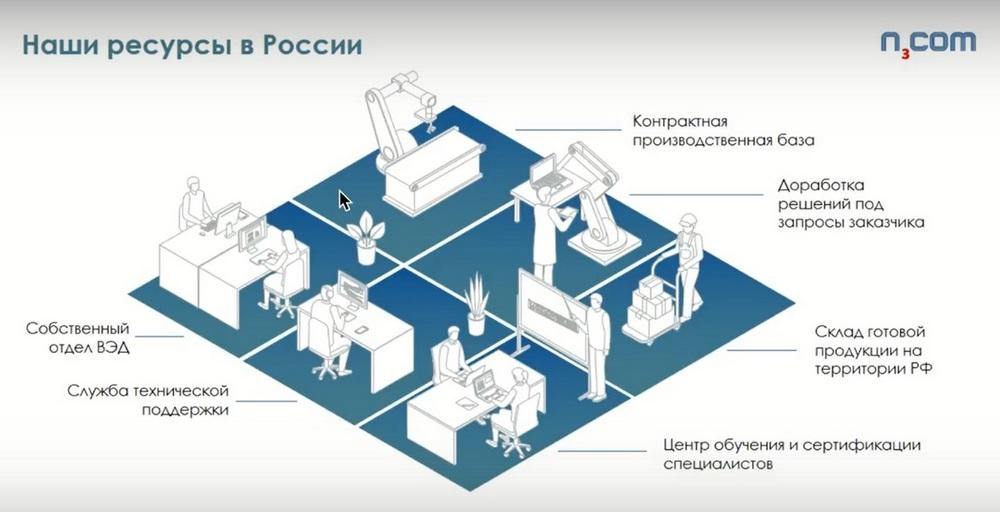
Our company is not one of those that only buy and sell. We have far fewer managers than engineers. We have our own warehouses. Our technical support service operates both within the company and there are partner solutions. The customer only needs to leave a request for consultation either by phone or by email.
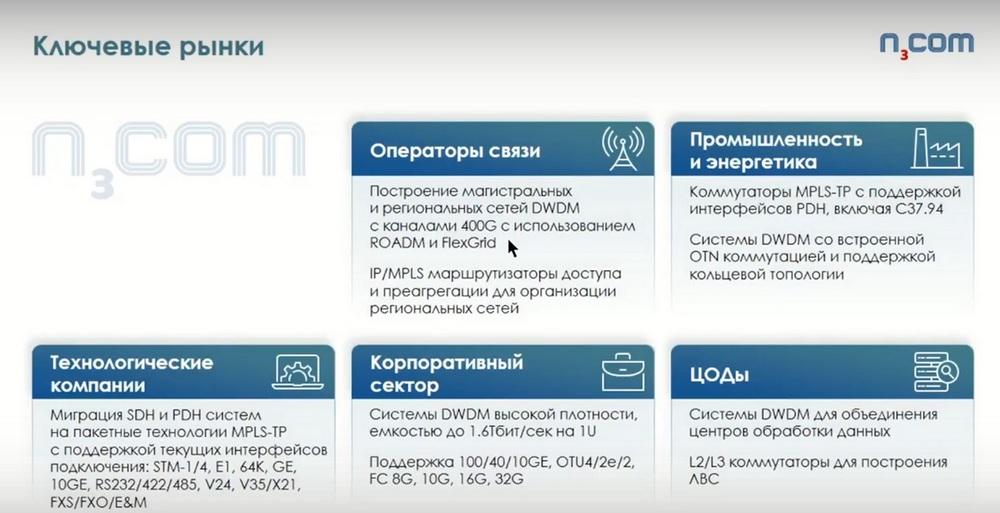
Of the key markets, we have identified primarily telecom operators. Who needs the construction of trunk or regional DWDM networks with 400 G channels. There are not very many of these now. Now customers are looking at a slightly smaller bandwidth, but everyone understands that we, as a manufacturer, are ready to provide equipment with 400 G channels between DWDM nodes using amplifiers and flexible configuration systems.
Also, telecom operators use our equipment - IP/MPLS-TP routers. The industry and energy sector is very interesting for us. There is already equipment that works in commerce as well. Therefore, we are accumulating a database, accumulating competence in the use of equipment in the industry and energy sector.
For technological and other companies that require migration from SDH to PTH or IP, we also have solutions.
Despite the fact that we have become somewhat detached from international traffic, we are seeing that corporate sector customers in the Russian market are developing rapidly.
We are also seeing a good trend in demand for equipment for building a communication network between data centers. Until recently, the number of rack spaces in data centers was a big shortage. Now a lot of data centers are being built in our country. Communication channels need to be compacted, we are ready for this. We have interesting solutions for communication between data centers, we have the necessary interfaces.
We pay a lot of attention to our so-called N3Com Academy.
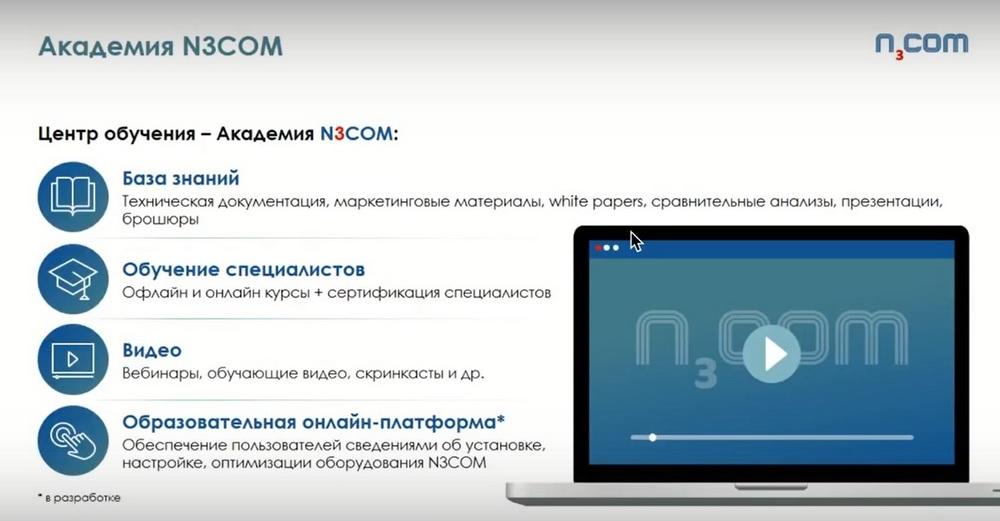
We are now filling the knowledge base of technical documentation. Marketing materials are available. Our presentations and brochures are available on the website n3com.ru. We have a training center. As a result of training, we issue a certificate confirming that the company's specialist has completed a course on configuration and operation, and he can competently work with our equipment.
Before proceeding to the sale, delivery or negotiations with the customer, you can independently view and evaluate the equipment, whether it is suitable for the customer or not.
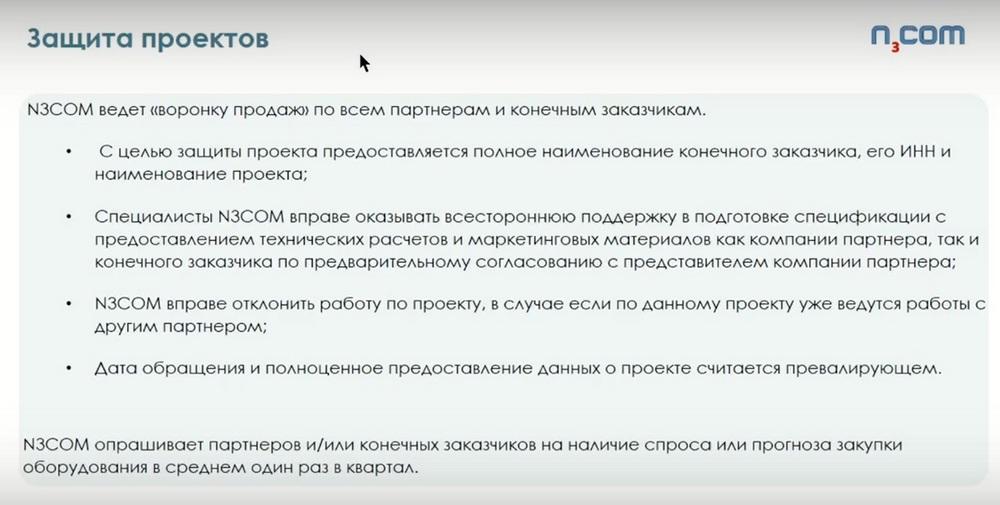
As a classic vendor with a traditional and well-established project protection program, I would like to note that whoever contacts us first is given a certain preference. But in any case, it is necessary to study who is our end customer, his TIN, his territorial location, and whether someone else is already working with this customer. I myself am a supporter of honest regulations for the protection of projects, but I know that sometimes there is a cross-request for price levels. Therefore, it is necessary to very carefully maintain a list of requests with end customers.
And it is also important to note what initial information we need to prepare feasibility studies. Why are we paying attention to this issue?
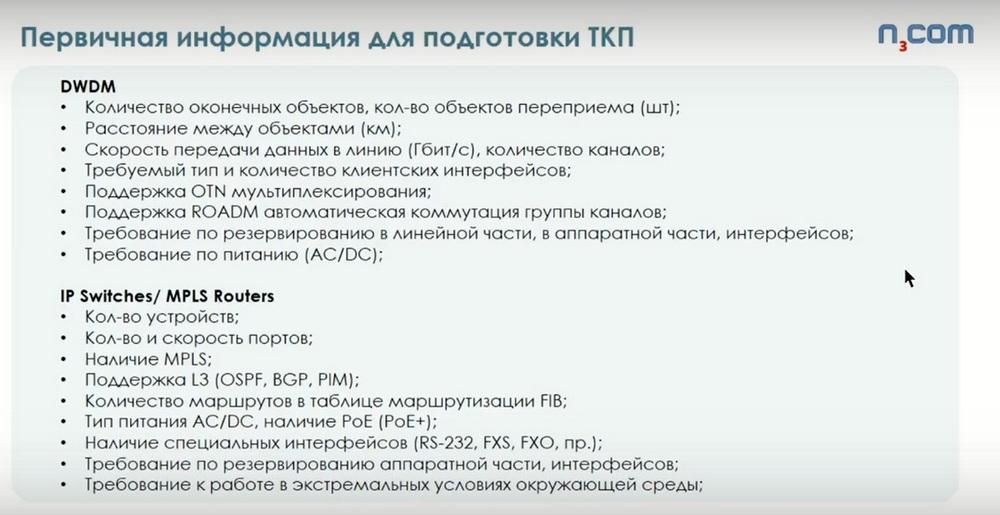
Very often at the beginning of our company's work, 90% of requests were something like this: "Here is a specification for Cisco, pick something similar from your portfolio for me. Oh, you don't have it, then I'll contact someone else." Trends are changing, there are fewer such requests now, but they still come. In order not to waste time, we ask you to inform us of the main parameters immediately. If you need to calculate for DVDM, then this starts with a structural diagram of the network, so that we can see what is connected to what, what it connects to, what interfaces are needed, what distances, because before we calculate the equipment, we will calculate the so-called signal-to-noise ratio, we will calculate the energy. Will the energy of our equipment pass or not on this line. This is a requirement for data transfer speed, this is a requirement for power supply and much more.
The same applies to switches. Very often, in order to just find out the cost, a potential customer assures that they only need one switch, and then it turns out that one switch is not enough. We answer such questions, but, you understand that if we make an extended request, for example, when a delivery is needed, then we can find something for you from the warehouse.
Testing for climatic conditions. Specifically at the request of the customer, we conducted testing with both freezing and heating of the equipment.
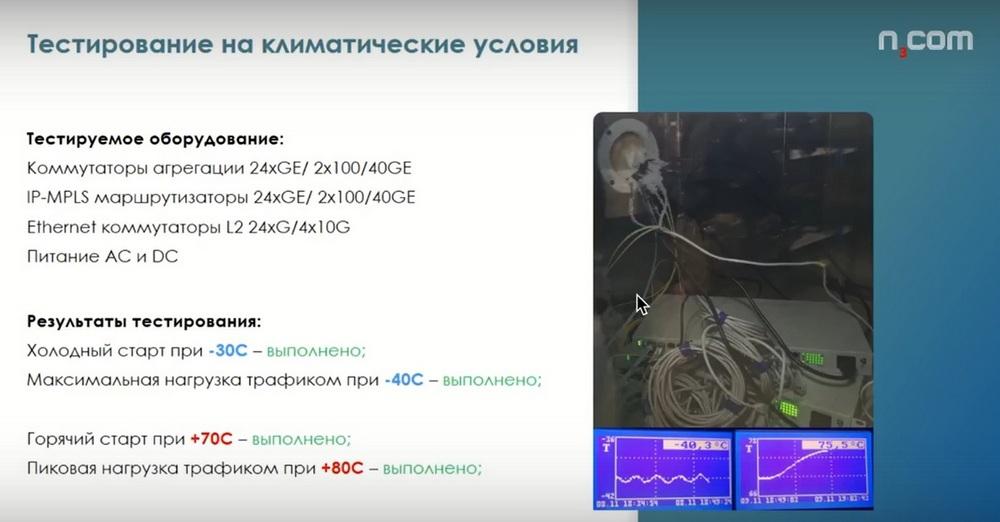
The customer very often installs switching equipment - Ethernet switches or industrial switches in places with potentially dangerous environmental heating. For example, this may be the space under the roof, which is strongly heated by the sun, and where a greenhouse effect occurs. Sometimes the customer has situations when the air conditioner fails in the block containers of communication, and in the summer. Our equipment withstood such tests. During a hot start at plus 70 degrees, the test is performed, and at peak traffic load at plus 80 degrees, the equipment works.
We are open to new partnerships, we are open to new dialogue, and often we are even open to considering issues of expanding the product line. We do not stop monitoring the market of the People's Republic of China.
We have selected several models from our line that will soon be produced in Russia. I think a press release about this will be at the beginning of next year. We will produce, conduct commissioning tests, output control, see how it works. We will replace some components that are currently supplied from China. Now I pass the microphone to Dmitry Peslyak, technical expert of our company.
He began the story about the line of switches that we usually offer for broadband access networks and local networks, about industrial switches that are mainly used for technological networks or some projects such as campuses, parks, locations that require special climatic or some other placement features.
The simplest lines we have are Layer 2 switches, there are Layer 3 switches, there are compact and fanless switches. The simplest line is ACS1700.
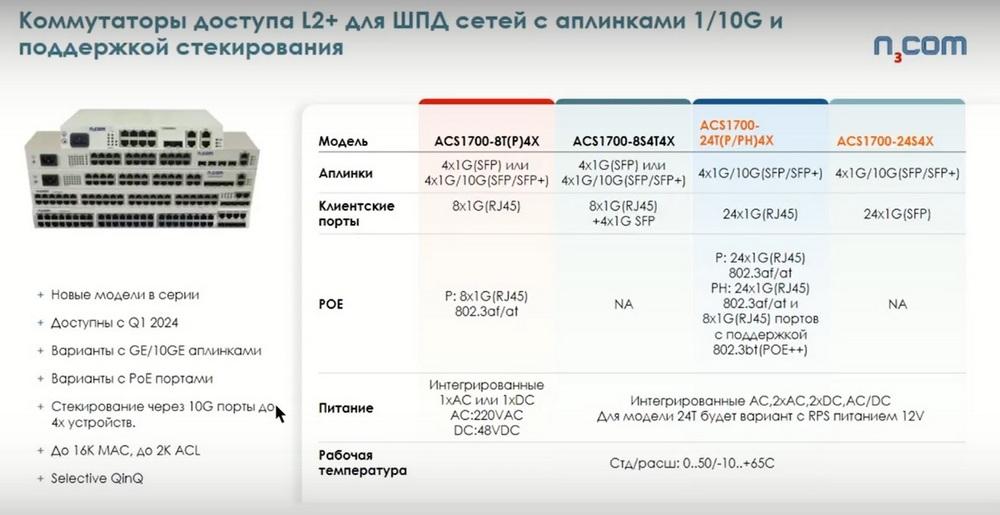
These are Layer 2 switches with support for up to 16 thousand MAC addresses. There are variations of execution with DC power, which is more required for telecom operators, there are compact options with PoE support, there is a standard version with 24 ports with PoE or PoE++ support. If you look at the names of our switches, in general they are quite transparent. If we talk about custom codes, then the power supply configuration will also be reflected in them. Codes for positions, and according to them you can focus on the type of power supply and the type of boards that are installed.
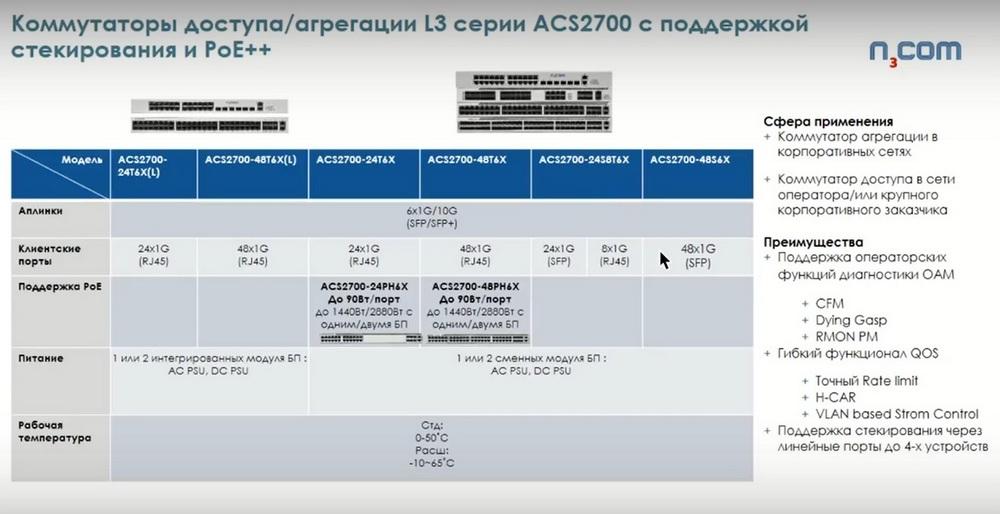
A slightly more serious line is the L3 ACS2700 line. There are more variations here, there are switches with the index L this is light, this is an option where the power supplies are built-in. And there is an option with one or two power supplies, to reduce the cost of the design.
There are models with 24 copper ports, 48 copper ports, six 10 Gigabit ports, which can be used for both uplinks and stacking. The remaining models, which are without the L index, are with removable power supplies. There is a variation with combo ports.
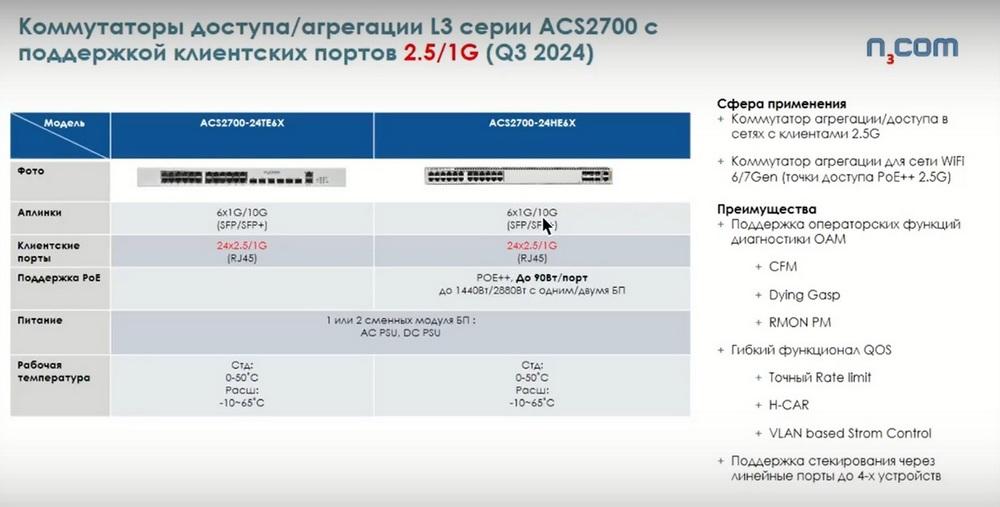
The peculiarity of the 24 or 48 port iPoE model, i.e. PoE++ up to almost 3 kilowatts of PoE power per switch with 48 ports. Here also access aggregation switches. This is a promising model that will be with client ports 2.5 and 1 Gigabit, and also with POE++ support, also replaceable power supplies up to 6 uplink ports, or which can be used for stacking. These models will appear in the near future. You can look at them and order them. We plan to order them to the laboratory, you can take them for tests.
The next line will appear in November. Here is more scalability for switches. There is also VxLAN support. Here all models are with a replaceable power supply, these are L3 switches. There are various options for 24 and 48 ports SFP or RJ-45. And there is one model that is with 100-Gigabit ports, namely the L3 switch, i.e. 100-Gigabit uplink ports 2 Gigabit ports and 24 ten-Gigabit client ports. This is the level of aggregation.
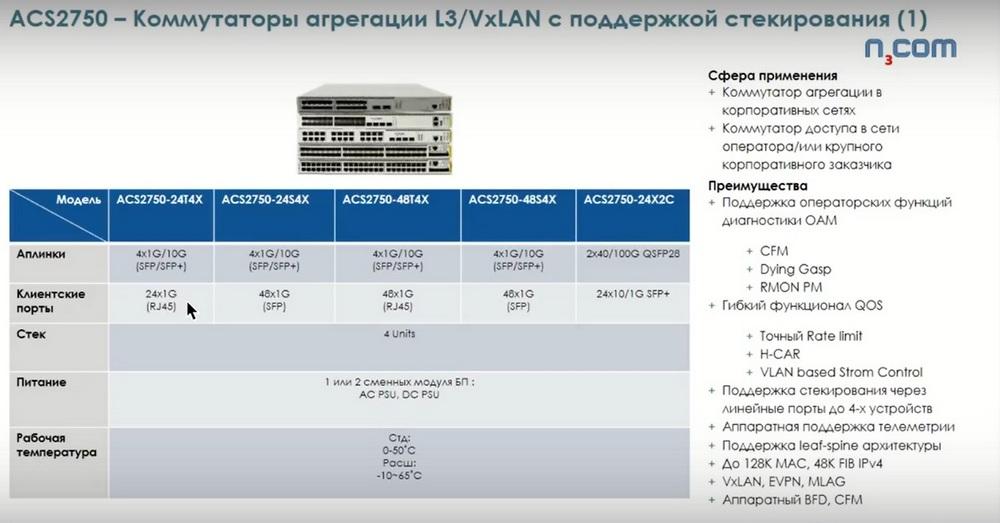
Functionality is VxLAN, EVPN, up to 128 thousand MAC addresses and up to 48 thousand IPv4 routes are supported. Also, hardware BFD and hardware CFM will be supported on it, which allows diagnosing L2 connections. Depending on this, switch to the vizer, see what you have with the subscriber, with the client connection.
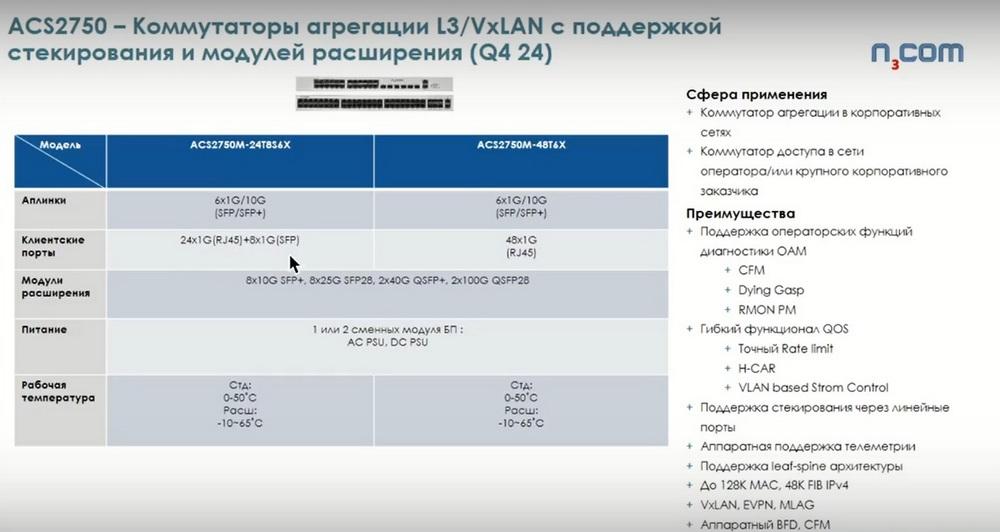
The ACS2750 model is also modular. It will also appear in the next quarter. It will have a fairly standard design of 6 Gigabit uplink ports, client ports 24 (RJ-45) plus 8 Gigabit ports. And the second option is 48 Gigabit ports, and plus there is an expansion module that can be installed. It will be either 8 10-Gigabit ports, or 8 25-Gigabit ports, or 2 40-Gigabit QSFP+ ports, or 2 100-Gigabit QSFP-28. Well, I think that this will be one module. And everything else is identical to the previous one in terms of scalability. We have more detailed information about the scalability of these lines on our website. There you can see how many such routes, what is the goal, how many MAC addresses which model supports.
Also in our line there are switches for Data centers. They can also be used as aggregating switches. Here we plan a few more variations of these lines.
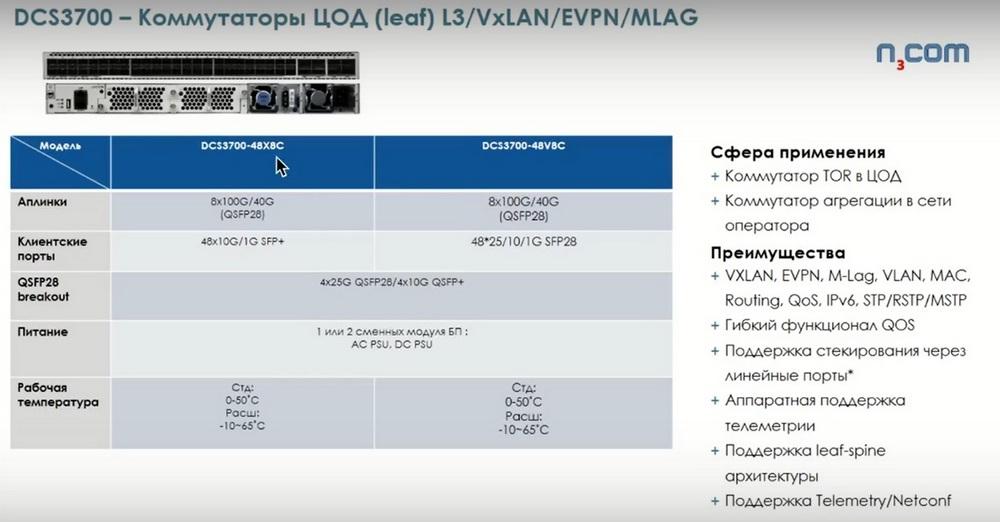
There will be fixed lines with a large number of 10-Gigabit or 25-Gigabit ports. And with 100-Gigabit uplinks. And there will be leaf models for them, in fact there will be a spine model that will have a large number of 100-Gigabit or 400-Gigabit ports. Such models will also appear soon.
Power supplies are replaceable. This is a standard scheme. Here is service from both sides. And the cooling option is front-to-back, as a rule. Sometimes it is required back-to-front, but we mainly have front-to-back.
Aggregating data center switches are so-called spine switches. There is a variation of 30 to 100, and there is a variation of 32 four-hundreds, which can also be split. For example, into hundreds.
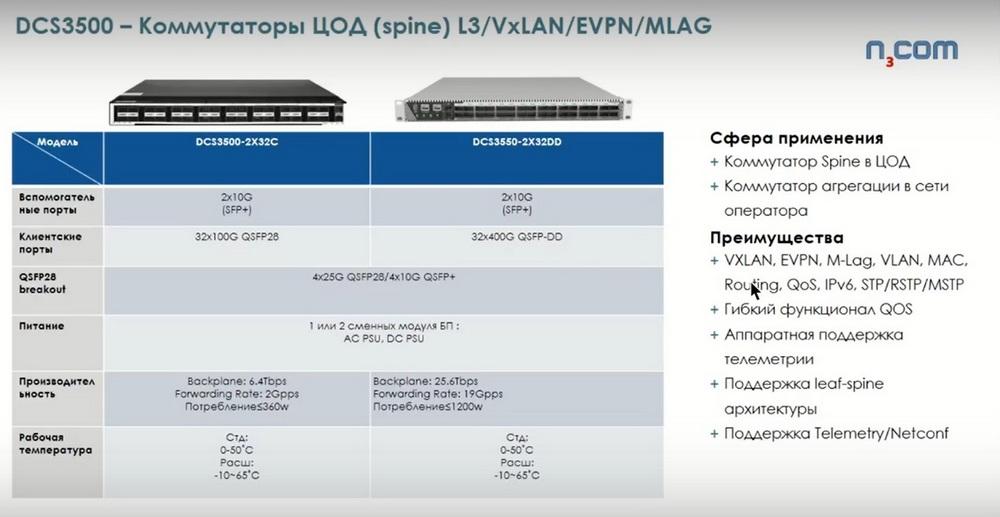
They have high performance. Further functionality is more or less standard for these switches that are used in Leaf Spine. These are more or less standard models. In principle, they are available from many manufacturers. The question is already pricing. Well, and an important question that is often asked is the question about the register. We do not plan to enter these data center switches into the register yet. There are now many domestic manufacturers who are doing this. And creating great competition for them is not part of our plans. Also, we are planning to have modular core switches appear in the line at the end of this year.
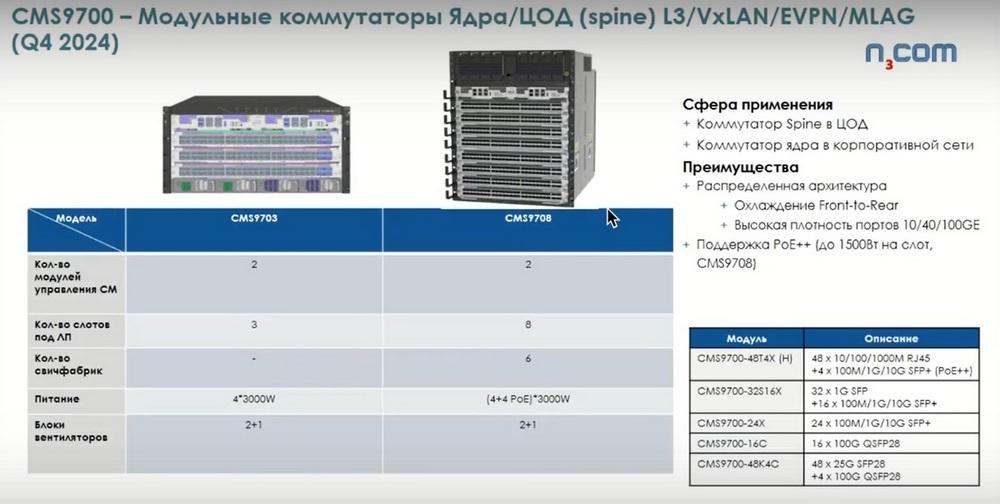
We think that they can also be used for data centers, but more, of course, these are switches that are used in large corporate networks, such as a large business center or campus, where a large number of aggregating ports are required, and it is possible to use connecting Wi-Fi access points of the sixth generation, where PoE++ is required. There are line cards with PoE++ support up to one and a half kilowatts per slot. And in this version there will be a classic solution for large corporations, where the series from ACS1700 to ACS2700 are at the access, and in the aggregation in the core of the network you can already put the CMS-9700 switch. We can make a three-level system or a two-level system, i.e. at the access to 1700, and then at the aggregation 2700 or 2750 and in the core put a pair of CMS-9700 switches. Here is such a design option.
Next, let's move on to the line of industrial switches. Here we have a little more universal solutions, there are not so many of them. We are trying to make such a universal portfolio in which it would be easy enough to choose a solution for yourself. There will not be any very specialized options there.
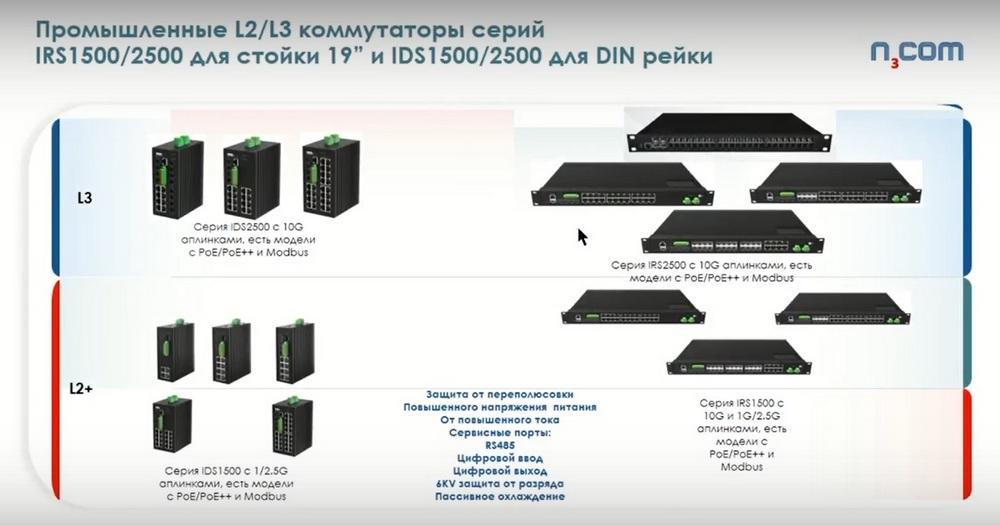
There are L2 switches and L3 switches. We have a marketing approach where the L2+ series will have gigabit or 2.5 gigabit uplinks. And the L3 series will have 10-gigabit uplinks. This is determined by the network architecture. L3 is usually placed on some aggregating device that already needs 10-gigabit ports. This model will be more expensive and have more functionality. The model that is placed on the access layer typically does not require 10-gigabit ports and does not require L3 functionality. This is again a matter of pricing. Visually, L2 and L3 models are identical. They differ in uplink ports and functionality. There is a version for one rack unit, there is a version for rack mounting, there are different types of power supply.
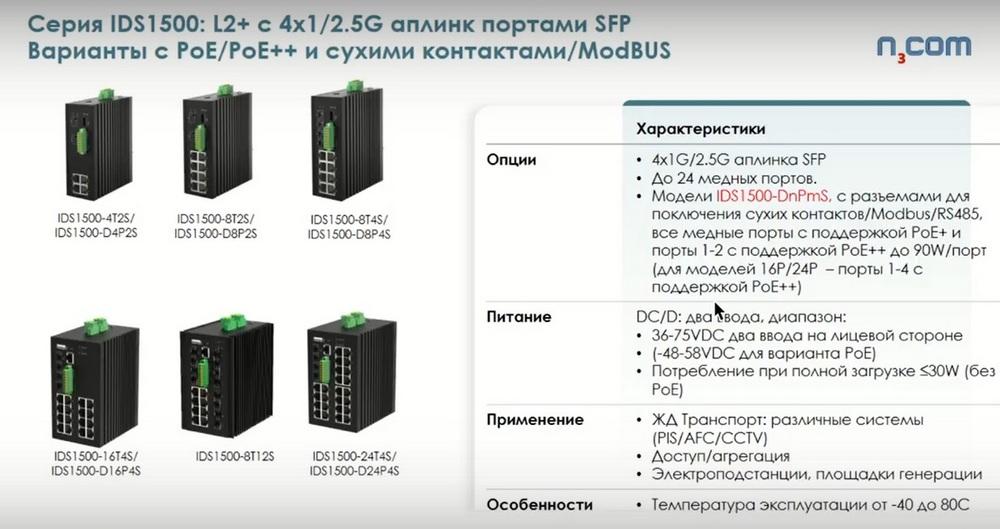
The mounting option, which is for one rack unit, here we only have DC power, AC power only through an external converter. We can offer it to you ourselves, or you can buy it somewhere else. They are usually used for some solutions with electrical substations, somewhere in transport there are options where a switch is used on a DIN rail, in general, where there is little space and it is possible to mount in a cabinet on a DIN rail. Sometimes there is a solution for aggregating Wi-Fi access points in some park. It requires an extended temperature range from minus 40 to plus 80, support for, for example, PoE++.
The L3 model has a slightly smaller range of variations in design, but it has quite good functionality. And here, 10-gigabit uplink ports can also be used on switches for DIN-rail mounting.
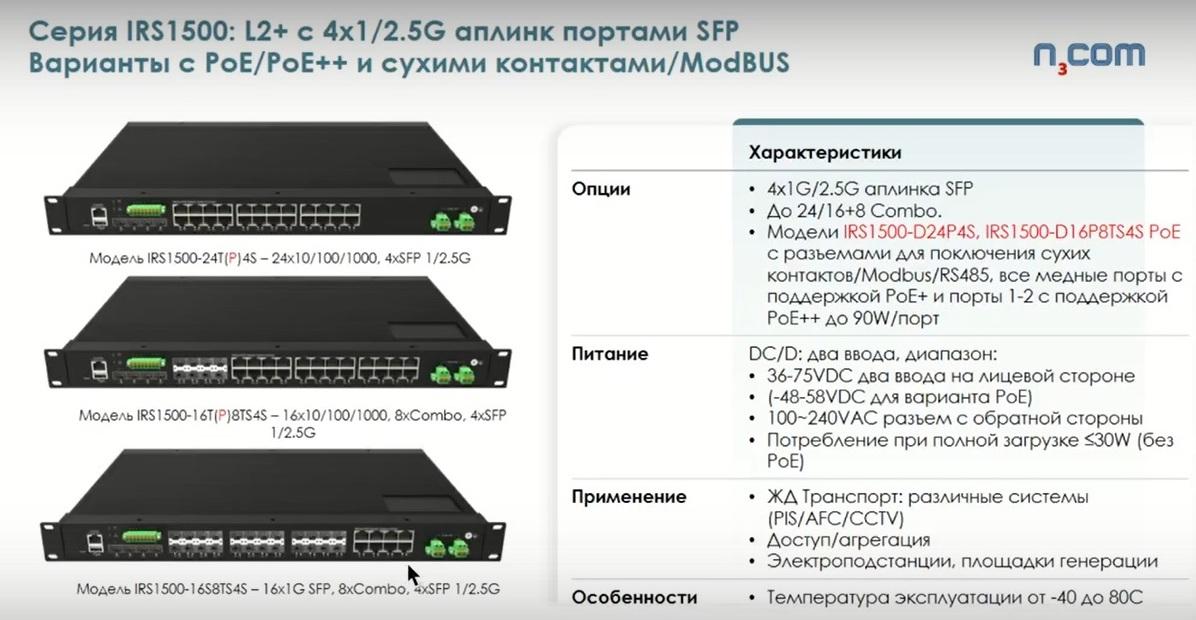
Models for rack mounting. There are three types according to the types of ports. It varies from the number of client ports, either more copper ports or more SFP ports. It depends on who needs what. The option with a lot of SFP ports is only without PoE support. All other options that support PoE have an order option with the index P, which is PoE support, or without the index P - without support. In this design, they have quite interesting power options. Here are two DC power supplies, two redundant inputs, and there is also an AC input, here they are on the back side, such direct redundancy in many options. Well, and the L2+ option with uplinks up to 2.5 gigabit interface, the L3 option with 10 gigabit uplinks.
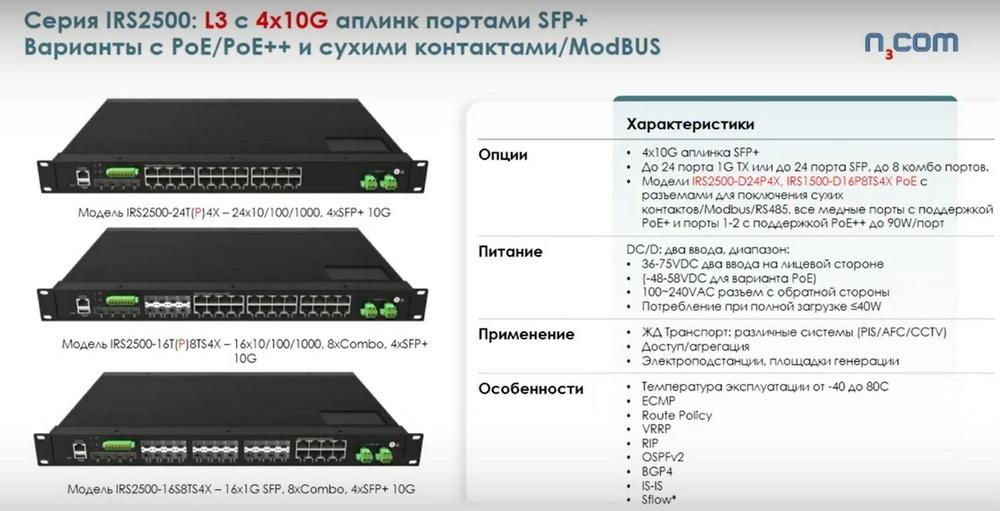
Examples of names are presented here. In principle, they inherit the names that we have for the ACS series by port type. Except that there is a slightly greater variety of port types in different models. There are also two 48-port models with PoE L2 or L3 support. They also differ in 2.5 gigabit uplinks or 10-gigabit uplinks.
In addition, we have a specialized model ITS1500-8P. This model is used for mounting on transport, most often railway.
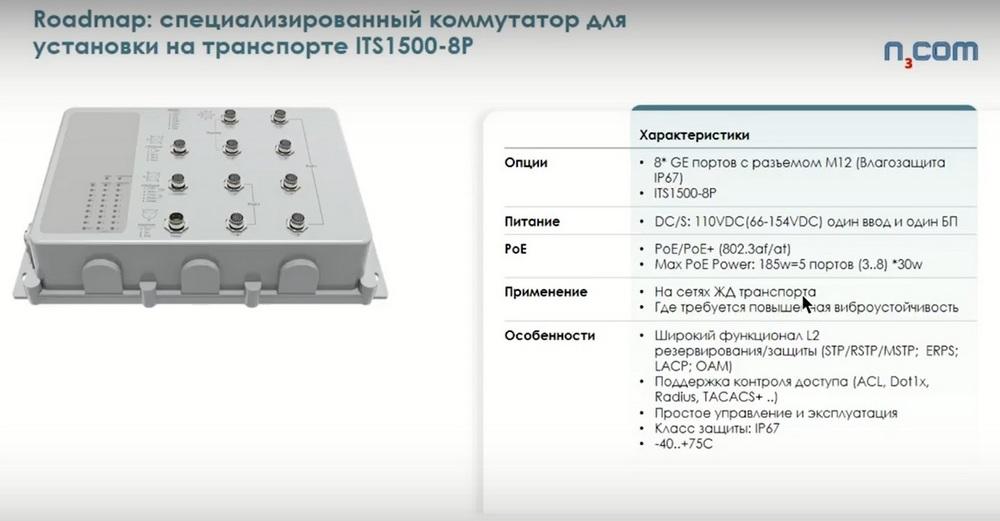
Here is the power range that is used on railway transport.
This is a vibration-resistant model with ports that allow them to be fixed. This is called an M12 connector, it is also waterproof. The physical port connector and the power connector are also fixed.
Typical application diagrams of switches are usually identical for all vendors. But we will offer some options for our models at different levels of the network hierarchy, how they can be installed, used, and so on.
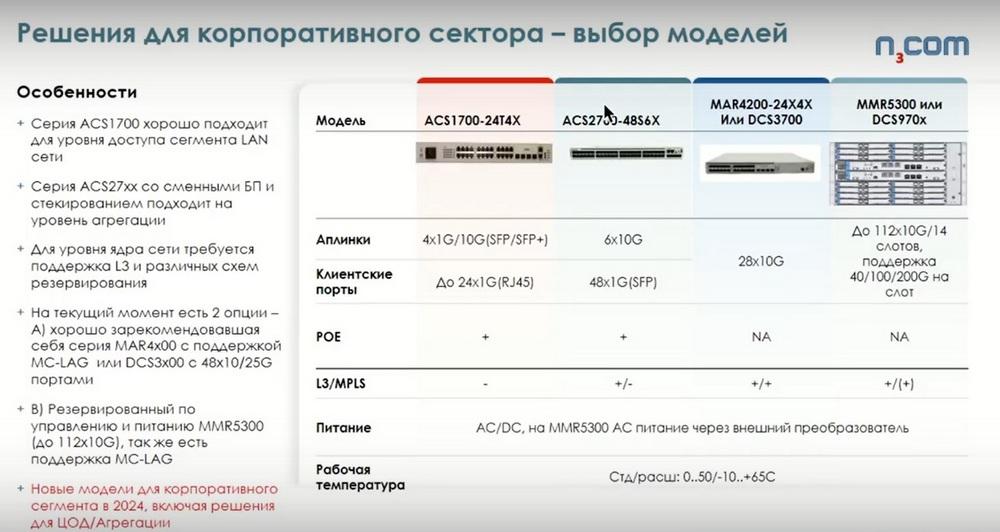
In particular, the ACS1700 model is most often used at the access level. There are a number of projects with broadband access operators. These switches have proven themselves well in tests. Temperature tests were also carried out with them, i.e. they are good to use as an inexpensive reliable access switch.
The next level is the aggregation level. There, SFP ports are already required, i.e. to aggregate these higher-level ACS1700 switches, again, you can aggregate them via gigabit. Uplink ports support both gigabit and 10 gigabit, or via 10 gigabit ports. You can use the ACS2700 line. Here, depending on how many levels are in the network hierarchy and what levels are in the network hierarchy, you can use MAR4200 or MAR5300 with a large number of 10-gigabit ports, and already MPLS support from this level. The MAR line is already MPLS "hardware", if there is a need for MPLS support. MPLS devices are not stacked and thus can provide redundancy. If stacking is required, then this is the FCS or DCS line in the form of a chassis switch. There is no stacking there, it is just a chassis switch that is reserved both for management and for power. In general, everything is determined by the requirement for the number of ports and the need for PoE or some other functionality, for example, MPLS.
The network infrastructure options that can be built on our switches are, in fact, what I am now talking about for the broadband operator, i.e. access to ACS1700, aggregation C2750 or 2700.
Illustrations provided by the press service of N3COM.