An event by OCS and ISPsystem, a Russian developer of hardware and server virtualization management systems. The meeting will focus on BILLmanager - a platform for automating business processes of providing virtual and physical resources, controlling and managing IT infrastructure elements. You will learn how to effectively manage virtual and physical infrastructure, monitor and forecast the consumption of various resources, automate the allocation of resources to departments within the company or external clients, and manage multiple virtualization systems.
How to use BILLmanager to:
• Automate service delivery; • Carry out financial transactions with service consumers (accepting funds, issuing reporting documents);
• Set tariffs according to various schemes (for guaranteed resources, based on consumption statistics, etc.).
• Organize a customer self-service portal.
Who will find BILLmanager particularly interesting:
• Organizations with geographically distributed IT infrastructure;
• Finance and insurance (tariffing financial and insurance products and controlling IT infrastructure);
• Manufacturing (managing physical and virtual resources);
• E-commerce (managing e-commerce: accepting payments, managing pricing policies);
• Hosting companies and cloud providers;
• Smart cities (monitoring and managing regional IT infrastructure to ensure the resilience of urban information systems and services).

The event is being led today by Igor Mikhailov, Product Manager, ISPsystem. ISPsystem is part of the ASTRA group of companies – a Russian developer of platforms for comprehensive IT infrastructure management.
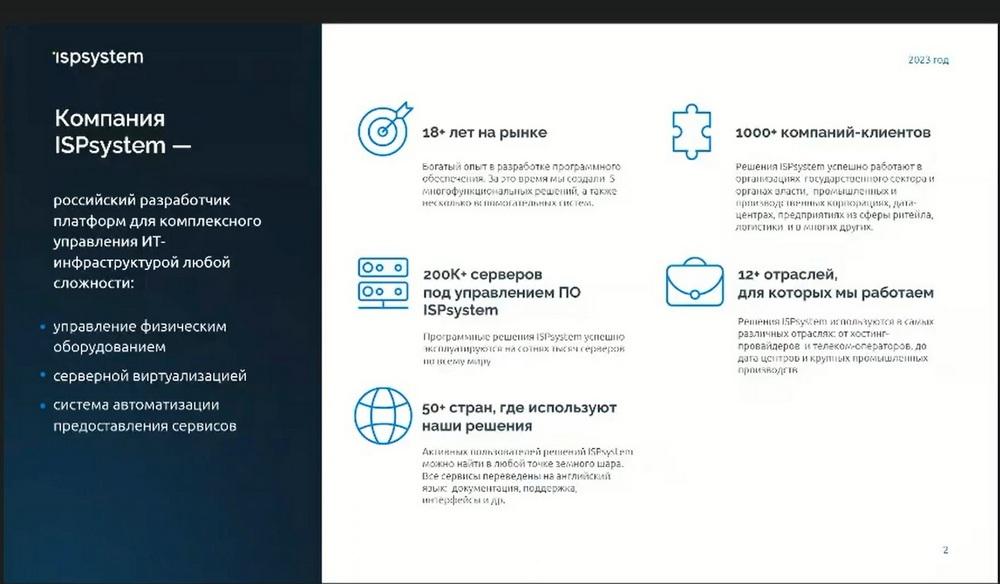
The company has been in the market for over 18 years, its software solutions are used on 200,000 servers worldwide, active users of the company's solutions can be found in more than 50 countries, and over 1,000 companies use ISPsystem solutions.
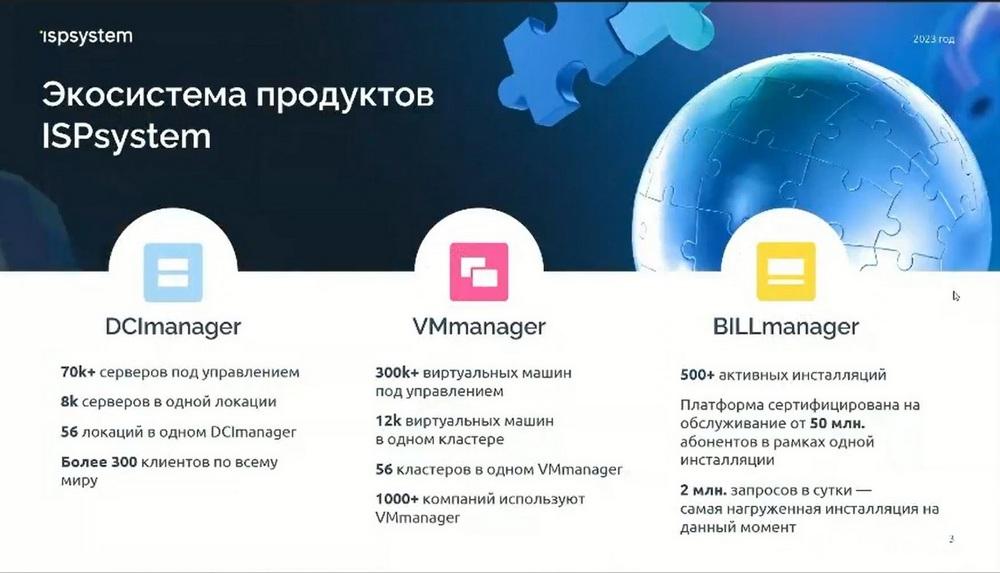
The product system is represented by three solutions: DCImanager, VMmanager, and BILLmanager. They are fully developed by ISPsystem.
DCImanager is a platform for managing physical servers and IT equipment, VMmanager is a virtualization platform, and BILLmanager is a platform for internal billing, for automating the presentation of physical resources, for managing multi-cloud geographically distributed IT infrastructures from a single window, a very extensive platform in terms of functionality.
Last year, ISPsystem conducted a study in which over a thousand respondents were surveyed, asking a simple yet complex question: what resource management problems do you encounter in terms of IT infrastructure management and control?
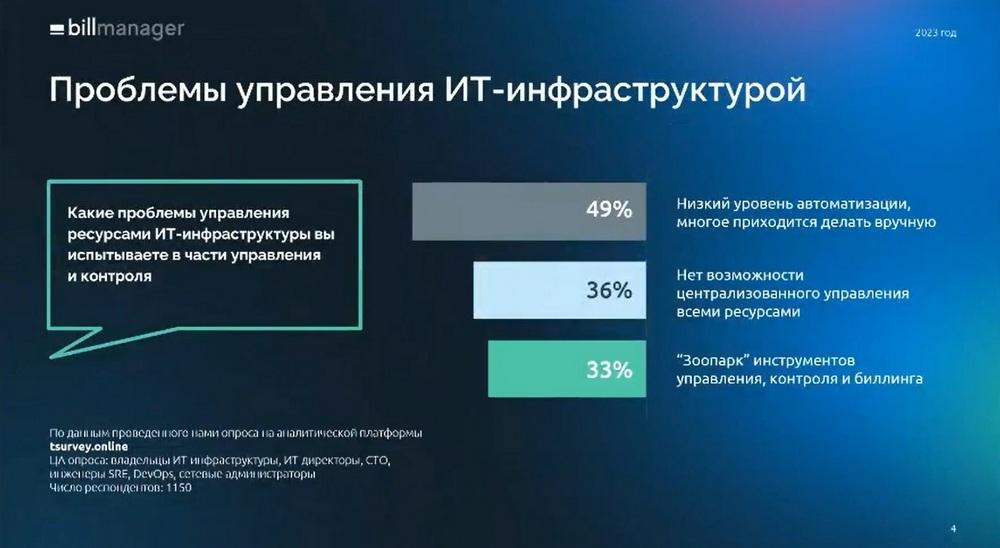
And as you can see on the slide, the main problem voiced by most respondents is the low level of automation, thus much has to be done manually. VMmanager is a platform that solves this problem in terms of providing end-users with virtual machines, physical servers, and managing services.
Let's move on to the platform's capabilities. At its core, BILLmanager is an orchestrator that, using integration with virtualization systems and physical resource management systems, allows you to issue and manage various resources, and compose complex services from them.
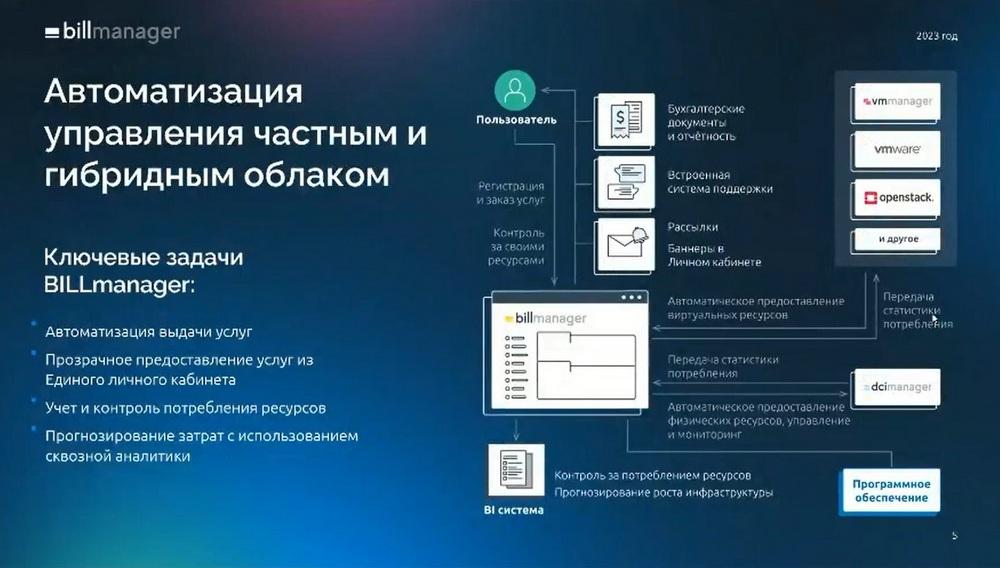
Issuing and managing virtual servers and resources is done using integration with various virtualization systems (some of them can be seen in the upper right part of the slide). VMmanager includes VMware center, cloud director, etc. In turn, automated issuing and configuration, management and monitoring of physical servers is done through integration with DCImanager. The end-user can order various services from their personal account, which are configured on the manager's side. For example, virtual data-center machines, virtual machine backups, dedicated servers, management and monitoring of these servers, domain licenses and certificates, and any other services that are relevant to the specific organization and managed through VMmanager. At the same time, services can be composed into service packages, for example, you can make several templates of the "virtual machine" service with different configurations for development and "production". You can specify different "executions" for each template, include public IP addresses by default, and not add "execution" for development. Thus, you can compose services from various components, with different "executions", combining them into service packages. Administrators and other interested parties with appropriate rights can monitor resource consumption; resource accounting is possible by allocated volumes, by consumption statistics, or it is possible to mix these consumption models and bill consumed resources differently at different times. It is possible to configure various notifications about exceeding threshold values of resource consumption.
If necessary, you can specify the cost for managed resources for cost accounting and settlements with legal entities. This is useful in various holding structures where there is a separate company that provides these services within the group of companies.
In addition to the above, there is integration with the "Dialog" electronic document management system. There is integration with "1C", which generally helps simplify financial accounting when providing these services. Also, our platform has a BI module. This is a system that allows you to forecast costs using end-to-end analytics. This is a set of built-in BI tools that allow you to monitor resource consumption and forecast needs, build trends, and visualize various data. At the same time, the BI module can handle any data, and also allows you to connect third-party data sources in order to conduct analysis.
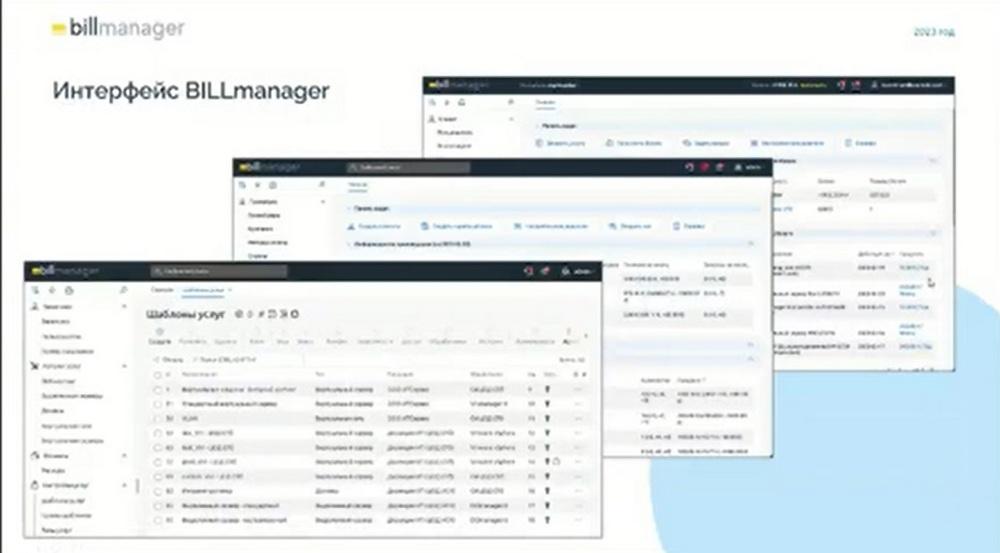
This slide shows examples of BI manager interfaces.
Let's talk about the advantages of the platform. First of all, of course, it is the reduction of labor costs for engineers, the availability of a personal account for the end-user and the delegation of service selection and ordering to the user, as well as the automation of the routine of creating and configuring virtual machines. All this frees up engineers to solve other important and useful tasks.
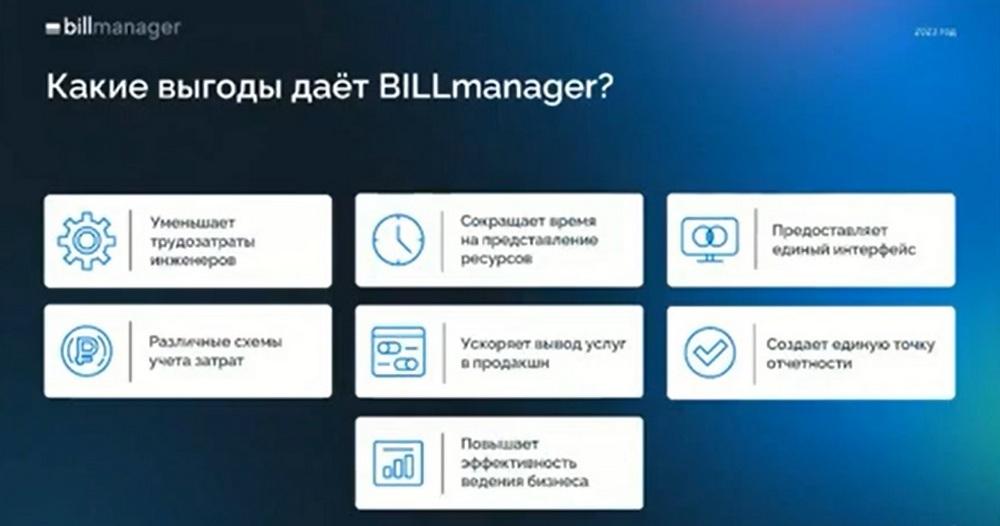
Secondly, it's about reducing the time it takes to provision resources. From the moment a user places an order in their personal account, the manager transmits the information through the BI system to the virtualization system or DCI manager. Then, the automation deploys and configures the order according to the configuration parameters set by the manager. The manager sends a notification and login details to the user. This entire process takes only a few minutes and allows resources to be provided to interested parties in a fully automated mode.
Billmanager provides a unified interface for accounting and managing the entire virtual infrastructure from a single window, regardless of the virtualization systems used. Naturally, this applies to the virtualization systems included in the integration package. You can manage a multi-cloud built on various virtualization systems. This is relevant for companies that have grown through acquisitions, which is not uncommon in the Russian market. Therefore, this product helps manage various resources built on different virtualization systems from a single window and interface.
Accelerating the release of services into production. Because we automate the creation and configuration of virtual machines and the allocation of network settings management resources, this reduces the time to launch new services and maximizes opportunities.
Consumed resources can be accounted for based on allocated volume, consumption statistics, or even a mixed approach. Flexibility is often in demand in large companies, and Billmanager provides the ability to choose the most appropriate accounting scheme for each specific situation.
Creating a single reporting point. Billmanager aggregates consumption data from all connected virtualization systems, making it easier to compare, analyze, and compile information about the infrastructure for the customer, which in turn allows for informed decision-making. Overall, these and other advantages of the platform ultimately help optimize workflows and improve the efficiency of IT infrastructure utilization.
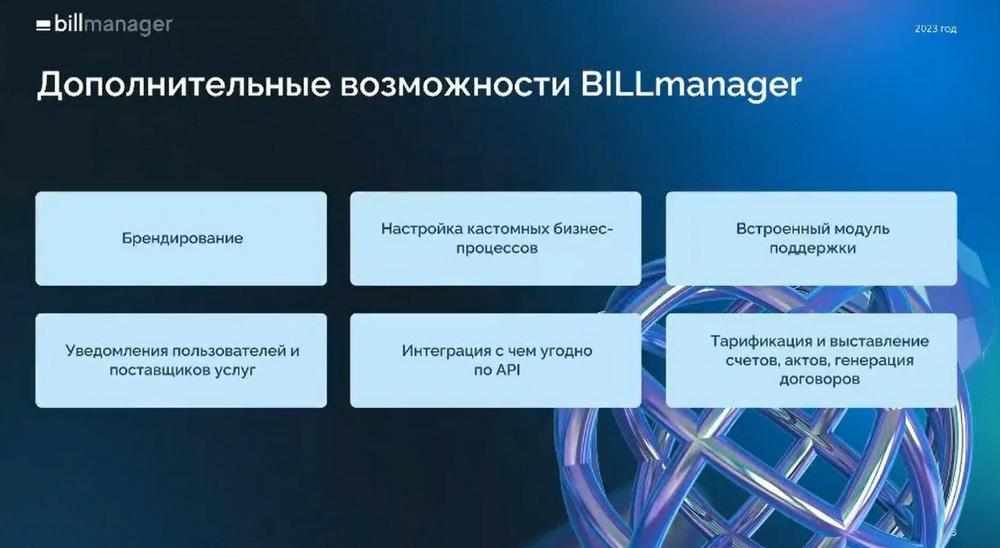
Now about the additional features and functionality of Billmanager. In 2023, Billmanager allows you to customize the interface and design of the control panel to match the corporate style and supports branding. In addition, there is a business process module where you can create various business process templates and show the sequence of tasks. Thus, you can add additional actions to the service ordering process, such as approvals or some preparatory work.
There is also a built-in support module. Of course, it will not replace a specialized ITSM system. However, following the principle of a single window, you can integrate with the ITSM system via IP, and specialists who work directly with the platform will be spared from having to switch to another system to process tickets related to manager actions and services managed through Billmanager.
Since we've mentioned the API, we have an open API that allows you to integrate the platform with any systems and tools, which expands the possibilities for automating and optimizing workflows. We have various mechanisms for notifying users and service providers, which simplifies communication between the customer and the service provider through automated notifications, allowing all interested parties to be promptly informed about the status of the order, various events that have occurred with the services, and changes to the services.
Since the platform is initially a billing system, there are options for pricing and providing invoices, as well as acts and generating contracts. Billmanager calculates the consumption of services and, if necessary, it can be integrated into the financial management loop, manage payments, generate invoices, acts, contracts, and send them to counterparties. This is especially useful in groups of companies where one of the companies acts as a service provider.
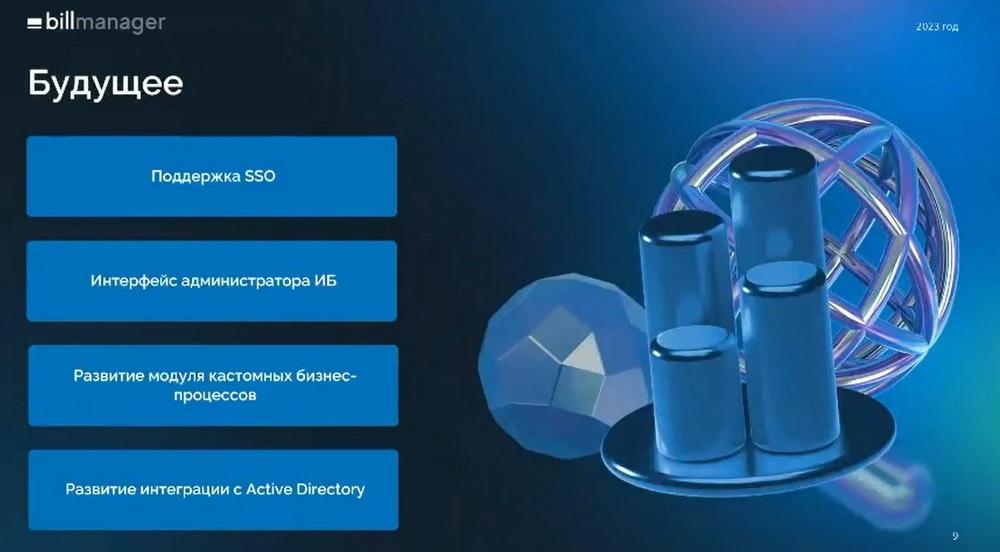
We will soon have SSO support. Currently, we are conducting research on implementation options. In the future, we plan to add new functionality. We are also constantly communicating with our current and potential clients, and they need an information security administrator interface. Let me explain why this is so. In Billmanager, everything is logged and saved, because it is a billing system, and its task is to count and save everything. However, access to information is mostly possible using the operating system tools that are deployed under Billmanager, and not the interface itself. We plan to fix this and provide information security specialists with a separate section in the menu with all the required information. In addition, the development of the Custom Business Process module is inevitable. Currently, the functionality of this module, from our point of view, as well as from the point of view of our clients, is somewhat limited and does not cover all requests to it. We will develop and improve this functionality.
The development of integration with Active Directory is also inevitable. Currently, the integration is a user selection without taking into account group membership and without the possibility of rights management. Many people need integration, and we will do it and expand it in the near future. From the point of view of interaction with directory management services, we have planned integration with LD Pro. This is an interactive Active Directory directory management service from Astra. There will also be alternative options for integration with the directory management service. These are not all the improvements and developments that we have planned. These are just the key and most significant plans that are important to note.
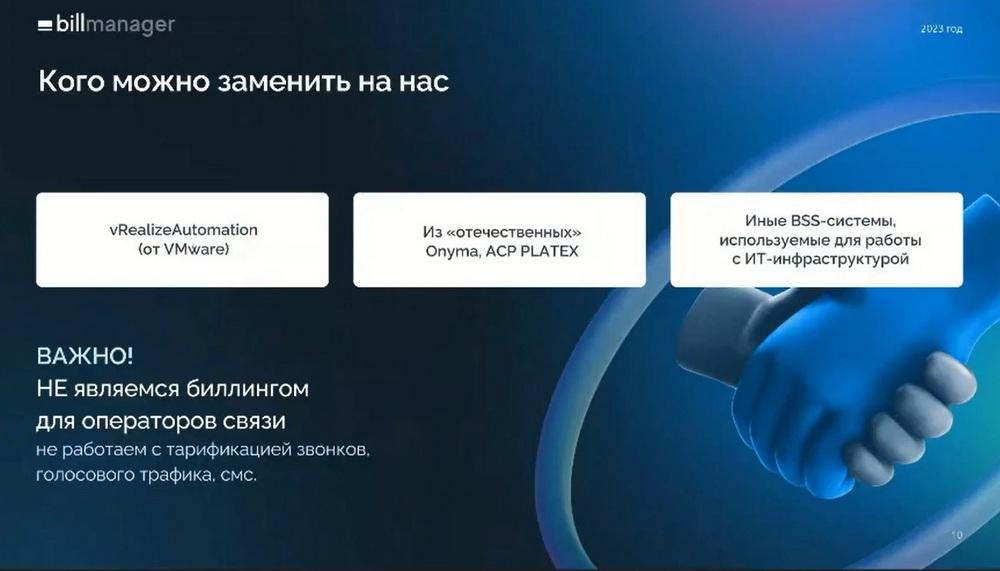
Who can we replace? From the point of view of managing various virtualization systems, we openly compete with vRealizeAutomation (VMware) solutions. They manage virtualization systems, and we manage virtualization systems. But we can manage more systems. But the possibilities are a little narrower. In general, this is just one of the products with which we directly compete.
From domestic solutions in terms of infrastructure management, these are Cloud Link and Rustec ESU. If we talk about billing systems, then these are Onima and ACP PLATEX. In fact, any billing systems, except for telecommunications. That is, we are not a billing system for telecommunications services. We successfully compete with other billing systems, and in most cases the capabilities of our platforms are significantly wider than those of our competitors. We can replace any systems that are required to work with IT infrastructure. Including various custom-written solutions that are still popular with some companies. In general, the scope of Billmanager is quite wide.
You can always test our product. You can order a free real 30-day license from a partner manager or on our website. We offer a separate automated web service to our most active partners, which allows them to order real licenses and access to pre-configured demo stands on their own. Write, call, we will agree on everything.