Translated with AI from the Russian original.
The flagship model with an independent disk power management system supports data transfer rates of up to 10 Gbps.
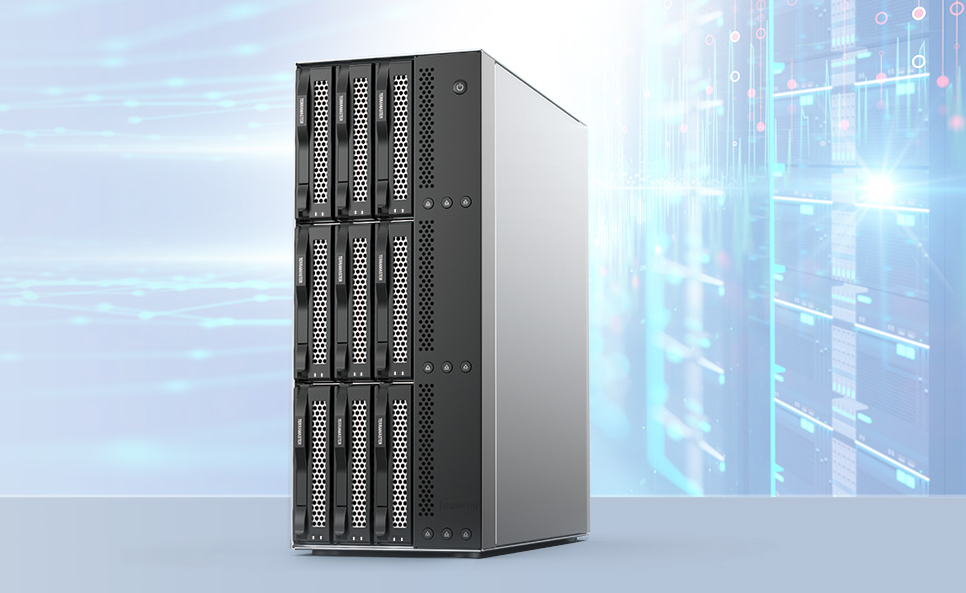
The all-metal enclosure features an unusual design with nine physical power switches and a main control switch. Thus, unused drives can be turned off independently of the others, reducing power consumption by up to 70%. The intelligent UPS power-off protection system automatically parks the heads and protects the data cache in the event of sudden failures. In addition, there is an intelligent sleep mode in which the device synchronizes with the PC, reducing disk wear and power consumption.
The D9-320 supports nine drives in single mode with a maximum capacity of 22TB per drive. Thus, the total capacity can reach 198TB. According to TerraMaster, real-world tests show read/write speeds of 1016 MB/s when nine 8TB WD Red hard drives are running in parallel, and 510 MB/s for a single 1TB WD Red SSD.
The device is equipped with a USB 3.2 Gen2 interface. The D9-320 is compatible with USB 3.0/3.1/3.2, USB 4, Thunderbolt 3 and Thunderbolt 4 ports. Mixed installation of 3.5\" and 2.5\" HDDs and SSDs is supported. An additional USB Host expansion port with a bandwidth of 10 Gbps is provided, allowing multiple storage devices to be connected in a chain.
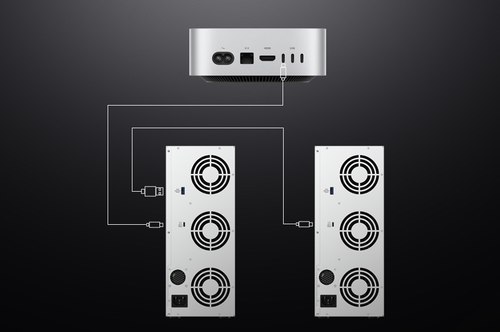
Users can expand storage for NAS and PCs, including Windows, macOS, Linux, TerraMaster OS, Unraid, TrueNAS and Proxmox systems.
The D9-320 9-bay hard drive enclosure is offered by TerraMaster for 52,000 rubles with a 2-year warranty and lifetime technical support.











