Translated with AI from the Russian original.
Joint event of OCS and CyberPower, a developer of uninterruptible power supplies, applied software for power and infrastructure monitoring and protection, and power accessories. The online meeting focused on CyberPower BMS software and monitoring, as well as energy saving and data center lifecycle issues.

Event program:
- Why monitoring is needed;
- What business tasks does monitoring solve;
- CyberPower BMS hardware monitoring tools;
- Software monitoring tools;
- Energy saving and data center lifecycle.
Andrey Kryukov, product manager from CyberPower, began his presentation by introducing his company. The Taiwanese brand was founded in 1997 and is present in more than 130 countries. It has 7 own factories around the world, its own development of single-phase and three-phase UPSs. The company will develop single-phase and three-phase UPSs, its own network cards, its own environmental monitoring, its own software. We have a leading position in the Russian Federation.
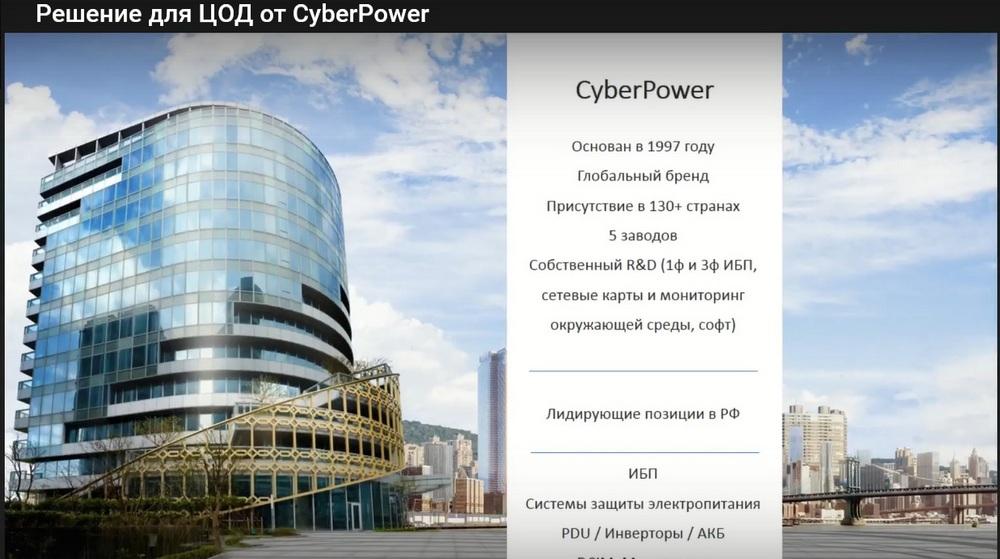
We have offers on the Russian market for UPSs, PDUs, inverters, batteries, and monitoring.
The Russian localized brand CyberElectro appeared more than two years ago. Therefore, all our Russian sales are made under two different brands. We have our own R&D, which is located in mainland China, and mainly in Taiwan. Factories in mainland China and the Philippines. We have a complete production organization from start to finish. That is, everything is done in house.
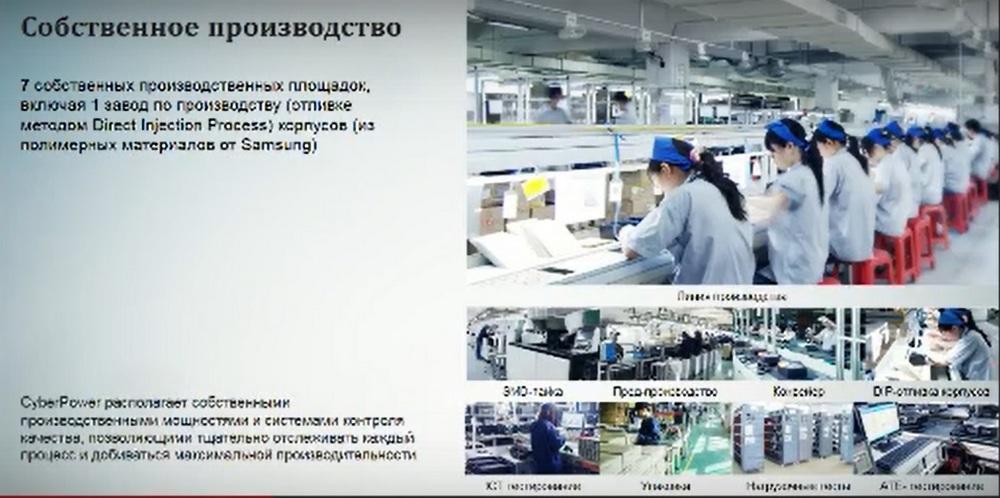
Seven production sites, including one of the factories that casts plastic cases for our products from Samsung polymer materials. We have our own facilities, a full cycle of production and control. We have certified our factories entirely.
This means that everything that comes out of our factory has already been tested according to the methodology of independent laboratories.
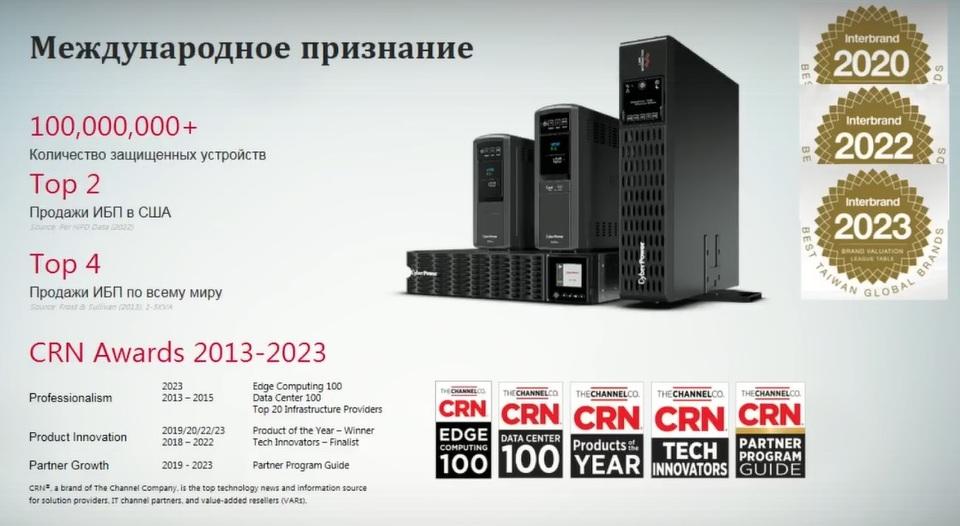
International recognition. The number of protected devices is more than 100 million, top 2 UPS sales in the USA, top 4 sales worldwide.
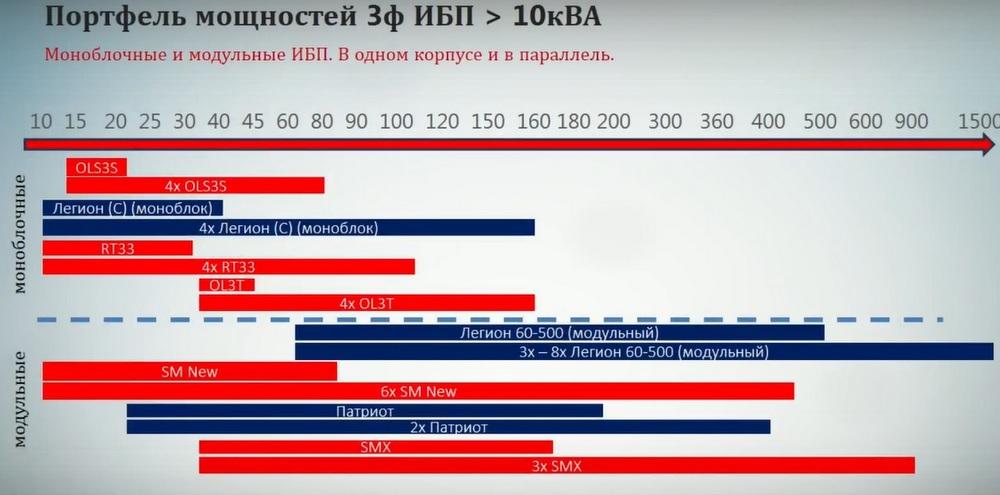
Let's move on to the products. In this slide, UPSs are marked in blue and red. Traditional CyberPower products are marked in red. Blue indicates UPSs localized in Russia - CyberElectro.
Here they are divided into monoblock and modular. At the top are completely monoblock UPSs, in which the failure of any component leads to the UPS definitely switching to bypass. Below are modular ones, they are of two types. Modular ones that can be bought as empty cabinets and filled with separate power modules. And UPSs already equipped with power modules. This is the Legion series. I will dwell separately on some of the models.
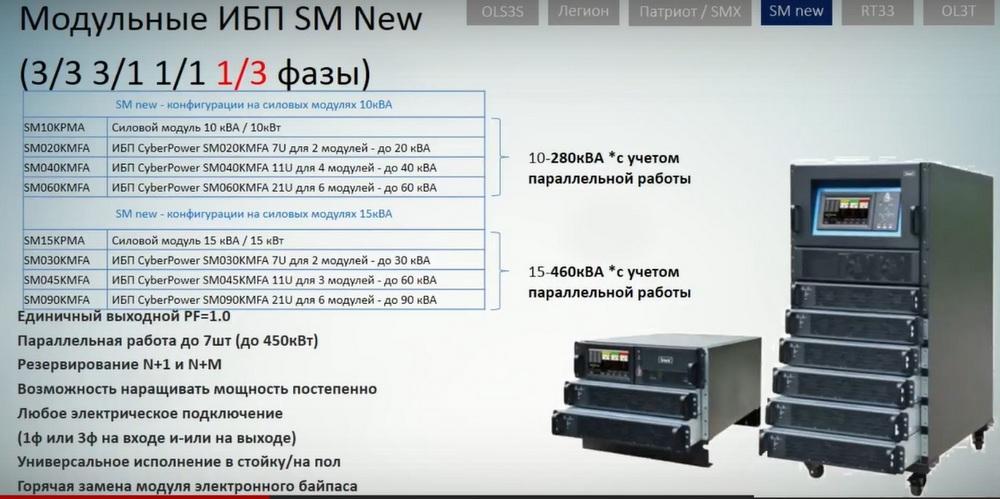
The new SM New series, as we call it, this module consists of two lines with power modules of 10 kilowatts and 15 kilowatts, each with three frames. What are its features? The power factor is equal to one, it can work in parallel up to 7 frames (up to 450 kilowatts), this is not very much, it is suitable for small data centers, while here hot replacement of all components and a single failure does not lead to either a stop in operation or protection, including battery power. That is, the UPS is fully reserved, a single failure of any component does not lead not only to a stop in the power supply of the load and its transfer to dirty power, but also does not lead to a loss of battery backup. In addition, this EBP can traditionally work 3 in 3, 3 in 1, 1 in 1, that is, you can make 450 kilowatts of single-phase load and even 1 in 3, that is, supply one phase, the oil industry loves this very much, for some reason they have one thick single-phase cable coming to the object and they get three phases from it.
Execution - in a rack and floor-standing. If you remove the caps from it, it will turn into a stand-alone UPS. There is also a reverse process, if we take it out of the rack, put on dustproof covers and screw on the wheels, then we get a separate BP. Works with any batteries, lead-acid, lithium.
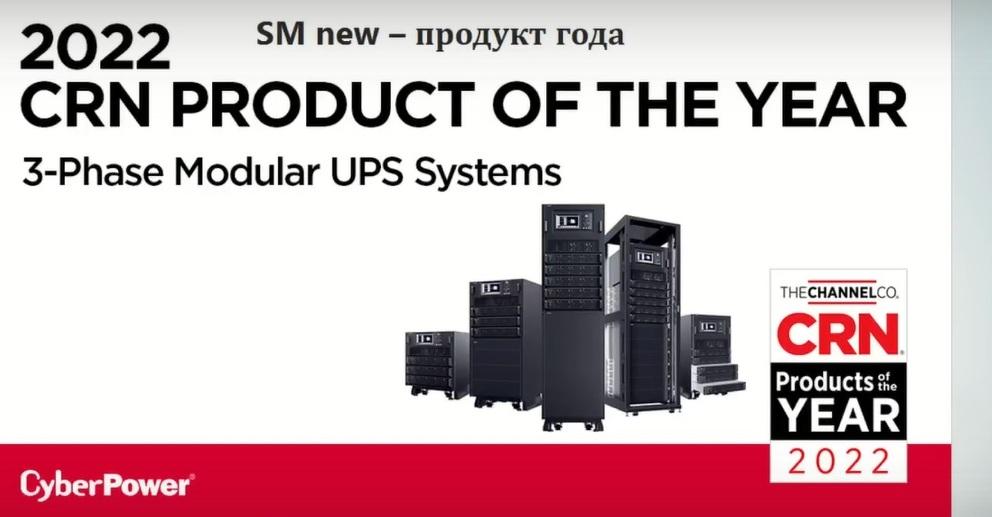
This product has already won the product of the year award for three-phase modular systems in the market where there are more data centers than in the rest of the world combined - in the North American market. This product is already available for order.
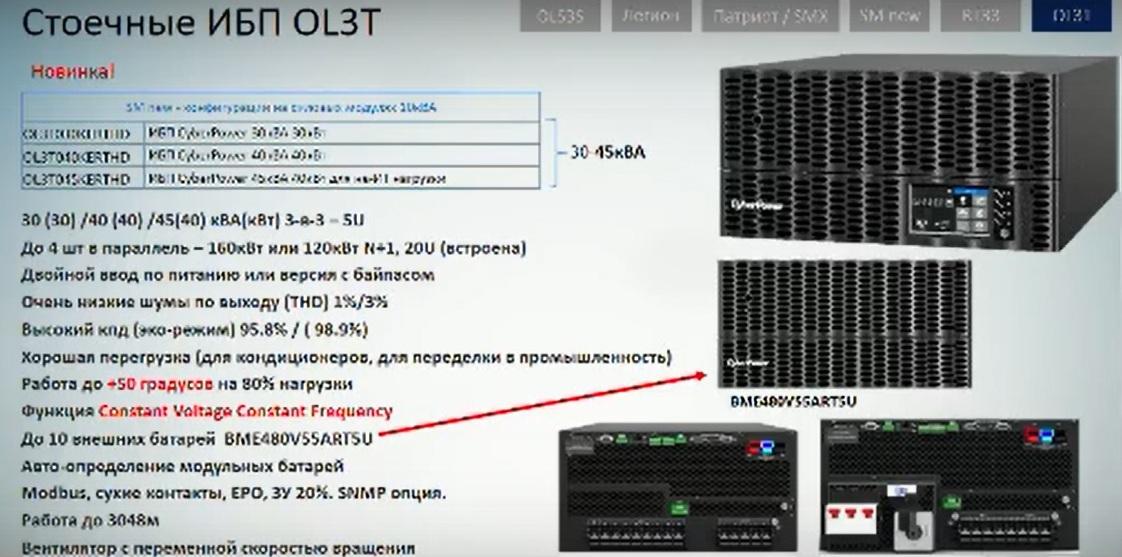
Another novelty. The OL3T three-phase rack-mounted UPS can also be conceptually installed in a rack, can be ordered as a floor-standing one, there will be a separate version with legs. What are the features? Only three models: 30 kilowatts, 40 kilowatts and 40 kilowatts for non-IT load. Works only: 3 in 3, takes up 5 units of space, 4 pieces in parallel, up to 160 kilowatts, also for small data centers. At the same time, there are two versions, either a double power input, this is slightly central at the bottom, or with a built-in mechanical bypass, this is the rightmost bottom picture. For this class of UPS, it has very low output noise (THD): 1 or 3% linear-nonlinear load. Very high efficiency in eco-mode. The percentages here are indicated for this class and price of UPS. These are very good indicators. Very good overload. For working with air conditioners, chillers or for using it in industrial devices, for example, sheathe it, put it in an IP54 case and you get an industrial UPS. Another feature is that it works up to plus 50 degrees at 80% of its nominal value. Why might this be needed? Of course, lead-acid batteries can fail very quickly in this mode of operation, that is, this is not a constant intended mode of operation, but lithium batteries will be able to work like this for a long time, supercapacitors will also be able to work at this temperature. And accordingly, in the case of normal operation, the UPS works with the air conditioner and the batteries with the air conditioner. But if the air conditioner fails, the UPS will not stop working. Until the service department arrives and starts the air conditioner, the batteries will also not fail in one cycle. Therefore, this is such a good function that makes it related to industrial UPSs. It is also related to industrial UPSs by the fact that it can operate at an altitude of up to 3000 meters.
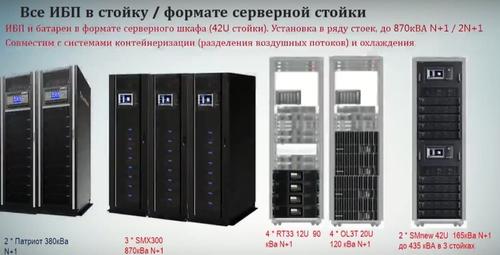
In this slide, we summarize all our "three-phase". We also have non-modular "Legions" and modular "Legions" that are simply placed in gray space or in a data center room, but not in a row of racks. There are five different UPS lines, which are either in the server rack case, these are the first two UPSs, "Patriot" and SMX300. Or they are installed inside, like rack-mounted UPSs. That is, for a data center, for installation in a row of server racks, we have 5 different products, and stable solutions can be built on all of them. Not only 2N, N+ is indicated here, the limit at N+. Accordingly, we will also assemble 2N on any of our solutions, simply by doubling the number of UPSs on two branches.
Five fundamentally different products. Let's go through them separately.
The first, modular UPS Patriot, formerly SM200: 200 kVA, 180 kilowatts in one cabinet. Two UPSs can work in parallel. Hot replacement of power models, replacement of electronic bypass and brains.
Next, the SMX300 UPS, 300 kilowatts in one cabinet, three pieces can work in parallel, up to 900 kVA. Here, hot replacement of power units and replacement of the electronic bypass without interrupting double conversion is also possible, but it is quite complex and requires either separate training or a service department visit. But in principle, a single failure of any component does not lead to battery protection and double conversion protection.
The next UPS, the RT-33 rack-mounted, three-unit UPS, up to 25 kilowatts in one case, up to 4 pieces in parallel, respectively, either 100 kilowatts, 4 pieces, or 120 kVA. Next, the OL3T, which was on the previous slide, here it is shown that 4 UPSs fit in 20 units, this is 120 kW with N+1 redundancy.
And the last SMnew here is also the limit, if we just fill one rack, then we can put two by 90, and it will be 180 kilowatts or 165 with redundancy. And accordingly 6 or 7 UPSs, here we are waiting for clarification from the factory how many cases in parallel, that is, formally there should be a maximum of 450 kilowatts in parallel, how many 6 or 7 cases, you need to calculate. But formally, you can make 435 kilowatts N+, in three racks.
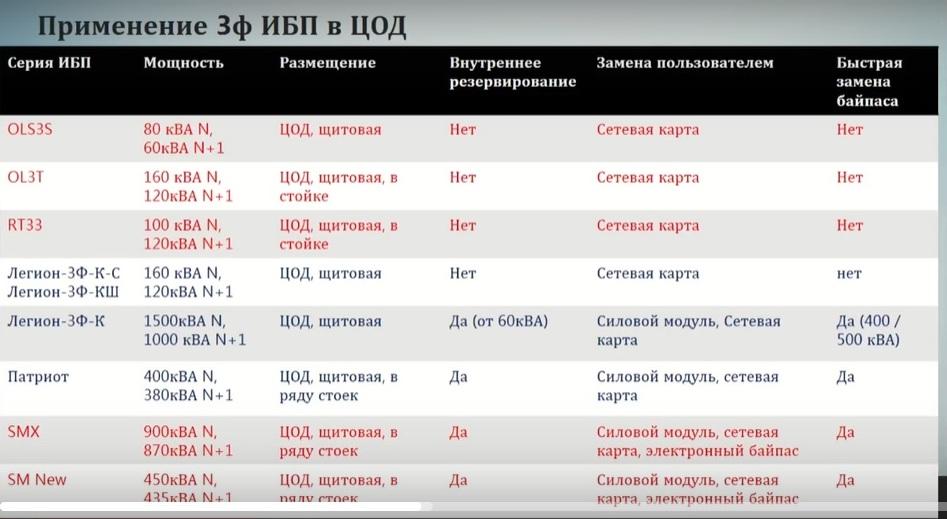
Summary table of all UPSs. Blue is CyberElectro, red is CyberPower, with maximum power, and where they can be placed in a row of racks, in a data center, in a switchboard room, or for general industrial use. Are there internal redundancies, meaning power modules, everywhere there are, power modules are replaced "hot-swappable". What can the user change in these UPSs? Independently, without training. We see only a network card in non-modular ones, in power modules, power modules are "hot-swappable", where the electronic bypass is changed hot-swappable, electronic bypass. Separately, our most powerful Legion 400-500 electronic bypass can also be quickly changed with a transfer to dirty power, but quickly enough, also a separate procedure.
Today we want to look at our comprehensive offer for data centers. In addition to many other intelligent functions that are in our three-phase UPSs, we have a hardware and software function. The "Legion" series UPS starts from 60 kW up to 500 kW.
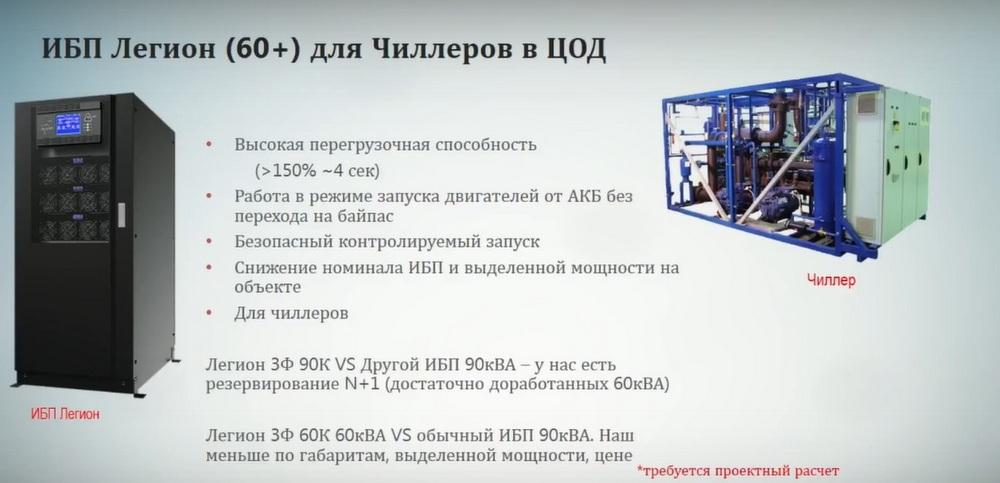
A special motor mode, fine-tuning to a load with a high overload current, is performed by a specialist, it is better not to turn it on thoughtlessly right away, but if you need and want to resize the UPS for a chiller, compressor, or even in industry, then we are ready to look at the project with you, look at the motor nameplate, read our internal documents again, and accordingly select a UPS so that in overload capacity it can work more than one hundred and ten percent for more than four seconds. Fine tuning, commissioning, testing. And thus, do not resize the UPS compared to others, with competitors, for example. What does this give us? Reducing the cost of the UPS itself, reducing the thickness of the wires, reducing the rating of the circuit breaker. Or if we still played it safe and still took the UPS at its nominal value, then we have an extra power module.
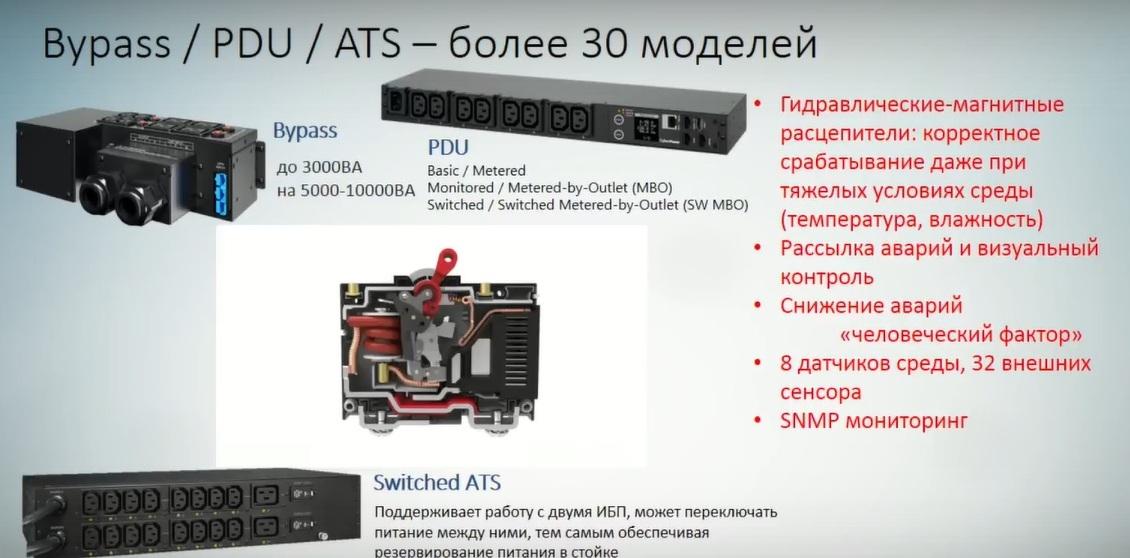
The following products for data centers are PDUs and ADS. We have many different PDUs, different series. From the names of the series it is clear what they are: Basic, Metered, Monitored, with measurement for each outlet, with control of each outlet, and combined. That is, everything that can come to your mind, what kind of PDU you need, we have them all. Horizontal, vertical, single-phase, three-phase, including up to 22 kilowatts, up to 44 outlets.
There is also a hydraulic magnetic release, that is, a circuit breaker that works correctly at high temperatures, which is typical for modern hot data centers. The hydraulic circuit breaker does not trip falsely. When triggered, and there may be several of them, it can be quickly returned to its original position, unlike traditional simple automatic releases, and accordingly, after an accident, when part of the outlets on the PDU tripped due to a short circuit or overload, you can very quickly return everything back after eliminating the accident, unlike inexpensive PDUs, which have a standard circuit breaker. In addition, all our PDUs are intelligent, they have a connector for network cards, you can connect a temperature sensor and an environment controller to them. They have intelligent functions. And they can send out information about an accident. On the screen you can always see what is happening with the PDU, the color is not only the LED, but also the large screen, what happened can be understood from afar. Warning of an accident or normal operation. And, of course, centralized monitoring via SNMP protocol is also possible. You can connect 8 environment sensors and up to 32 sensors, all this to one PDU.
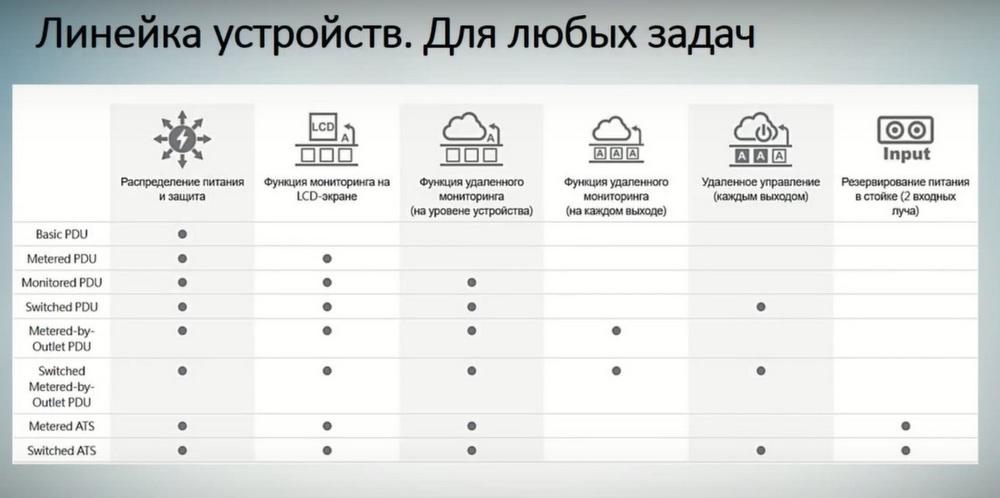
Here is a brief overview of our PDU and ADS product line by function, respectively, the name of the line and what functions are included in it.
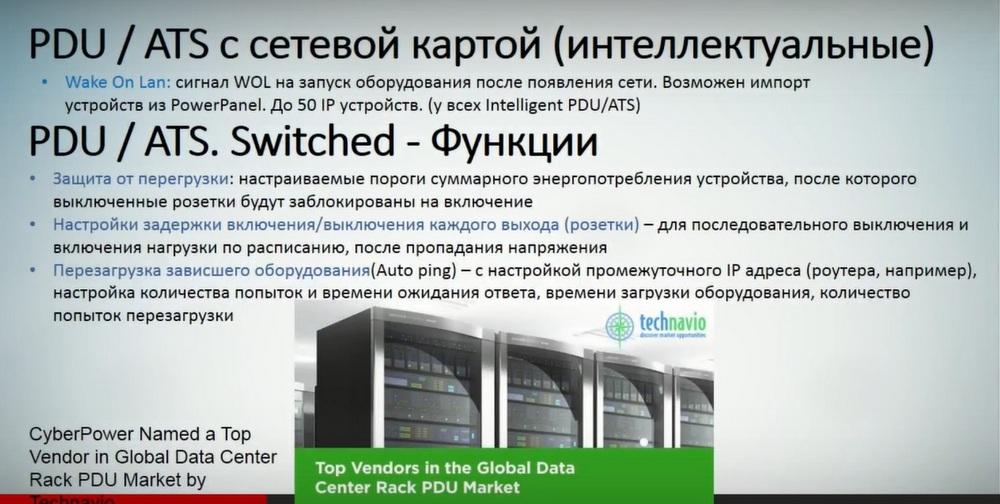
Intelligent functions of our PDUs and ADS. All those who have a network card have the Wake On Lan function, that is, "wake up the servers" that did not wake up because the power returned. That is, servers usually start when power returns, but not all. Our network card can store up to 50 servers inside and wake them up upon power return. And all PDUs that have a controlled outlet have several more intelligent functions. This is overload protection, that is, as soon as the load on all the included outlets reaches a certain limit, say 90%, it will not be possible to turn on new outlets in order not to "drop" the PDU and ADS into overload. Further, you can individually configure each outlet for a delay in turning on and off, according to a schedule after a voltage drop. And the last intelligent function is the reboot of frozen equipment - autoping. The PDU or ADS stores IP addresses that are tied to specific outlet outputs, pings them constantly. If after a series of pings the server still does not respond, the PDU simply turns off its outlet, waits a bit, turns it back on, the cycle repeats.
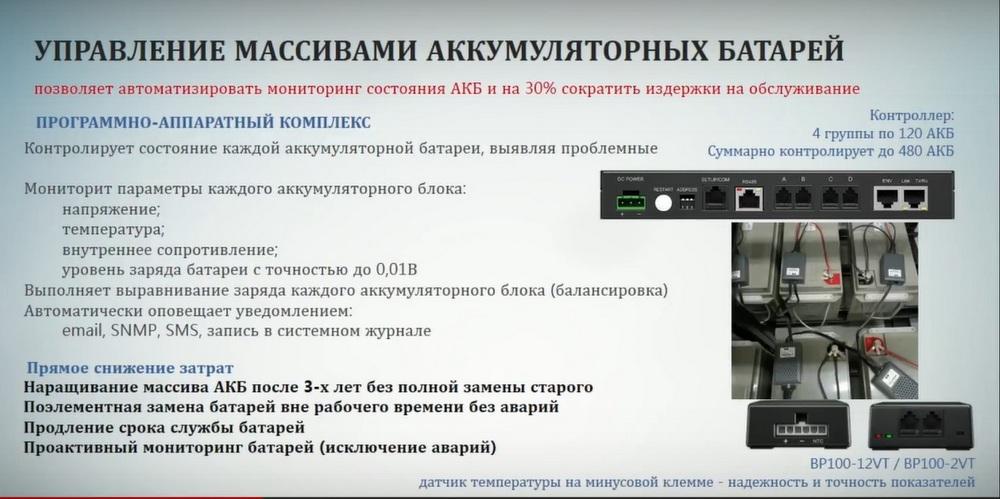
Let's move on to BMS (Battery Management System). We independently produce our own BMS system, which allows you to monitor a battery array. In the photo above is the controller, at the very bottom are the sensors that are hung on each of their batteries, and approximately in the middle of the photo, this individual sensor hangs on each battery on large batteries.
BMS is a battery management system. It monitors voltage, battery charge level, and temperature with high accuracy more often than once a minute. It periodically measures the internal resistance of the batteries and thus constantly monitors the health of each battery. With the BMS system, this control is carried out constantly. Battery states are constantly recorded, tracked, and boundaries are set. Why is this? Equalization of charge when charging batteries. Each sensor can shunt up to 1 amp bypassing the battery. Thus, if some battery is charged earlier than others, and as you know, the charging current of a lead-acid UPS goes to all lines at once, we can’t do anything about it, feedback only on the total battery voltage by temperature. Somewhere in the middle of the battery array there is one sensor. And the batteries that fail earlier, firstly, we don’t know about it, secondly, the rate of failure increases exponentially, because they are all charged at the same current, if some battery has already been charged, then there can be two scenarios. Either the UPS will turn off earlier, respectively, the other batteries will not be fully charged if one is overcharged. Or the UPS will continue to charge the remaining batteries, but then this battery, which was charged earlier, will be overcharged. What is undercharge, what is overcharge, failure will be enhanced. That is, one battery will drag everyone along. That is, if one battery starts to degrade in a traditional scheme, then after some time after deep charge-discharge cycles, unsupported, all batteries will deteriorate approximately to the level of this worst one. Which is not very pleasant. BMS allows you to eliminate this in several ways. Firstly, balancing the batteries during charging. Secondly, constant measurement of voltage and internal resistance, some call this SOH (State of Health), that is, battery health. This will allow you to see in advance that one of the batteries is starting to fail, but it will fail alone, because we have balancing. And plan in advance when you buy a new one, and then in non-working hours, in order not to lose reservation, you can safely change only one.