A joint event by OCS and "BaseALT SPO", the developer of the Russian "Alt" operating systems, which allow creating IT infrastructures of any scale.
What we are talking about today:
- The "BaseALT SPO" company and its place in the modern IT market;
- Characteristics, features and advantages of the "Alt" operating systems;
- "Alt Server" OS. Alt Domain / MS AD, Samba, ADMC support;
- OpenUDS VDI broker;
- Domestic operating system "Alt SP" release 10;
- Our assistance in implementing "Alt" OS to cloud users;
- Deployment of virtual machines from templates;
- Simplicity of technological partnership with "BaseALT SPO";
- Benefits of technological partnership with "BaseALT SPO";
- How to become a technological partner;
- Opportunities for technological partners, levels of integration with "BaseALT SPO".
Lissa Oparina, Partner Relations Manager, with resellers and distributors, started today's meeting.
The "BaseALT SPO" company was founded in 2001 and was then called Alt Linux. In 2015, a rebranding took place and the name was changed to "BaseALT SPO". Our product is the Alt operating system.
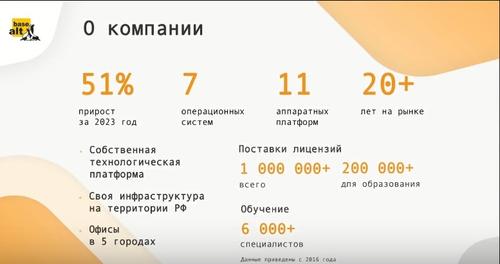
We have our own development platform with a full life cycle, equipped with our own assembly, testing and integrity control tools. Our peculiarity is that we are not a clone of any foreign operating system.
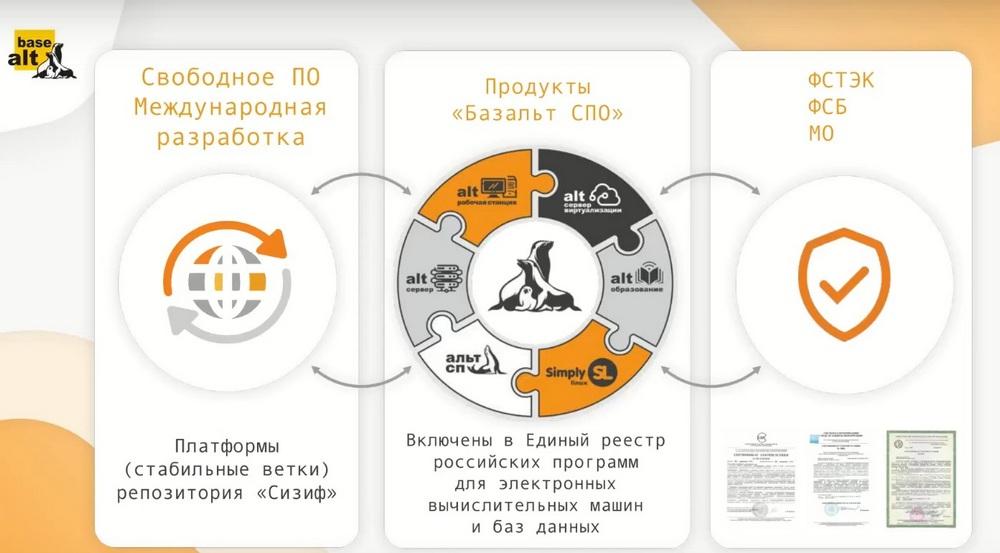
We have our own international independent project "Sisyphus", which we use as a basis for building all operating systems of the Alt family. All our products, except Simply Linux, are included in a single register, which is confirmed by certificates in the FSTEC, FSB and Ministry of Defense. Our products are presented here.
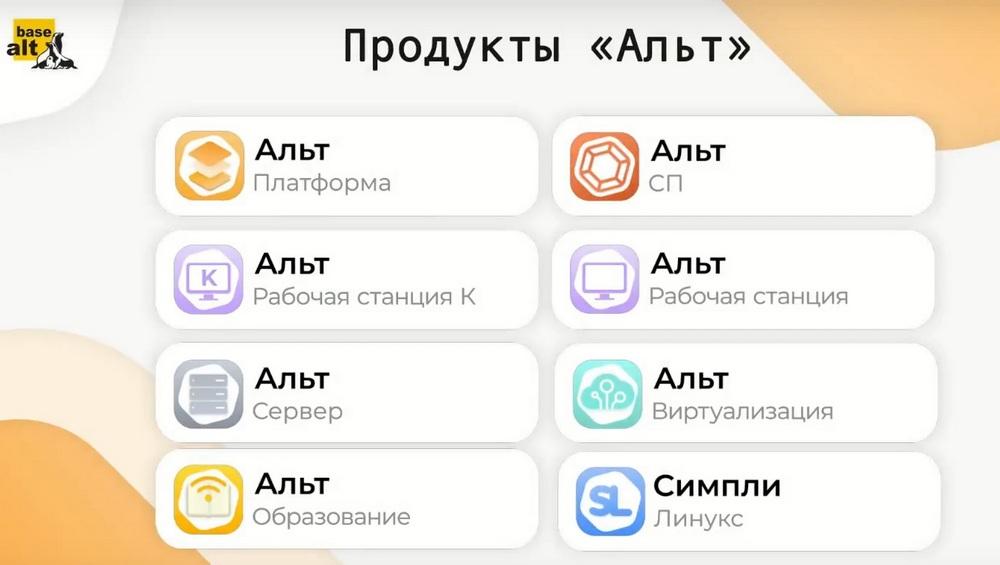
The first is the Alt Platform. This product was released in February of this year. This is a technological complex for assembling general system and application software and releasing distributions. Alt SP is our flagship, a distribution for servers and workstations with built-in information protection tools that are certified by the FSTEC. Next come uncertified products, Alt Workstation, which, depending on the graphical shell, is divided into Alt Workstation and Alt Workstation K. Alt Server is a distribution for building a server infrastructure.
Alt Virtualization is a distribution for building a virtual environment. Alt Education is a license for educational organizations and Simply Linux is the only product that is not included in the register and is available for download on our website.
Colleagues, I give the floor to Pavel Lukiyanchuk, Partner Relations Manager, "BaseALT SPO".
Pavel Lukiyanchuk began his story about the sale of Alt operating systems specifically among cloud providers. Who are cloud providers? These are those who have data centers, have cloud platforms on which they provide their users with a service for providing capacities on which the infrastructure is deployed. The most well-known platforms are Yandex, VK, Megafon, MTS and others. Surely in your work you may have met or will meet some cloud providers as your clients who need an operating system to expand their services. Because for any end user who uses the cloud service, he, of course, needs an operating system on which he will work. In general, we have several operating systems, but two of them are used on cloud platforms.
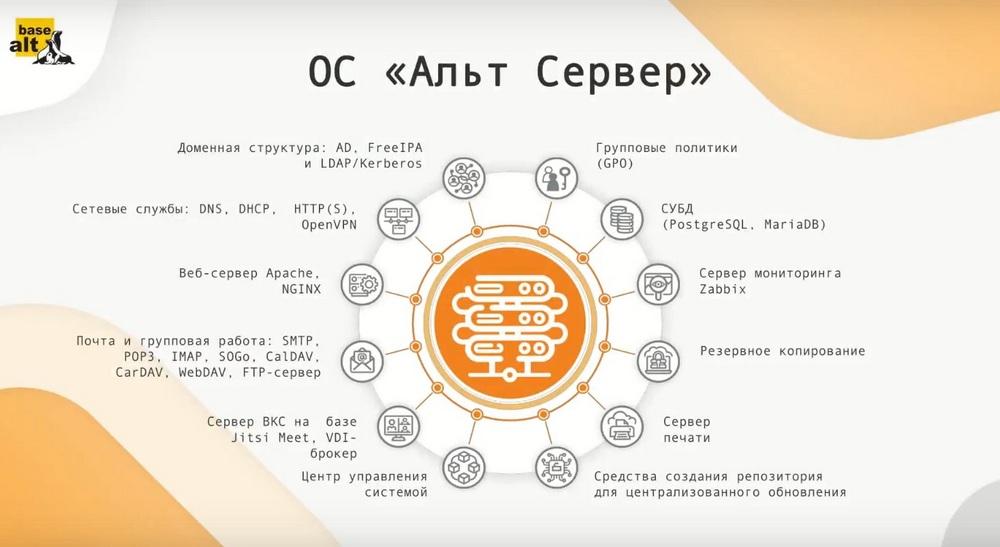
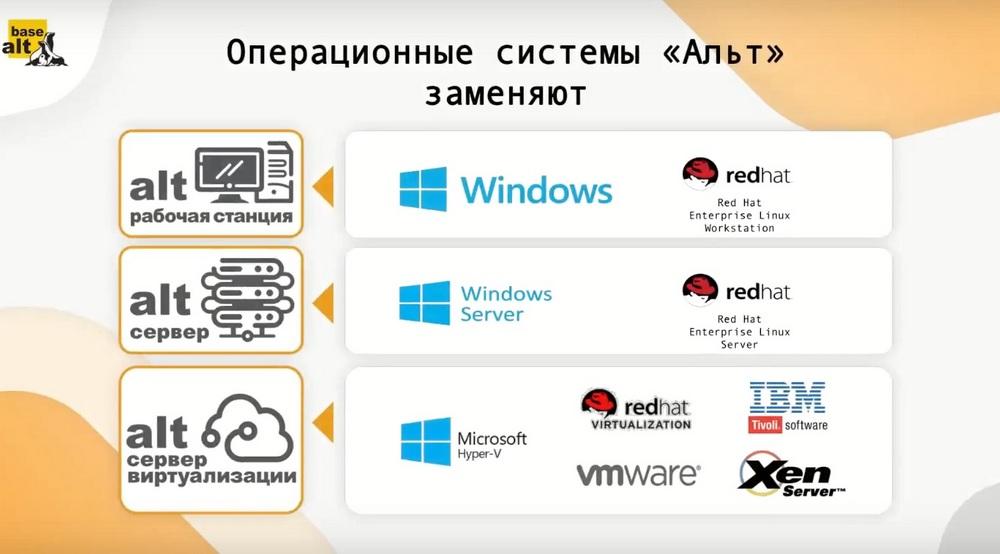
These are two server OSs: Alt Server - regular and Alt SP Server, which have an FSTEC certificate and built-in protection tools. What is the main advantage of Alt Server? This is support for the Windows domain controller, which is called Microsoft Active Directory. Alt Server is a server operating system that has all the necessary set of functionalities that are necessary. That is, this is a mail server, this is a monitoring server, backup, VCS server, print server, various external services, such as DNS, and domain controller support. That is, all this is included in the functionality of this operating system. That is, it has all the necessary set of functions that are needed, in principle, by any customer. And it completely replaces analogues of foreign manufacturers, such as Windows, in particular.
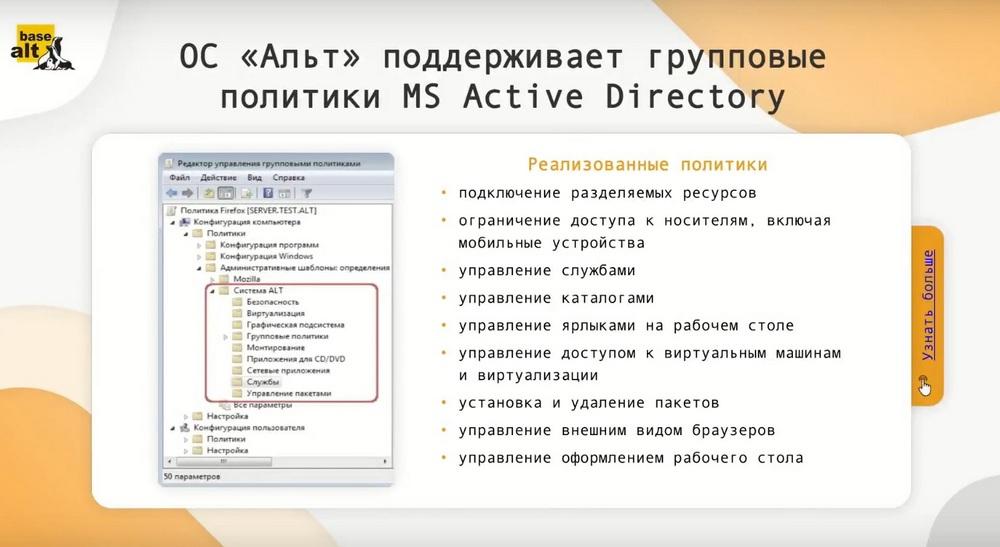
What is the advantage of supporting the Windows domain controller? What is a domain? These are all the workstations that are part of the company's IT infrastructure in the cloud. These are servers, workstations and what unites them. The software that allows you to set different settings for different workstations is called the controller of this domain. Well, as an example, let's say there is a company, it has an accounting department. Accountants have some of their own settings, their own access rights. The sales department has access to some advertising materials for clients. Marketers have their own rights, financiers have their own. And so on. That is, the program that allows you to create all these settings is called the domain controller. And it is clear that the absolute, overwhelming majority of end users in the cloud use or used Windows. And it is clear that when they already know it well and have been working on it for 30 years, then switching to the Linux operating system is a big problem, and these are very big risks, both of the transition itself and of the loss of data. And with this transition, of course, there is always a great risk that the company's work may stop and the company will suffer losses. So, the support of this Windows domain Microsoft Active Directory allows you to migrate from Windows machines to Linux seamlessly, that is, smoothly. That is, you can introduce machines on Linux into the existing circuit. And they will work simultaneously in the same network. This is called support for heterogeneous networks. When machines on different operating systems work in the same infrastructure. And this is very important. Therefore, this is the most important advantage that I would like to note. And therefore, a user who uses the services of cloud providers and works on Windows, he can gradually introduce Linux machines into his circuit, manage both at the same time. And then, if desired, for example, in 10 years he can already, when he understands that he is working calmly on Linux, he can turn off the Windows machine.
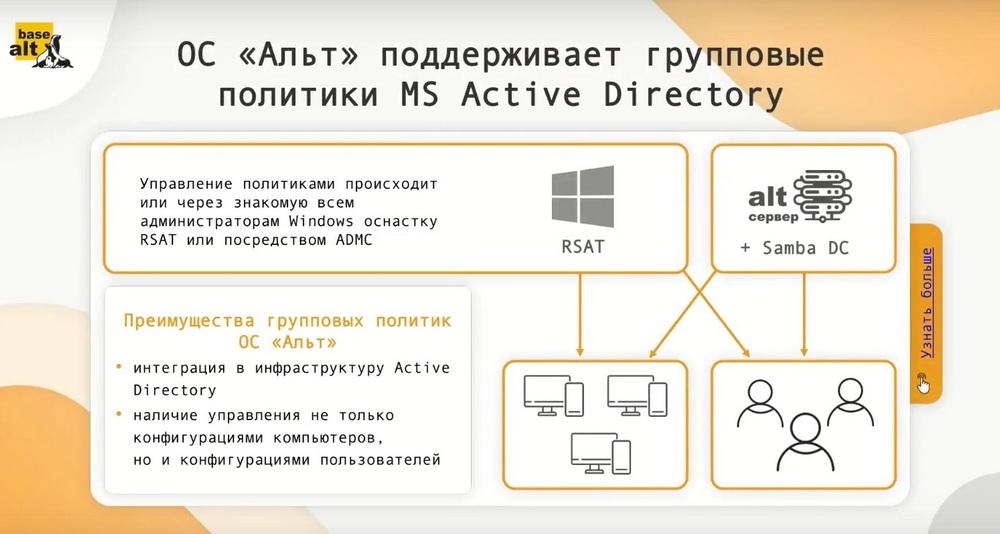
All our competitors, such as American ubuntu, fedora, do not have such support. There, migration is possible only in a rigid format. And this is a very big risk. The tool itself, which allows you to introduce new users into the domain, give them access rights, give them some passwords, in Windows it is called RSAT. This tool is very familiar to all Windows administrators. Our tool is called ADMC. Functionally, it does the same thing. Administrators say that it is even intellectually a little simpler. That is, it contains a more understandable interface. But in general, both of these tools can work simultaneously in the same network and not have any problems. In addition, we can drive not only machines, but also users.
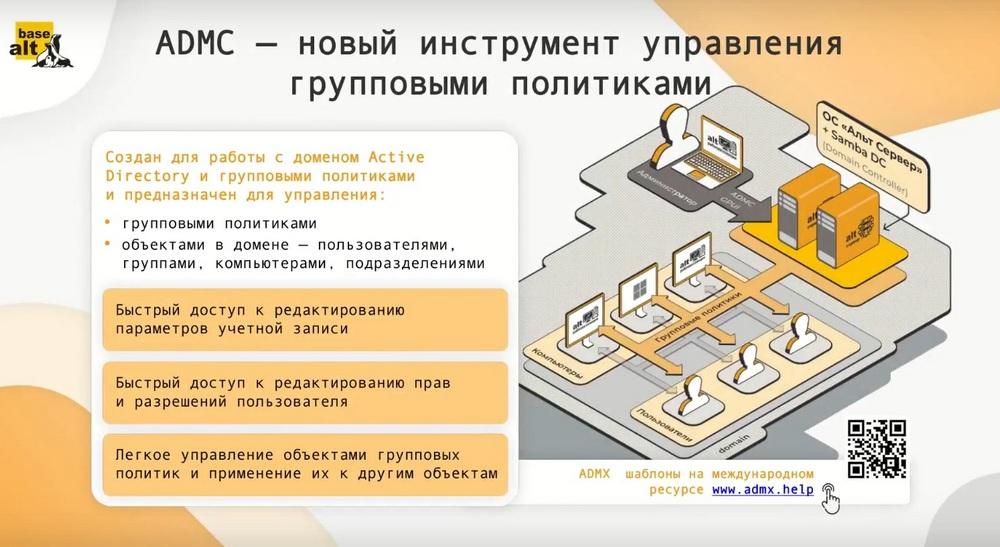
For example, if an employee of any company has one laptop at the dacha, another in the office, and a third in the city apartment. He is assigned scientific data, he can enter them from any machine and immediately find himself in his workplace, which is located in the cloud. This is very convenient and it solves any situation when a person can be anywhere.
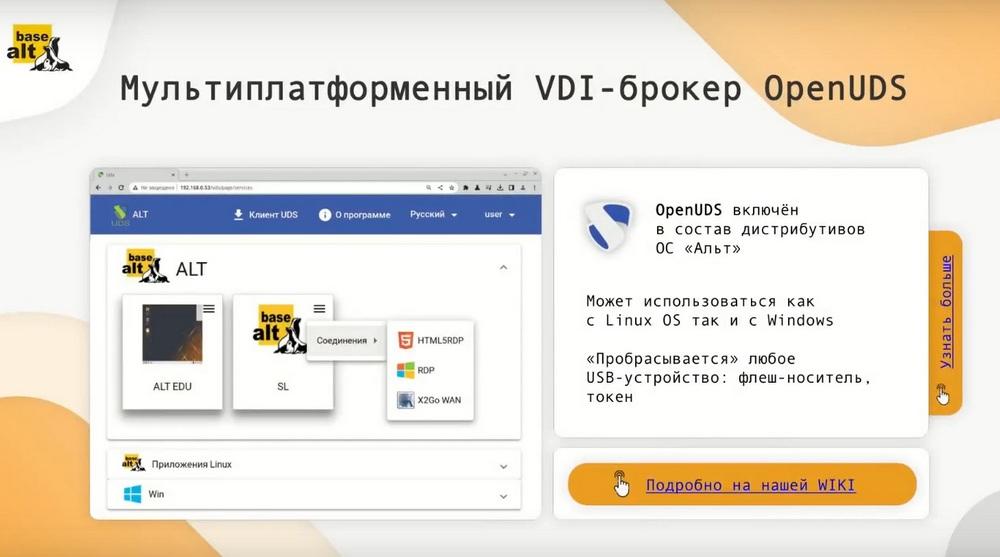
I would like to note the multi-platform VDI broker OpenUDS. It is needed in cases where there are already many virtual machines in the cloud. And in order not to mess with each machine separately, it allows you to systematize the work with a large number of virtual machines. Well, it is clear that for us, maybe, this does not say much, but administrators, namely network administrators of any company, they understand what we are talking about, and this is important for them.
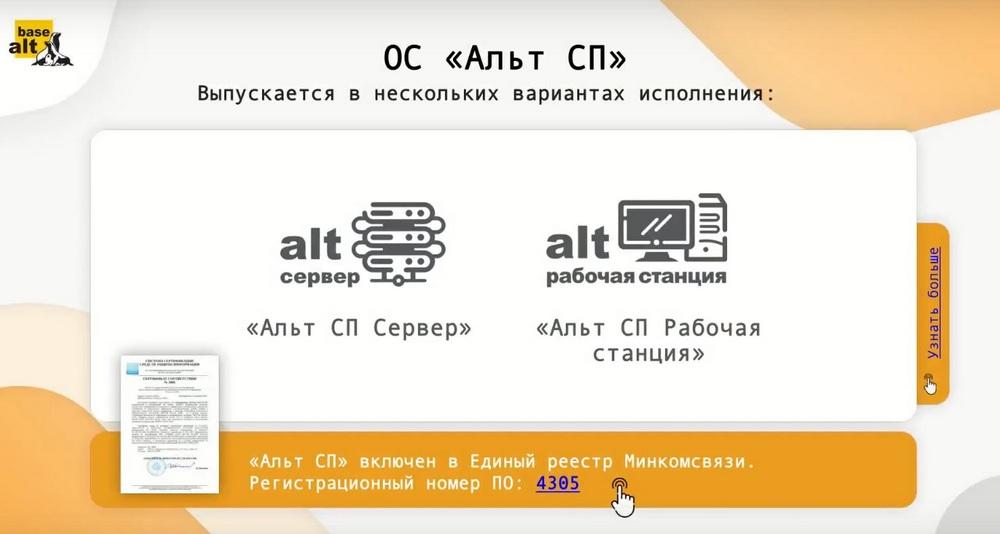
Alt SP Server functionally is exactly the same operating system as Alt Server, but has built-in protection tools and meets the requirements of various regulators. It has a certificate from the FSTEC, FSB and the Ministry of Defense. What is important, in order for you to, let's say, sell operating systems to cloud providers, you do not necessarily need to understand them so deeply, since these can be administrators.
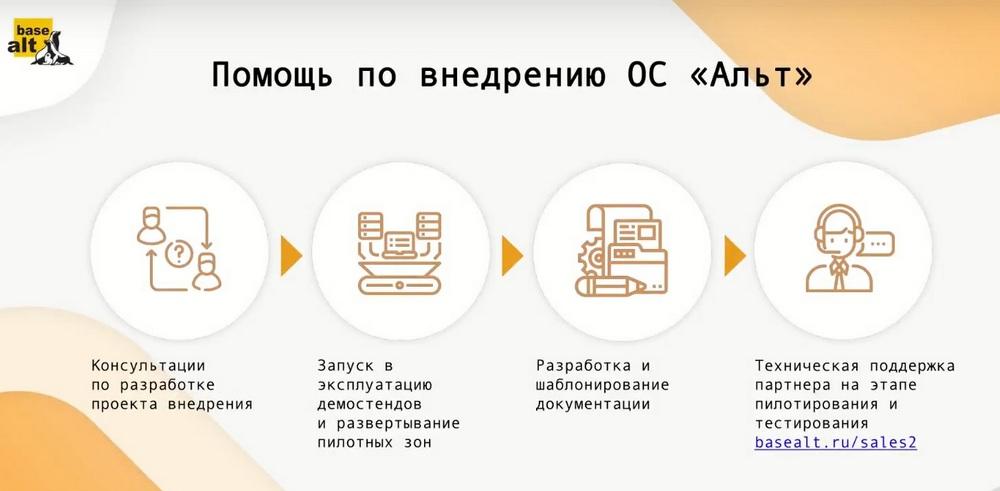
That is, therefore, we are not going so deep now, but if suddenly there are any problems in your projects in the cloud, then we are always ready to connect. We have our own support platform, you can contact there. The end customer's administrators can write there, ask questions, get answers. That is, we are always ready to connect to certain projects. Let's summarize what has been said.
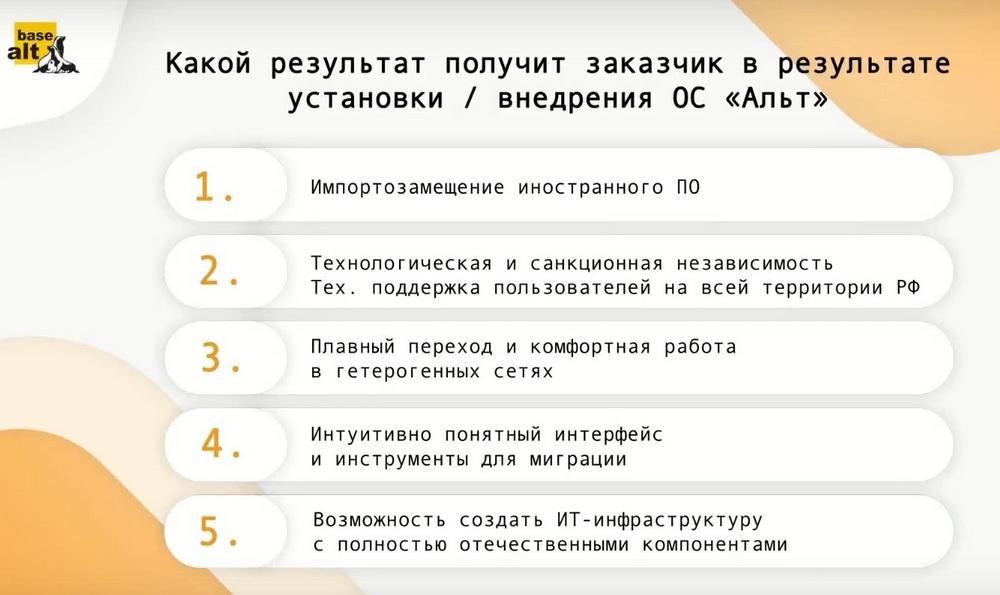
So, what result will the customer get as a result of implementing our information systems in the cloud? Compliance with the government's import substitution order, because our server operating systems, including cloud-based ones, are included in the register of domestic software. Secondly, since we have our own repository located within the country, there is absolutely no risk that we will be disconnected from it. Third, it is a smooth transition from foreign operating systems to ours. Intuitive, understandable interface, intuitive, understandable migration tool and the ability to create an IT infrastructure with completely domestic components.
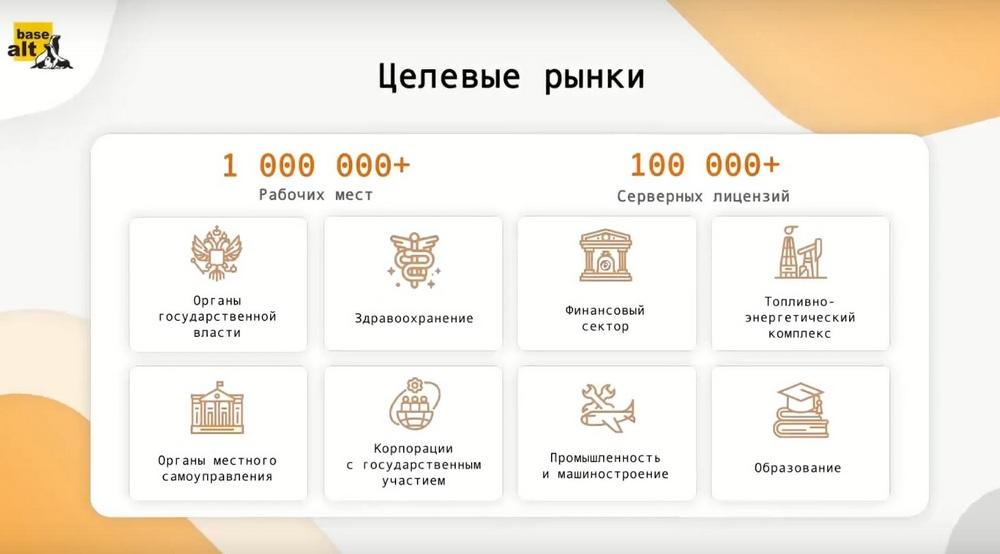
What are our main markets? It is clear that small and medium-sized businesses are not yet at the forefront of switching to the Linux operating system, but companies with state participation, authorities, healthcare, education, the fuel and energy complex, and so on, some large factories, banks, are now all switching to domestic software in accordance with the government's order, so these are our main target markets.
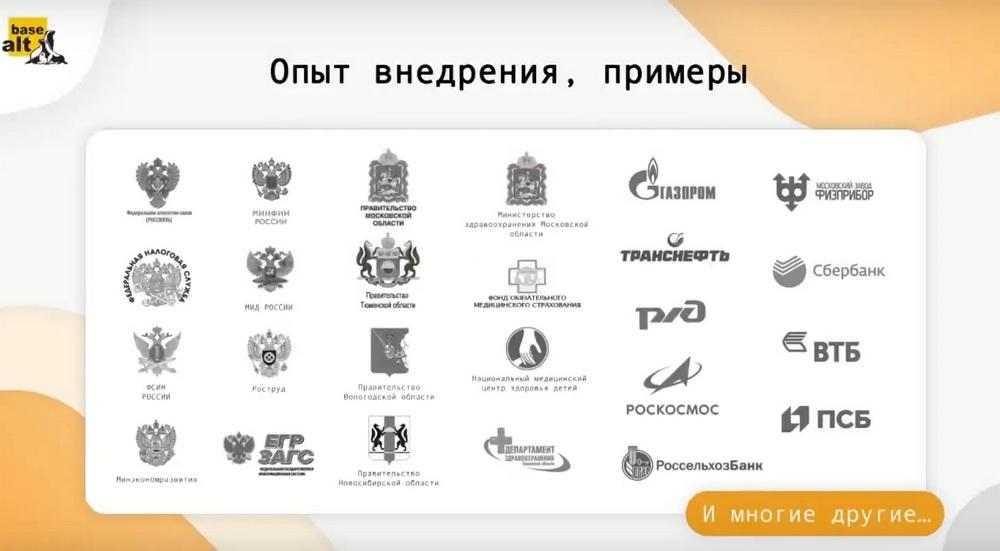
This slide shows examples of our customers. Once again, our operating systems in the cloud completely replace foreign counterparts, including Windows.
Competitive advantages.
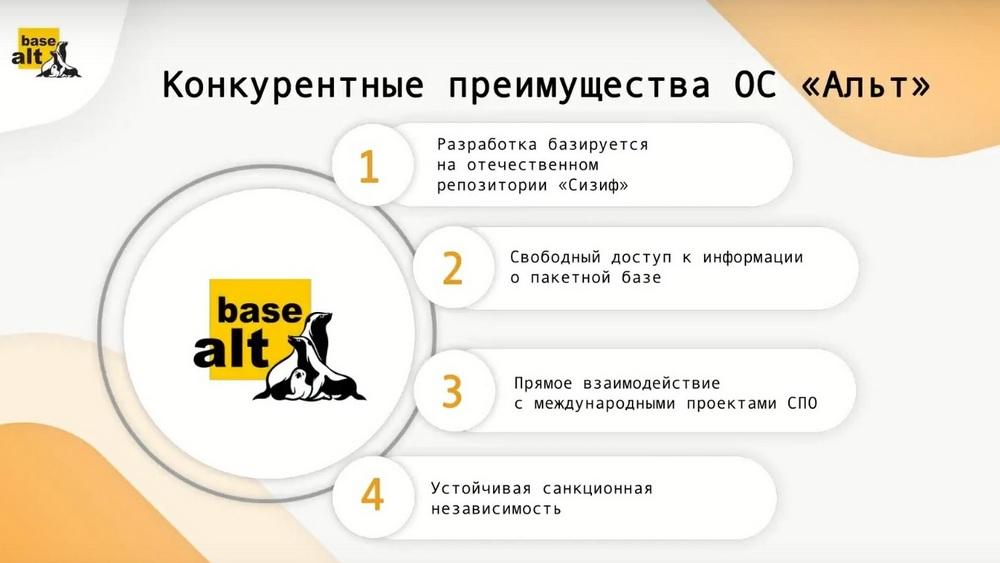
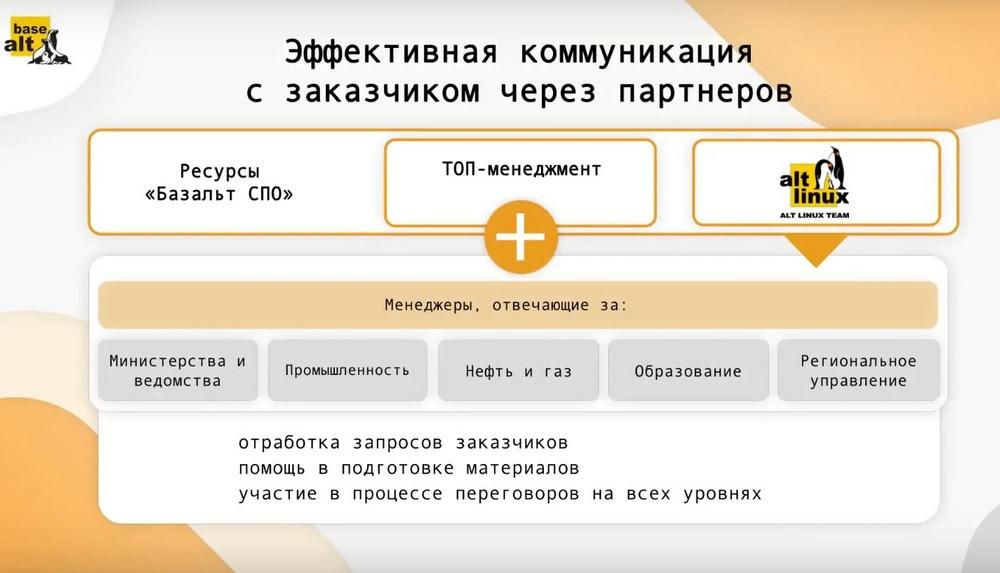
I have already said that our development is on our repository. There is free access to our repository. Even those who have not yet purchased the distribution have access to it, only want to test and see how it works in the cloud. Everyone has access to the repository. Well, and sustainable sanctions independence. What else? If suddenly the end user of the cloud turns out to be some large client with thousands of jobs, i.e. such as factories or mining enterprises, and so on, with a large number of employees, then a special manager can be assigned from us who will deal with this project. But it is clear that all commerce and shipments will also go through you, through distributors.
No operating system would have value if it were not compatible with application software. Therefore, we are doing a lot of work on this topic. Only some examples are listed here, such as office suites, antiviruses, and so on. But this is a very important piece of work. Denis Kropivnitsky is in charge of this.
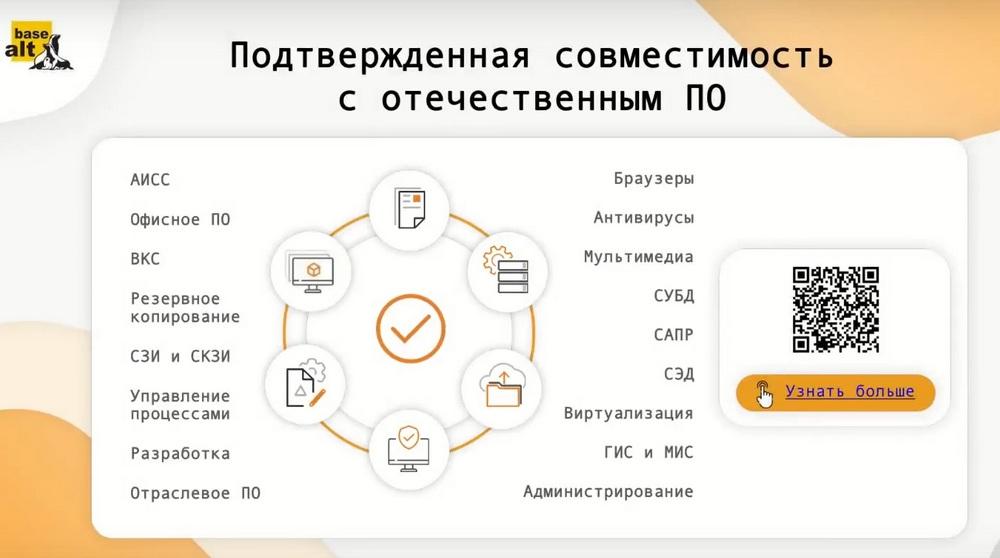
He will tell you a little more about this. Here are just a few examples of who we are compatible with, including Consultant+, Kaspersky, Garant.ru, and so on.
If a user wants to try working on our operating system and starts implementing it in the cloud, and something does not work out for him, he can safely contact us. The very fact that there is technical support for end customers is a mandatory point, because American vendors, such as Ubuntu, Fedora, and so on, do not provide support. And if something "doesn't take off", there is no one to write or call. You can spend two months and not solve anything, because it is not immediately obvious what, in fact, is the "stuck". By contacting our support, you can quickly solve some issues at the time of implementation. And this is very important.
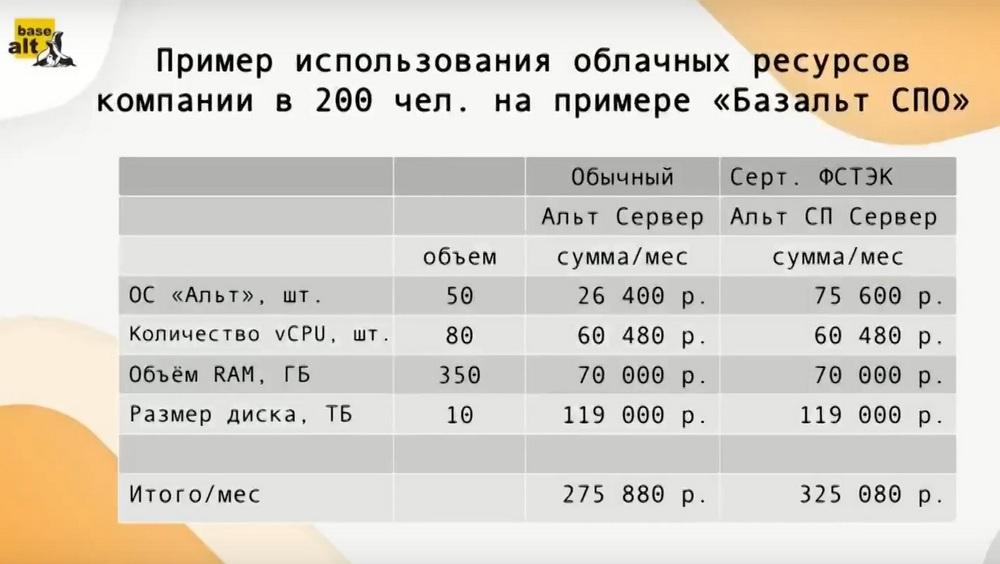
Here are small numbers, that is, what percentage of the turnover is added by sales of operating systems. It is clear that cloud providers are mainly focused on selling their core business, cloud resources. But, nevertheless, the operating system is essential for using cloud resources and therefore it adds somewhere around 10-15% to the turnover.
Therefore, you will probably have cloud providers appearing on the horizon as your partners. Well, and of course, this will also be a plus to your turnover.
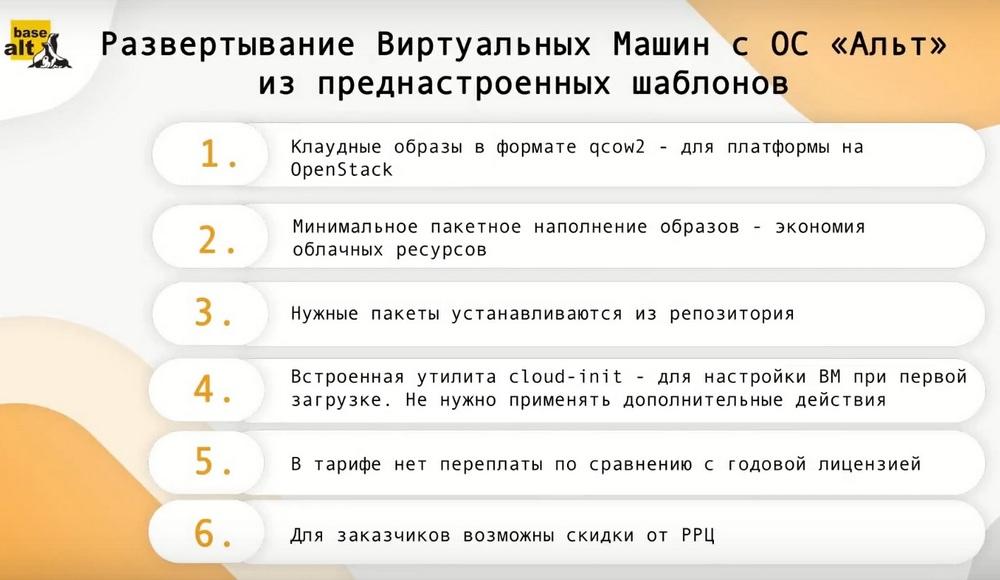
And this slide talks about why it is convenient for customers to deploy virtual servers in the cloud from pre-configured templates. That is, what does it look like? That is, on the cloud platform there are some already pre-configured operating system templates that allow you to create virtual servers with the click of a button. You don't need to, let's say, solve some quests, because each platform has its own deployment requirements.
And if the end customer's administrators do not have sufficient qualifications, they may simply not understand how to run the OS on a particular platform. This work has already been done for them, deep testing of these templates has been carried out, so it is enough to simply press one button, select resources for deploying the virtual machine and it is immediately created, in one minute.
The second point is that cloud providers do not sell annual licenses, as the rest of the market does. There, the pricing is either daily, hourly, or monthly, depending on who. But our rates are such that at the end of the whole year, the end user pays the same money if he bought an annual license on the market. There is no difference. Working according to this scheme, which is called pay-as-you-go, is more convenient for the customer, but if you also sell our operating systems in the same format, this is a plus to the turnover.
And there is also such a thing as package fillings. For a cloud operating system, they have a minimal package filling so as not to waste cloud resources on unnecessary packages. The most correct format is this, that is, a minimal operating system is installed and then only the necessary package from the repository is already installed in the second step and thus no extra cloud resources are wasted, which means the budget is saved.
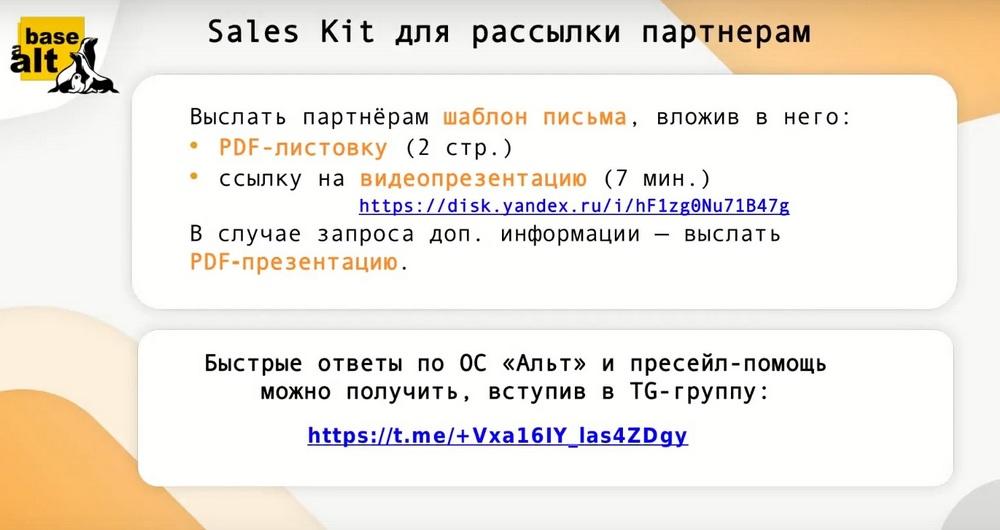
What Sales Kit do we have? We have a short 7-minute video that you can send to your clients, if you have any partners who are cloud providers or who simply work with them, then you can give them a link to this video. There is a certain letter template, where it is very briefly and succinctly written why our operating systems are needed in the cloud, what tasks they solve. Well, there is also a more in-depth pdf presentation, but it is only needed if the customer has already shown interest and wants to learn more, that is, there is already a presentation with links with a more detailed explanation.
I give the floor to Denis Kropivnitsky, manager for working with technological partners, "Basalt SPO". He will talk about technological partnership.
Good afternoon, my name is Denis Kropivnitsky. In our company, a lot of attention is paid to this division, we value our technical partners no less than ordinary partners, because we all understand that a developed ecosystem is very important both for our partners and for us. And, of course, in the end it is important for our clients. Colleagues, many partners who come to us, first of all ask the question, how easy is it to become your technical partner. It's really quite easy. First, you don't have to pay anything. We have already written some instructions for you on how to conduct testing.
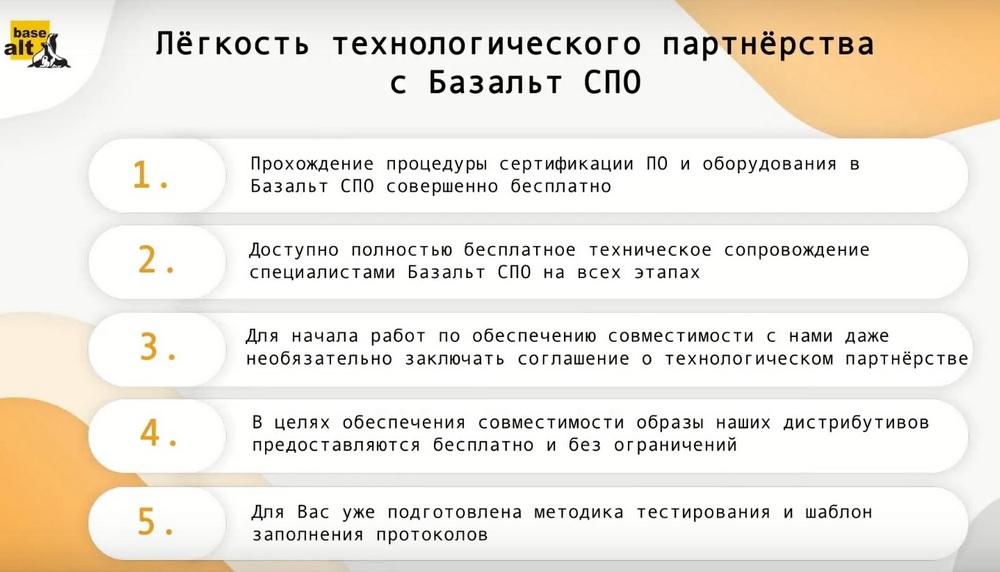
To start work, you don't even need to conclude any agreement with us, if you don't want to. In principle, there is no direct need for this. That is, you can start working right from the start. All our images, distributions for work are available on the site, at least the basic ones. There will be no problems with this. Among other things, we have a methodology, templates, at least for equipment, they are written and you can use them. At any stage of your testing, our technical support will be available to you, which is also important, because sometimes there are difficulties, problems with software adaptation.
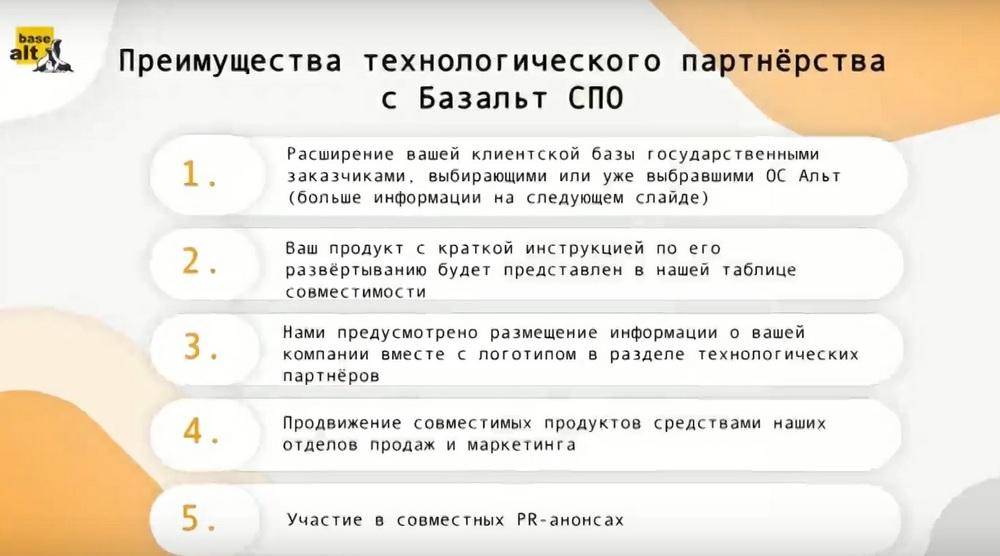
What are the advantages of a technology partnership with Basalt SPO? First of all, as I said, you are definitely expanding your base of potential customers. That is, it is clear that now our software is located and operated in many organizations. Therefore, if you want your software to be further operated, then of course it is better if it is compatible with Basalt products and this will greatly simplify life.
In addition, as soon as you have achieved compatibility with our software, we post instructions for installing your software on our website. This is a kind of advertising, it simplifies the life of customers, customers always react positively when they visit our website and see that your software has already been adapted, that is, they understand that you are on the list of partners. Accordingly, if they purchase your software, they will not have any problems. That is, they install it and everything will work. And if it doesn’t work, they will come to us and we will help. That is obvious. In addition, we also place your company logos on our website in the list of tech partners, but this is a kind of advertising. And then joint PR, participation in joint PR announcements. So, colleagues, how do you become our tech partner? On this slide, probably the most valuable thing is the link to compatibility programs.
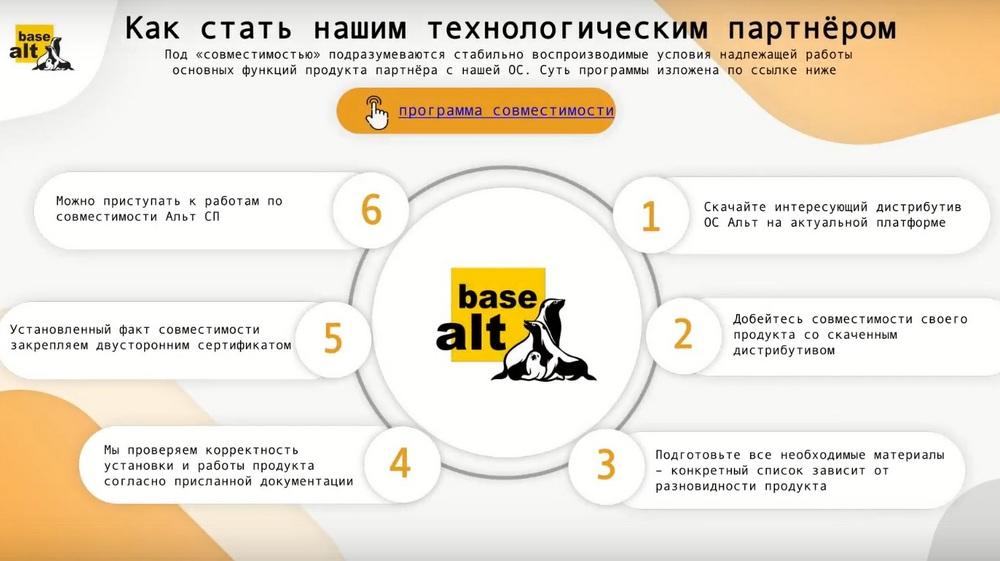
It describes all the nuances in great detail: disks are available, addresses, passwords, logins, mail. What needs to be done? First of all, you need to download the Alt distribution that interests you and with which you want to achieve compatibility. Then you need to achieve compatibility, if you have problems, you come to us, we help you. Then you prepare the necessary material, instructions, guide, transfer your software to us, either test software, if it is enough, or software with licenses, with keys. After that, we check the work you have done, make sure that everything really works, everyone is happy, your software does not destroy our system, and, accordingly, it can be safely operated.
After that, as soon as you receive a certificate of compatibility, we can place you on our website, also post instructions, and you can start working with Alt SP. Alt SP is a certified system, it is a little more difficult to work with, so we always recommend first achieving compatibility with publicly available operating systems of the Alt family.
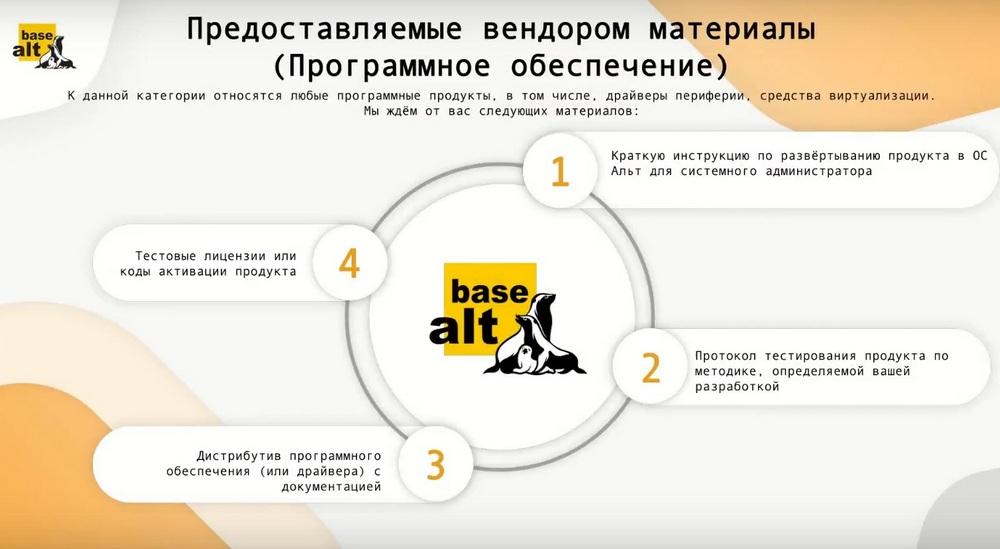
See what materials need to be provided in certain cases so that we can confirm the fact of compatibility. Well, if we are talking about software, then it is clear that this is a brief product instruction, an instruction for the system administrator of your product, a testing protocol according to the methodology developed by your company. This is an important point, because we do not produce your software, we cannot know how to properly operate it. Accordingly, the distribution, as I said. Then test licenses and activation keys. Provided that the test system provides full functionality, then licenses and an activation code are required.
Autonomous virtualization platform. Here, in principle, everything is the same. The only difference is that you will definitely have to take a report under root (this is point 3) and, accordingly, provide it to us. Again, you will also need a brief administrator instruction, a protocol and, accordingly, a distribution and keys, if the system does not provide full functionality without them. We have a fairly developed system of joint solutions, that is, many colleagues have already joined the compatibility program. As a result, you can follow the link on the website for a more complete list.
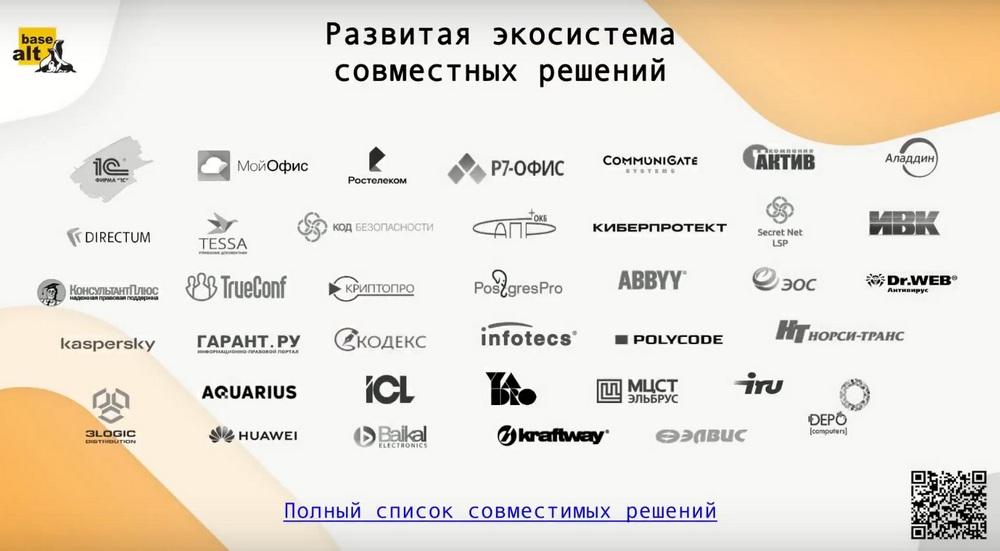
In fact, we already have more than 300 vendors and over the entire time of the compatibility service, we have established about 4 thousand facts of compatibility of various products.
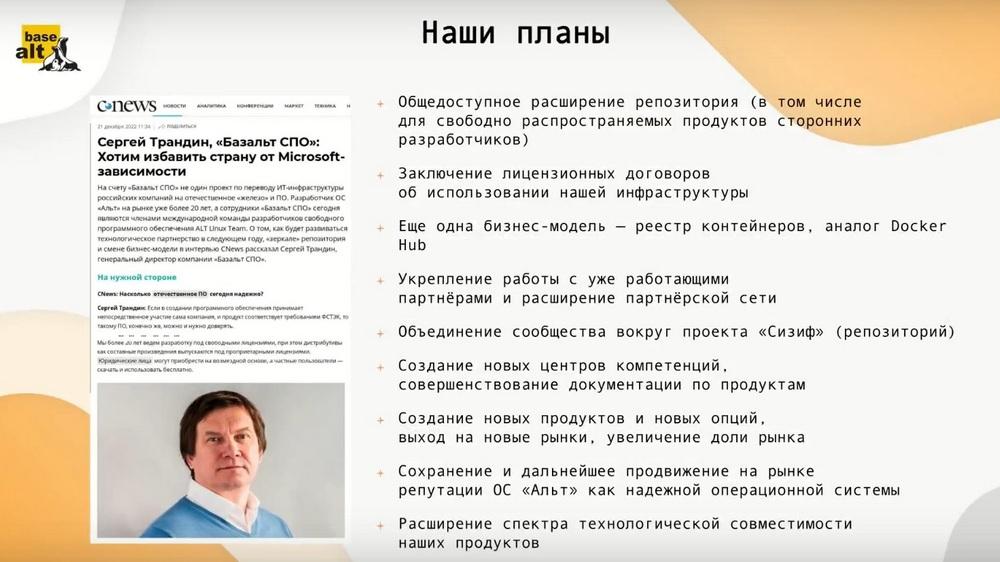
Our plans, where we are looking next and what we want to do, where to move. We are very actively looking towards containers, we are very active now, we have already released the Alt Domain product, it will appear on the market in the near future. We are also very enthusiastic about the association around the SIZIF project, this is our repository. At this point I would like to dwell, because there are very different systems for adapting your software to Alt Linux. They do not always include simply adapting the software and running it. For example, one option, if your software is free, a free license is issued, you can simply assemble it for the SIZIF repository. It will be included in SIZIF, if there is great interest from customers, it will gradually migrate to P10. These are the publicly available licenses that are on our website. And then it can also get into the certified release. Well, after all the checks, of course.
There is another way of integration, which many partners ask about. They come and say, well, we have achieved compatibility, now our software runs on Alt, but we want it to be in Alt right away. Well, unfortunately, there are two ways here. I have already described the first method. You open the license, this is not always available, assemble it in SIZIF and, accordingly, then everything will end with your software being in Alt. But this function is not available to most partners. Why? Because the code is proprietary, no one wants to open it, but this is logical. Well, accordingly, there are several options here. For example, you can assemble some client under an open license that does not represent a major commercial secret. But nevertheless, you can rebuild it and use it again in Alt. The second option is no less interesting, but a little more complicated. You deploy a repository on your territory, assemble a package for it and connect this repository to ours. Accordingly, the customer sees a common space, he also goes to the console, gives the get install command and installs your software directly on Alt. Well, these are the schemes we are currently testing, if anyone is interested, come and discuss.