Translated with AI from the Russian original.
An increase in corporate data volumes is a common feature for Russian business, according to a study by IT distributor OCS.

As the study showed, 74% of the surveyed companies from among medium, large and largest enterprises in terms of revenue expect that the amount of information under management will increase significantly by the end of 2025. 21% of organizations predict growth in the range of 10-25%, and 17% - more than a quarter.
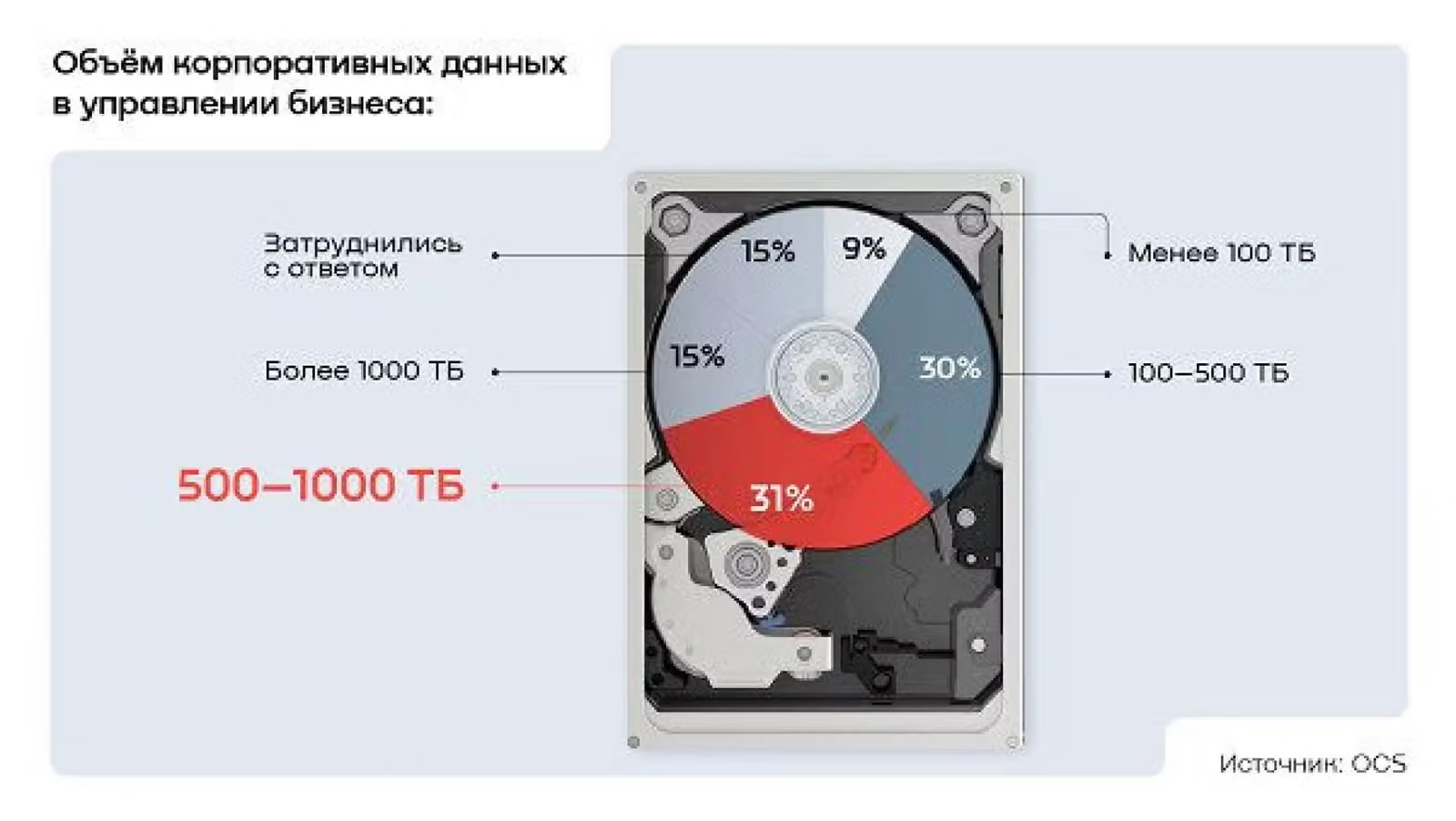
To process new volumes of data, 78% of companies plan to expand their corporate fleet of servers and data storage systems by the end of the year. At the same time, every third company intends to increase the volume of equipment purchases by at least 25%.
Most often, businesses operate with 500-1000 TB of data in the course of their operational activities - this volume was named by 31% of companies. A more modest 100-500 TB is managed by another 30% of respondents. At the same time, every seventh organization (15%) works with very large amounts of information - over 1000 TB.
In terms of industries, the leaders in terms of the amount of corporate data under management were financial sector enterprises - on average, representatives of the financial industry work with 800 TB. In second place were organizations from the oil and gas and coal complex with a result of 750 TB, and in third place - the chemical industry with an average volume of 700 TB.











