Translated with AI from the Russian original.
INFERIT Slim D4 B760, INFERIT Slim D4 H770, and INFERIT Desktop D4 B760 models have passed inspections and testing.
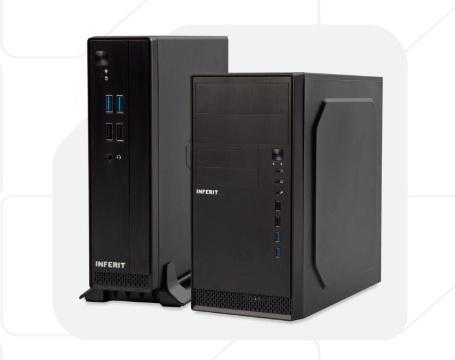
INFERIT personal computers are solutions in form factors familiar to users. Desktop models feature classic cases with convenient port placement. Slim models are compact workstations for situations where every centimeter of space is important. They support Intel i3/i5/i7 processors from the 12th to 14th generations.
INFERIT Slim D4 H770 and INFERIT Slim D4 B760, with dimensions of 100 x 335 x 356 mm, can be positioned both vertically and horizontally. The supported socket is LGA1700.
INFERIT Desktop D4 B760, with dimensions of 325 x 170 x 350 mm, is an office PC. The availability of a large number of drives and the possibility of installing a discrete graphics controller significantly expand its capabilities. The supported socket is LGA1700.
INFERIT Desktop and INFERIT Slim support hardware and software data protection tools, as well as secure domestic operating systems and application software. The devices provide full compatibility with MSVSfera ARM 9 OS and its applications.
INFERIT provides service support for PCs and offers a one-year warranty with the possibility of extending it to 3 years. INFERIT PCs are already available for corporate and government customers.











