Translated with AI from the Russian original.
A ready-made data storage solution that meets the requirements of the import substitution policy.
The Helius.KUB hardware and software complex, designed for creating data storage systems, has been officially included in the register of the Ministry of Industry and Trade of the Russian Federation. This was announced by the Russian manufacturer Graviton.
The corresponding entry, made following the inspection of the Graviton developer, confirms the domestic origin of the solution and its compliance with the requirements for Russian computing equipment.
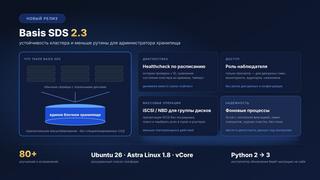
The complex is built on Graviton servers and uses software for software-defined storage (SDS). The system architecture supports file, block, and object access to data, and the multi-controller All Active scheme ensures high performance and fault tolerance.
Ivan Rybin, Director of Software Product Development Department at Graviton, noted:
The inclusion of Helius.KUB PAC in the register of the Russian Ministry of Industry and Trade is a strong argument for our customers who are aimed at creating a legally clean and technologically independent IT environment.