How is AI becoming the autonomous core of corporations? Friends, while the whole world is discussing scandals surrounding OpenAI's military contracts and the mass exodus of users to Claude, a much more important shift is taking place in the technology market. We are finally saying goodbye to the "question-answer" format.
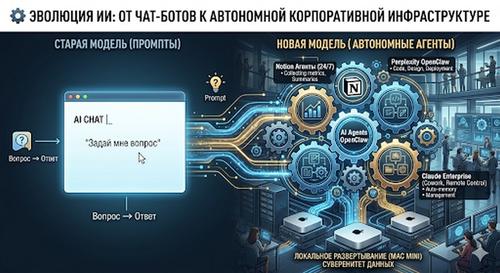
The past week's news shows that AI has transformed from a smart conversationalist into an autonomous infrastructure. Here are three main signals for business:
1. Agents Who Never Sleep
Technologies are moving towards continuous task execution without human intervention.
* Notion has launched custom AI agents that work 24/7. You set a trigger once, and the virtual colleague independently collects product metrics, makes summaries for management, and sends updates to the team.
* Perplexity has rolled out its own OpenClaw framework. This is no longer just a search — the system is capable of coordinating multiple models to independently write code, create designs, and deploy projects from start to finish.
2. Seamless Enterprise Control
Enterprise implementation requires strict management, and developers have finally given businesses the necessary tools.
* Claude introduced the Cowork update — now it's a full-fledged operator for the entire organization with centralized plugin management.
* The problem of context loss has been solved: Claude's new auto-memory feature saves debugging history and project specifics between sessions. And with Remote Control, a developer can start code compilation in a terminal on a laptop and continue to monitor the process from a phone on the go.
3. Infrastructure Sovereignty and "Hardware"
Autonomy requires new capacities. Apple is unprecedentedly relocating Mac mini production to the USA (as part of a $600 billion investment program). The reason is simple: these compact computers have now become a global hit for local deployment of AI agents (such as OpenClaw). Companies want digital employees to work strictly within the corporate security perimeter.
What does this mean for us?
For those who manage innovation, especially in high-load and scalable areas like large retail, the focus of attention should shift dramatically. The question is no longer "which neural network to buy for employees." The question is how to integrate autonomous agents into the company's architecture so that they safely manage real business processes.
Some companies and startups are already ready to entrust routine tasks to a virtual colleague who doesn't need constant instructions.
Evgeny Dzhamalov