NVIDIA has wonderfully broken down the AI market into 5 layers. I really like how NVIDIA recently described the structure of the artificial intelligence market. They presented it as a five-layer "cake," where each upper level is critically dependent on all the lower ones. No magic - pure physics and economics
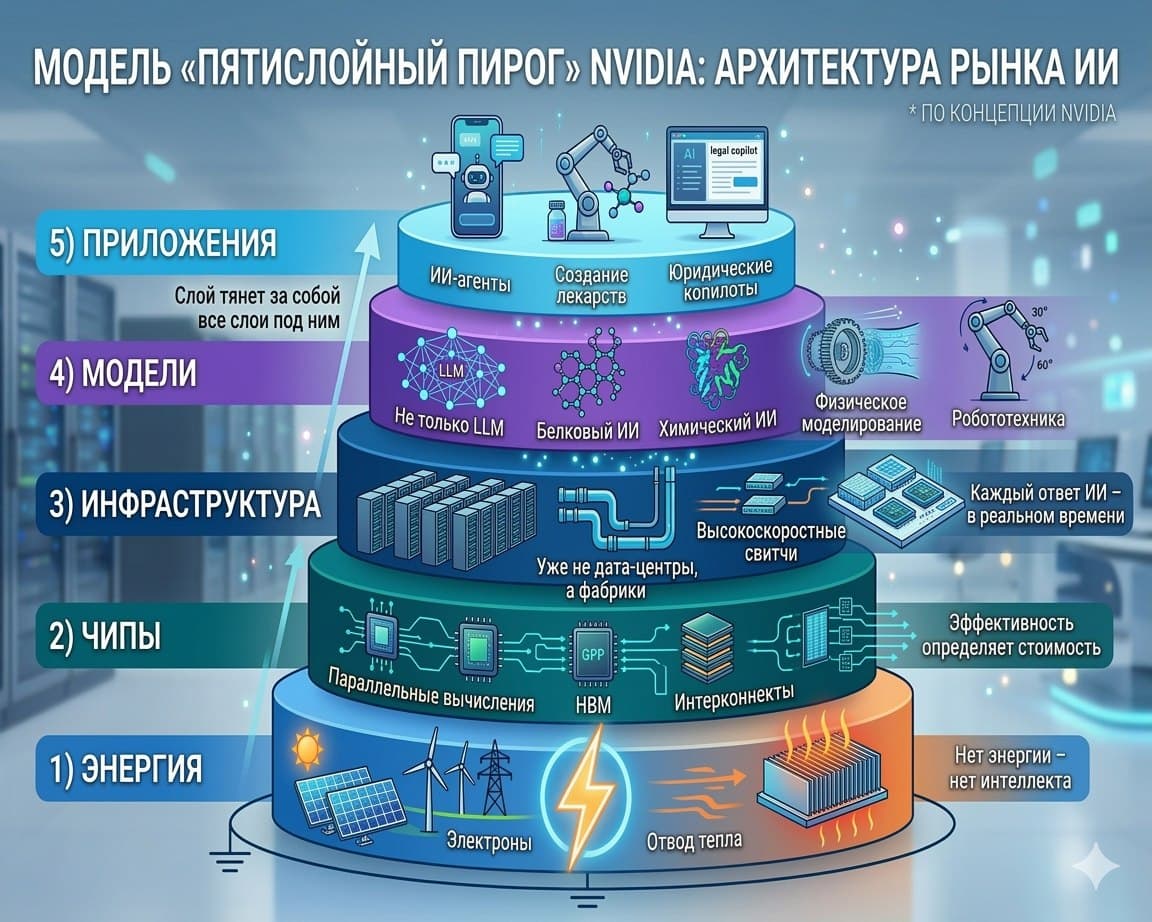
Here's what this architecture looks like:
1) Energy. The basis of everything. Each generated token is real electrons and the need to dissipate colossal heat. No energy — no intelligence.
2) Chips. Parallel computing, HBM memory, interconnects. This is where energy efficiency determines the final cost of each AI solution.
3) Infrastructure. Classic data centers are becoming a thing of the past. The future lies in entire "computing factories," where each neural network response is calculated in real time.
4) Models. This is no longer just the LLMs we are used to. AI for physical modeling, protein and chemical AI, and smart robotics are entering the scene.
5) Applications. The very top, which the end user sees: AI agents, systems for creating medicines, legal co-pilots, and business assistants.
When I led innovation at "Magnit", "Pochta" and other companies, we constantly encountered the same illusion: everyone wants to immediately implement the fifth level (applications) in order to get a quick business effect. But the reality of corporate scale quickly sobers up. Any complex AI product instantly reveals the entire pyramid — you need adapted models that rely on the readiness of the infrastructure, the availability of chips, and electricity limits.
Using artificial intelligence today is not just about writing beautiful code. This is the heavy industry of the 21st century, where each new use case entails the modernization of power grids and semiconductor factories.
Evgeny Dzhamalov