In the fall of 2025, OCS surveyed more than 100 Russian vendors - manufacturers of IT equipment and software developers. The study was intended to answer the question of what results Russian manufacturers of "hardware" and software have achieved in localizing their solutions.
"Russia has long been pursuing a course towards import substitution of IT solutions. For these purposes, our state has developed a system of criteria that help determine which products and to what extent can be considered Russian. It is important to understand that this is not about abstract 'purity of origin', but about formalized requirements fixed in regulatory acts and registers. It is they that set the permissible localization framework today," said Nadezhda Medvedeva, Deputy Director of the Components Department at OCS.
A survey of vendors showed that IT products consist of an average of 55–60% of domestic components. The degree of localization largely depends on the type of solution: for software it is 77%, and for "hardware" it is 40%.
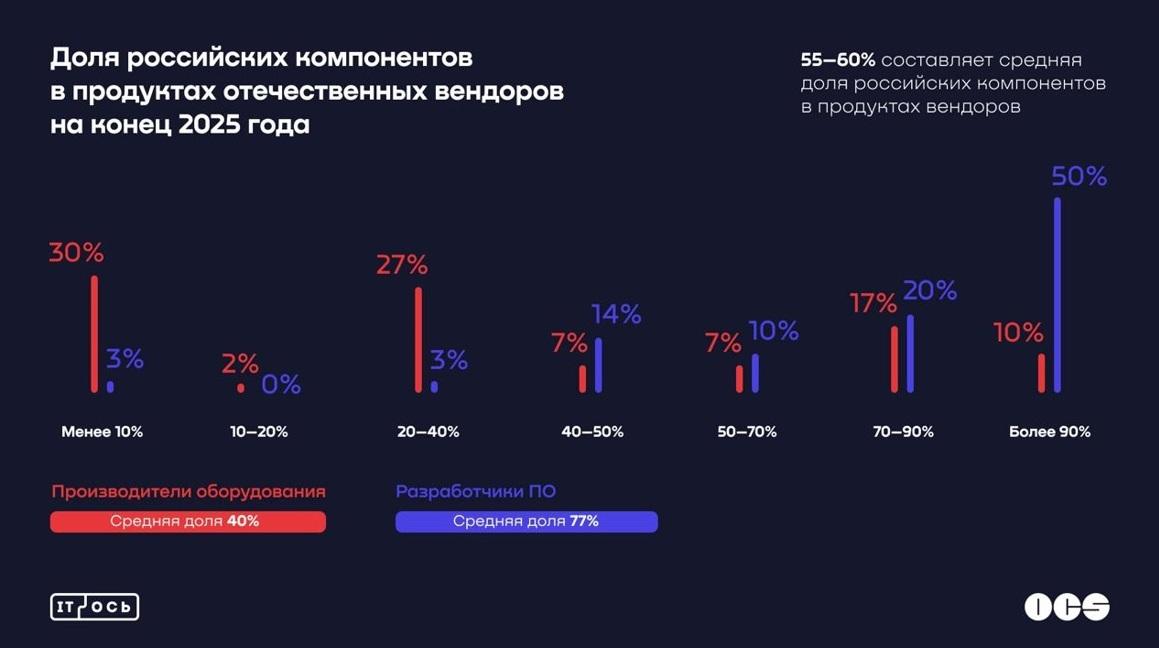
"Unlike software companies, equipment manufacturers face more barriers to localization. Many technological units are not assembled in Russia, and some analogues have not yet approached the quality of familiar foreign components. For example, video cards and processors are only available through import today," said Nadezhda Medvedeva.
The list of components produced in Russia is gradually increasing. This is facilitated by the active development of small-unit assembly (CKD, Complete Knock-Down): domestic vendors use CKD kits to transfer the production of some components to sites within the country.
"OCS was one of the first to bring CKD kits to Russia. According to our analysts, the heyday of this segment fell on 2024 over the past eight years — sales have grown many times over. In 2025, there was a slight decline due to difficult economic conditions in the country, but the second half of the year also showed good results, — said Nadezhda Medvedeva. — Russian vendors have successfully mastered the assembly of motherboards, RAM, various drives and many other components. Last year, devices from every fourth company consisted of 70% or more of Russian components".
After 2022, the CKD direction underwent significant changes. Foreign manufacturers of A-class CKD kits stopped cooperating with companies from Russia, as a result, domestic vendors switched to working with B-brands. "The reversal also had advantages: for example, B-brands work with small batches and allow you to buy out the rights to developed units," said Nadezhda Medvedeva.
The plans of Russian vendors for further localization of products differ depending on the type of solution, according to the OCS study. Software developers intend to either maintain the current level (40%) or increase it slightly — by 10–20% (23%). Among IT equipment manufacturers, almost every second company (43%) is going to increase the share of domestic components.
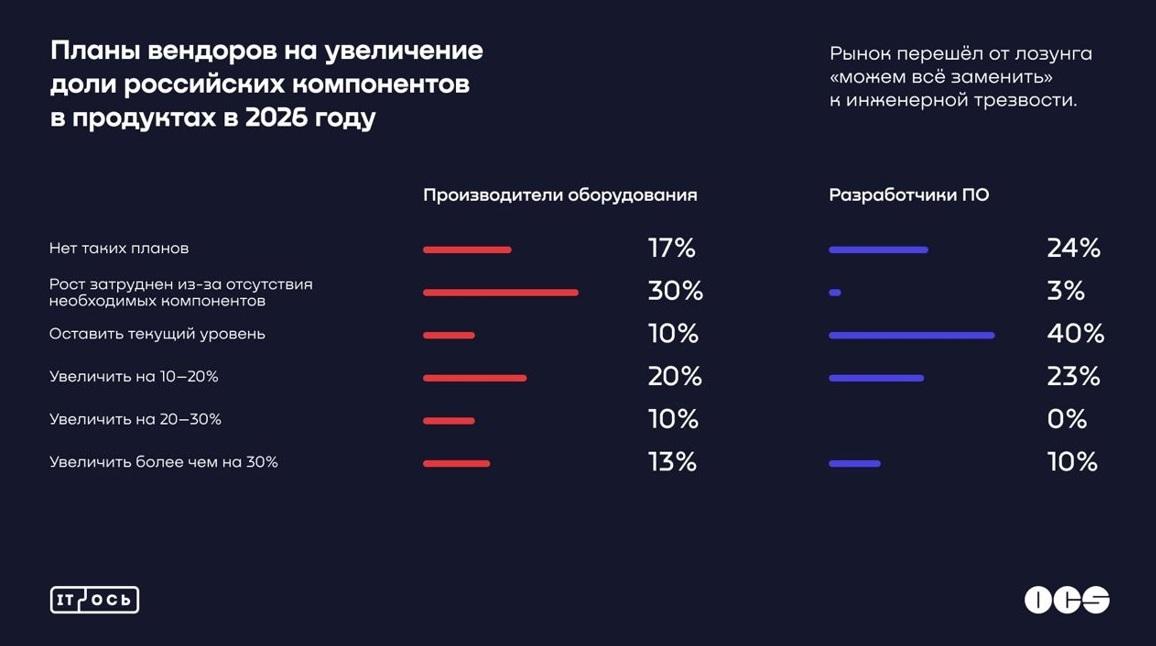
"Software developers have high localization rates, so most intend to maintain the current level or increase it slightly. Equipment manufacturers have a slightly different situation. They have room to grow. However, there are fewer and fewer opportunities for import substitution of components — almost every third manufacturer of 'hardware' says this directly," emphasized Nadezhda Medvedeva. In the production of IT equipment, further localization already requires significant investment in R&D.
The market has moved from the slogan "we can replace everything" to engineering sobriety. The pace of localization today is determined not by the company's strategy, but by objective technological and industrial limitations. "The next breakthrough requires combining the efforts of various participants in the IT market. We need not just partnerships, but large technological alliances that will create demand for Russian basic technologies and support it at the level necessary for payback. Distributors, for example, as holders of engineering expertise and deep product analytics, can coordinate this process," noted Nadezhda Medvedeva.