Translated with AI from the Russian original.
The company "Gigant Integrated Systems" has announced the release of a new 27-inch monitor, the G-View27 Repro Edition, designed for designers, photographers, and specialists working with video and color.
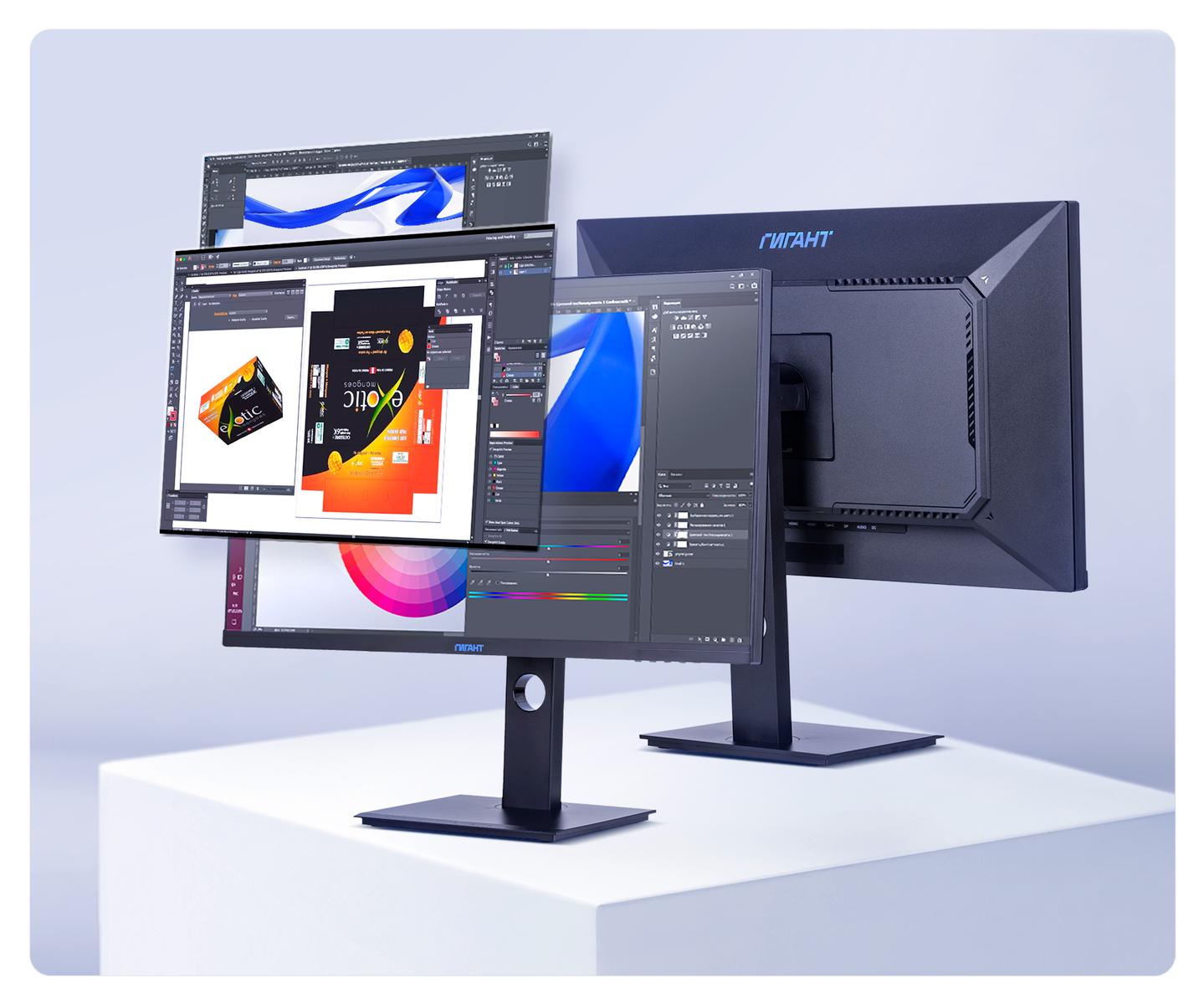
The company stated:
The creation of the G-View27 Repro Edition was the result of comprehensive work by the engineering team at "Gigant Integrated Systems." During the research and testing process, the company's specialists studied 27 types of matrices and 12 types of backlighting to achieve uniform brightness across the entire surface and perfect color reproduction accuracy.
The development was carried out from scratch, taking into account the specifics of the professional market and the requirements of Russian users.
The G-View27 Repro Edition is equipped with an IPS-matrix panel with FRC technology and UHD resolution (3840 x 2160 pixels). The monitor reproduces 99% of the DCI-P3 color space and 99% of Adobe RGB, and uses MiniLED backlighting with 576 local dimming zones. The maximum brightness in HDR mode reaches 1000 cd/m², and the typical brightness in SDR is 450 cd/m².
The monitor is equipped with an adjustable stand with height adjustment (HAS) and portrait mode (Pivot) capability. For connectivity, there are two HDMI ports, a DisplayPort, and a USB Type-C port with support for video transmission and charging up to 65W, as well as an audio output.











