Translated with AI from the Russian original.
2U dual-unit servers based on Intel Xeon Scalable processors and in proprietary enclosures are aimed at small and medium-sized businesses.
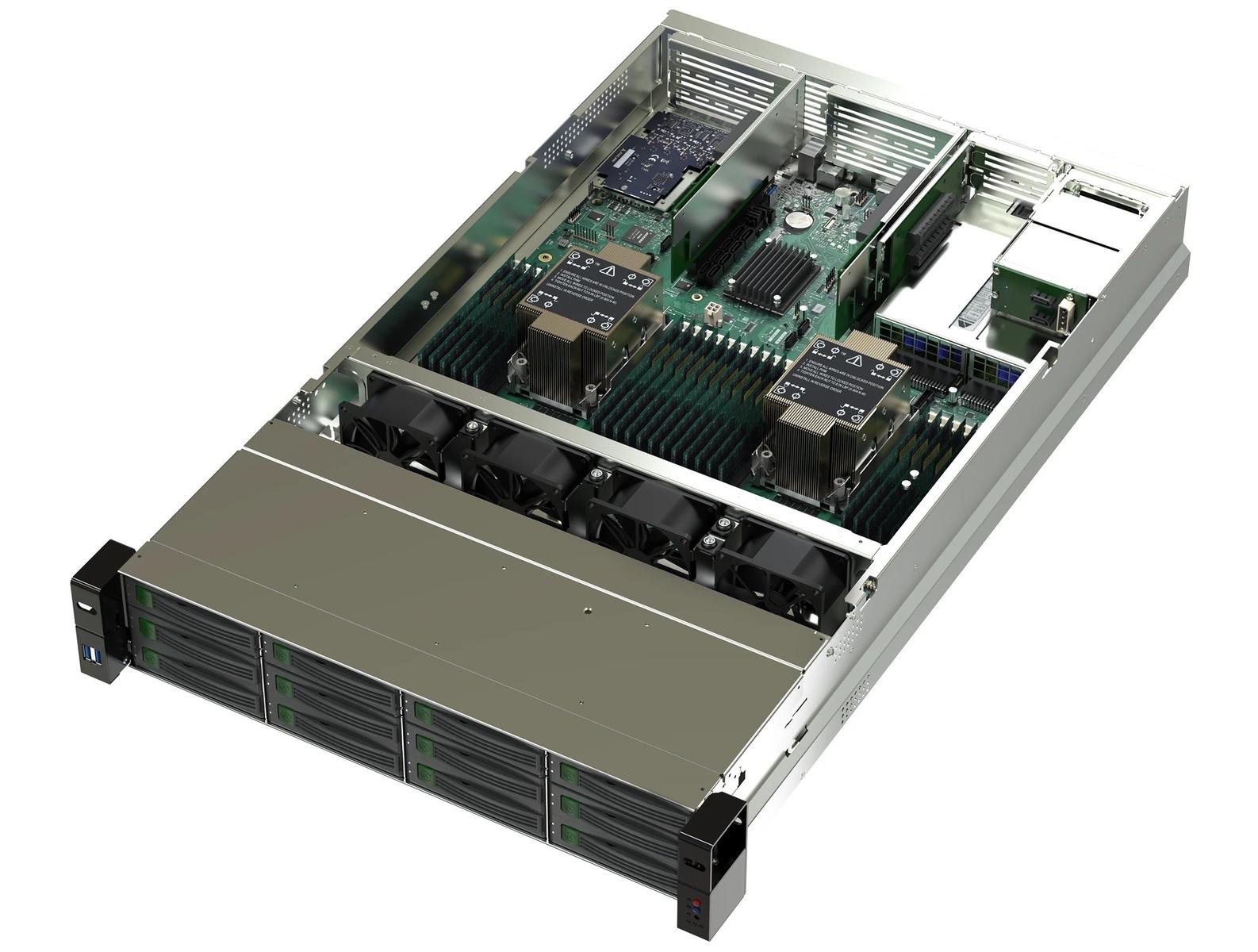
Rikor servers are currently available in the KNS network, and will soon appear in other major online stores and marketplaces. The devices are aimed at the IT infrastructure of small and medium-sized companies, IT outsourcers, local data centers, integrators and resellers.
The servers are equipped with 24 slots of fault-tolerant server memory. Currently, two models are offered in retail. Rikor ProServer RSP6208 is a 2U dual-unit server with the ability to install up to 8 2.5/3.5-inch drives. Rikor described the model:
Optimal for working with accounting systems, including 1C, in companies with up to 50 people and suitable for tasks such as corporate network management, data storage (files, e-mail, web pages), office applications and basic infrastructure.
Rikor ProServer RSP6212 is a more productive solution equipped with two processors, advanced I/O capabilities with the ability to install up to 12 2.5/3.5-inch drives. It is also designed to work with 1C, as well as with databases (calculations, analysis, order processing), multi-user environments, rich virtualized systems, data storage and video surveillance systems.











