"Basis", a company operating in the Russian virtualization market, announces the release of the next generation platform for creating and managing virtual desktop infrastructure (VDI) - Basis Workplace 3.0. This solution was presented at the "Basis" conference on May 28, 2025. The key idea of the update was to improve the platform architecture and expand automation scenarios.

The company's engineers not only rebuilt the core, but also significantly improved the existing Basis Workplace capabilities, added new functionality, and optimized performance. In total, more than 300 tasks for the development of the platform were implemented during the development of Basis Workplace 3.0.
New architecture
Basis Workplace 3.0's monolithic architecture has been replaced by a horizontally scalable architecture using containers. This not only made the VDI infrastructure more stable, but also made it possible to implement a number of important functions for the platform. In particular, phased updating of system components without stopping services.
Companies with a developed branch network and service providers will appreciate the implementation of multitenancy, which ensures the creation of isolated virtual environments for different departments or clients on a common infrastructure.
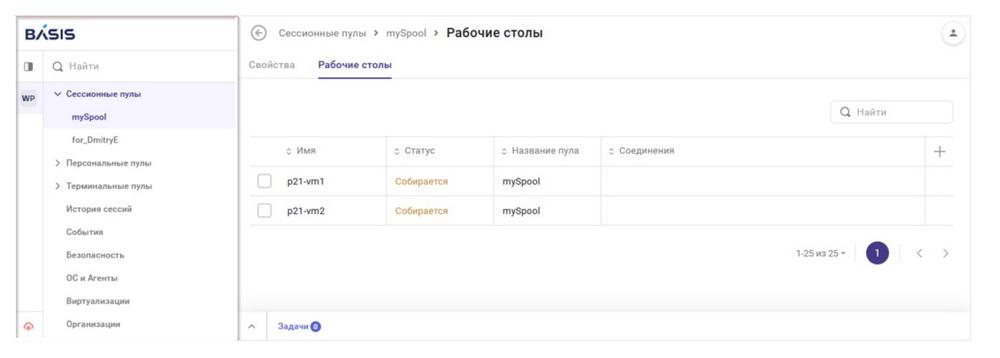
Support for virtual graphics accelerators (vGPU) opens up the possibility of working with graphics applications (3D modeling, CAD) with performance comparable to local workstations, while optimizing the use of expensive graphics resources.
Launch, configuration, monitoring
Basis Workplace 3.0 uses its own web portal to manage the virtualization environment, which can work with both Basis Dynamix and other virtualization environments: Rosplatforma, OpenStack, vCenter.
Support has appeared for multiple Basis Workplace clients on a single user device. Clients are configured individually, each works with its own agent and can be used to work with multiple VDI circuits. Delivery protocols RDP, RX, Loudplay are supported.
Monitoring has become more efficient: VM agents now register themselves on the backend and are controlled by the "polling service", which allows administrators to receive up-to-date information about the status of system components and ensures the smooth operation of virtual machines (VMs).
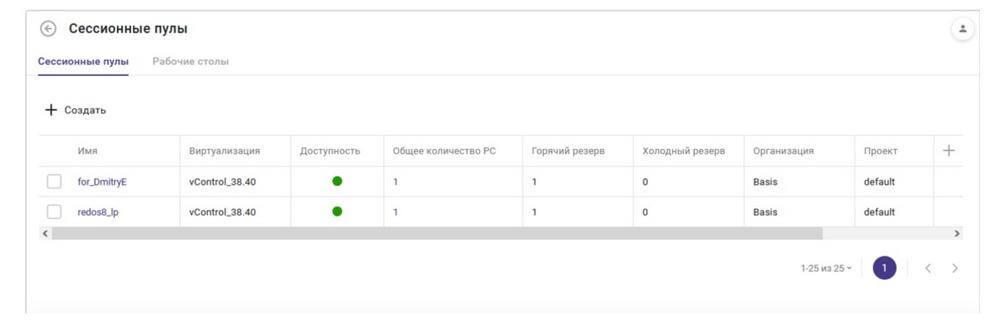
Combining session pools for group management of settings has significantly reduced the time spent on administering virtual workplaces, reduced the number of errors during configuration, and made it possible to quickly scale the infrastructure while maintaining unified policies.
In addition to the standard connection via a broker, direct access to virtual workplaces is now possible.
The addition of VM creation and activation queues in Basis Workplace 3.0 saves resources by turning on VMs only when necessary, reduces waiting time for users (VMs are ready when work begins), and optimizes the load on the infrastructure.
Automated installation and update
For installation, instead of Ansible scripts, you can use a web installer in Basis Workplace 3.0. New mechanisms for updating client software through the web portal and updating system components without interrupting services have reduced software update times by a factor of four. Administrators received centralized update management, and users can work without downtime caused by maintenance.
VM maintenance mode allows administrators to perform maintenance without generating false alerts and with minimal impact on business processes.
«According to iKS-Consulting, Basis Workplace occupies 52% of the VDI solutions market. Therefore, in the new release, we have significantly expanded the functionality of Basis Workplace and redesigned the architecture. The new horizontally scalable architecture has made our solution more efficient and easier to operate, and has also set a significant potential for the development of the platform,» said Dmitry Sorokin, technical director of «Basis».