Translated with AI from the Russian original.
"Systeme Electric", a manufacturer of integrated solutions in the field of power distribution and automation, is launching another size of switch-disconnectors on the market - SystemePact SD80 with DIN-rail mounting for controlling networks with a voltage of 400/415V AC from 16 to 80 A.
Switch-disconnectors SystemePact SD80 are suitable for controlling electric circuits and sectioning and are used in power supply systems of industrial enterprises, as well as at non-production facilities. The technical characteristics of the new line ensure reliability and safety of equipment operation, as well as minimal maintenance costs.
SystemePact SD80 are available in three- and four-pole versions. Models with a rated current up to 80A (SD80) can be operated at temperatures from -30 to +70°C. The devices also maintain the rated current at temperatures up to +50°C.
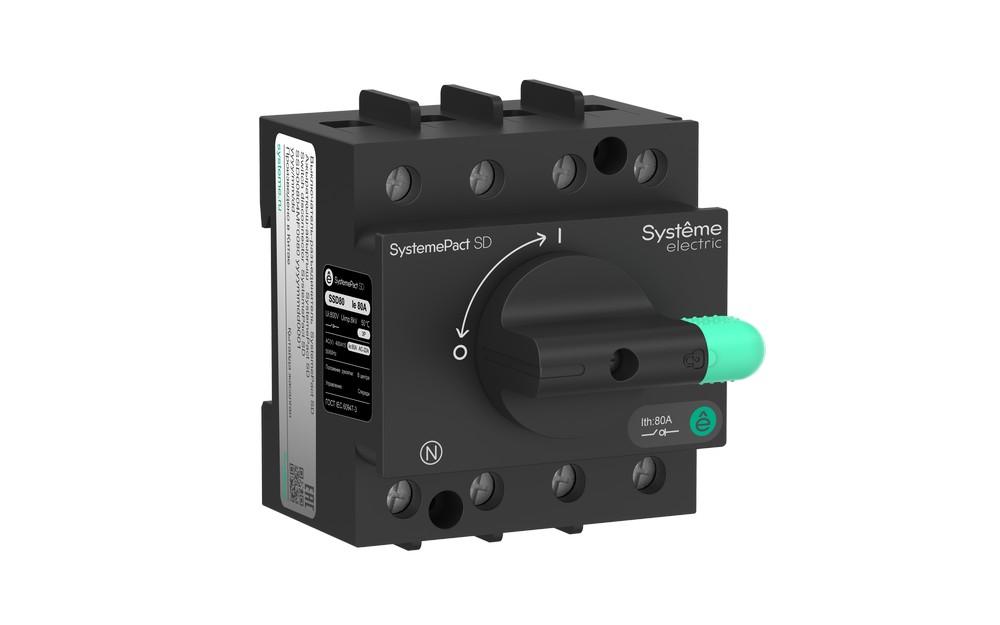
Compact switch-disconnectors are installed on a DIN rail in one row with modular switches under a single cutout of the front panel. The mechanical wear resistance of SystemePact SD80 is 10,000 switching operations, and the electrical wear resistance is up to 3,000 switching operations. The handle can be locked with a padlock.
The new size of compact switch-disconnectors SystemePact SD80 is designed for use in the switching category of mixed active and inductive loads, including moderate overloads (AC-22A).











