Today's event is dedicated to the Loudplay desktop virtualization protocol. The protocol allows for the transmission of high-quality images over low-speed data channels and ensures a fast response.
The solution has an open API that allows it to be integrated into existing VDI products from Russian manufacturers. The quality of the protocol has been tested by millions of cloud gaming users over the years of Loudplay's operation in the B2C market.

Today, Loudplay's goal is to provide corporate customers with a high-quality and functional protocol in partnership with various Russian developers of VDI and terminal services, to become competitive with internationally known protocols such as ICA (Citrix) and Blast (VMware).
Today's program:
- What is Loudplay.
- Why offer Loudplay together with Russian VDI solutions.
- Loudplay Partner Program.
- How to register a deal?
The event is led by Elena Denisenko, Commercial Director of Loudplay.
Today, we want to talk about Loudplay, why it should be offered as a commercial product in addition to VDI, how to become partners, and what the main rules are in our partner program. Currently, there are already many VDI solutions on the Russian market aimed at closing the import substitution task for our Russian customers. Nevertheless, many customers still remain on previously purchased solutions from Citrix and VMware. They cautiously test and try VDI solutions, not yet moving towards a full-scale replacement, because the requirements and functionality they are accustomed to, the requirements they place on VDI solutions, are quite high. Most of these solutions use Open Source protocols, so by offering the Loudplay delivery protocol, a commercial protocol, on the market, we aim to help quickly close the topic of VDI performance for the import substitution task for our Russian customers.
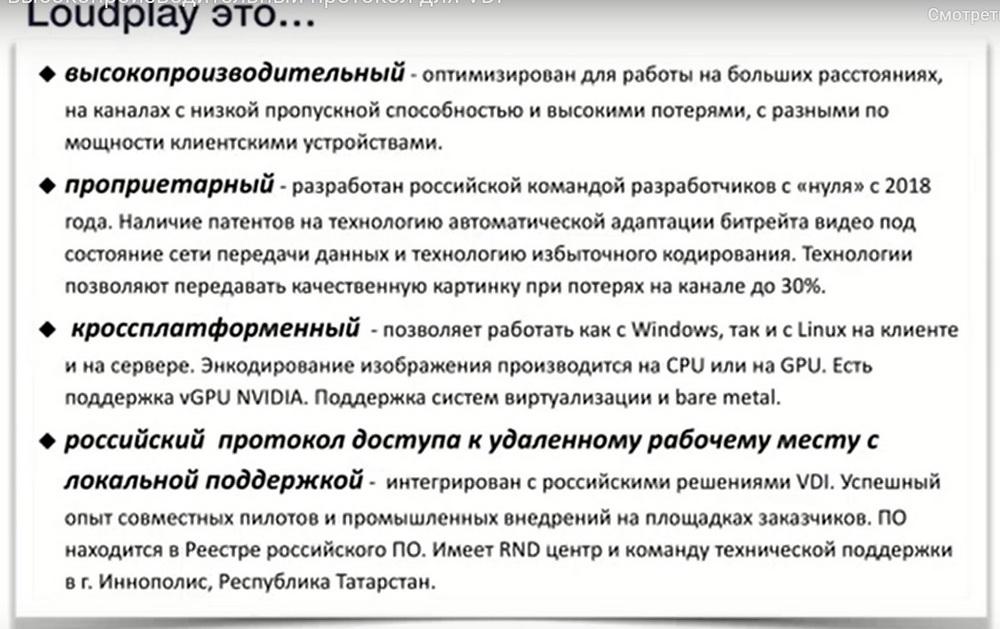
Loudplay is, first and foremost, high performance, because the protocol was specifically designed for delivering video content and high-graphics content over long distances, even with access channels to the cells where the servers were located having delays, and devices being of varying quality. Therefore, the task that was set when building this solution was aimed at addressing all these shortcomings. The protocol is proprietary. Whether this is good or bad is debatable, but we believe it is good. The choice was made specifically in this direction because at the start, when Loudplay was forming its cloud gaming solution, options to use Open Source protocols were considered, and it became clear that this was impossible because a higher quality was required than what publicly available solutions provide. Therefore, the protocol is indeed proprietary, written from scratch since 2018. Several technologies have been implemented, and patents have been obtained. We can transmit high-quality images with relatively high losses, up to 30%. We believe that the products have a high degree of readiness for commercial use in the corporate market. I would also like to note that Loudplay is a cross-platform product. It works on both Windows and Linux, on both the server and the client. All of this is implemented in a single edition. The customer does not need to switch from one protocol to another when using Loudplay. They get consistently good quality when working with both CPU and GPU. It has built-in support for NVIDIA cards and can work with both virtualization systems, because it's point-to-point, and with bare metal. But an important point is that the entire development and support team is locally available. And we continue to optimize our protocol. We are ready to consider any special requests from your customers and revise or optimize priorities in forming our roadmap. It must be said that over the previous, probably, year and a half, we have come a long way to enter the B2B market with this protocol. If anyone knows, previously the protocol only worked with GPU on the server. This was necessary to maximize the task of cloud gaming. A year ago, a version was released with the ability to work on CPU. We still work well with images, as much as is necessary for the corporate market. By the end of the year, cross-platform compatibility was implemented, that is, we were able to write code for working with Linux. And in April, we released a version that allows USB devices to be passed through. So there is the possibility of working with peripherals.
These are three main large tasks that we set for ourselves and with which we have coped quite successfully. At the beginning of June, we are releasing the next release immediately, which allows working with terminal services. So far, this is Linux-Linux, but considering that the history with terminal services was planned for the end of 2024 in our roadmap, we are ahead of schedule for Windows. It will probably be a little later, but we are definitely meeting the deadlines.
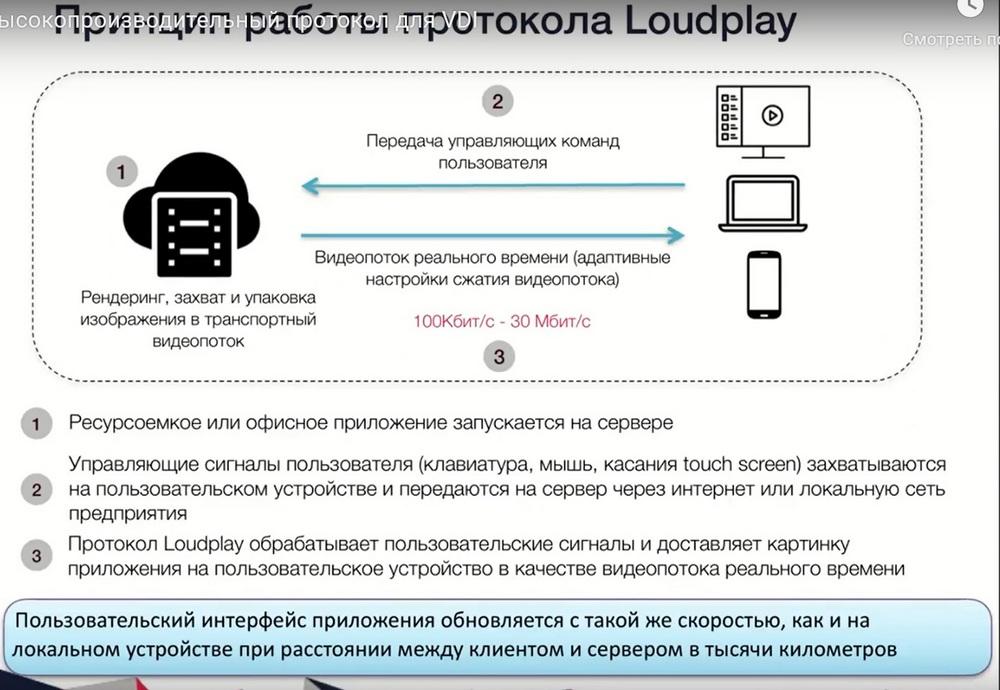
The principle of operation of the Loudplay protocol. Here, the picture is not deeply technical, but what I would like to draw your attention to is that the protocol is quite flexible, it allows you to work with different channel widths. In particular, it can be adapted to work at both 100 kbps and 30 Mbps when high-quality video content is required and channels allow. And, as I already said, in our past life, where the protocol is used for cloud gaming, the realities are such that with a server that is, for example, located in a data center in Moscow, customers can work with it from different parts of the globe.
I can't help but share a recent story that one of our major customers told. He compared the operation of our protocol with the Citrix protocol. And he evaluated how the protocols work when delivering video content from Vladivostok. We were pleased to hear that, in fact, Citrix with fine-tuning and Loudplay work with comparable channel utilizations.
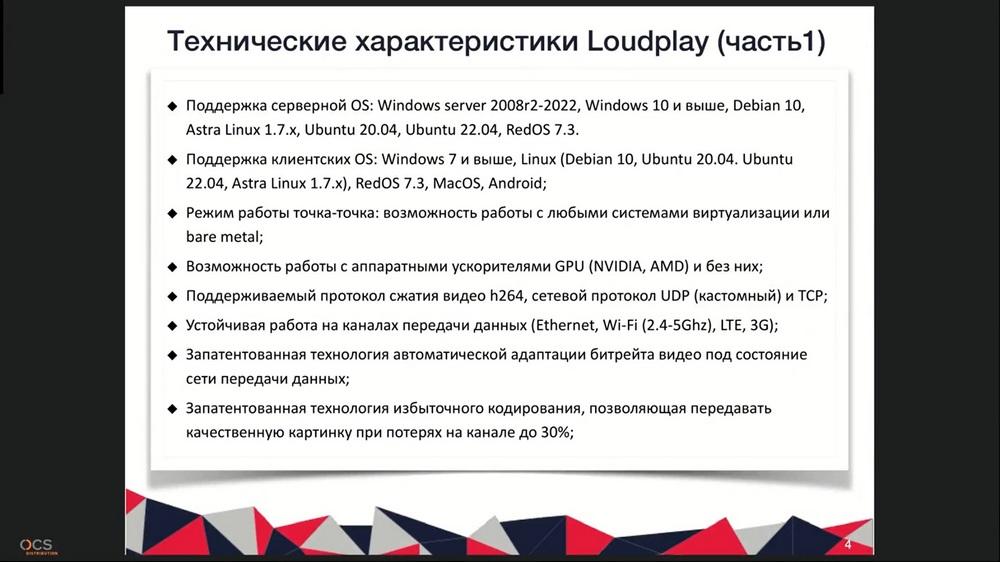
Now a little about the technical characteristics of Loudplay. Today, we support the Windows, Debian, Ubuntu, Astra Linux, and RedOS operating systems.
We haven't gotten to RAS and ALT yet, but we have some understanding that this won't cause us much difficulty, because in essence they are very similar to other OSs. Why haven't we gotten to these OSs? Simply because there was no commercial task. But of course, we have this task. For client operating systems, in addition to those listed, there are also macOS and Android. They are historical for us, because these operating systems are used in client devices, in our B2C branch. Let me remind you, the operating mode is point-to-point. That is, we can work with any virtualization systems and bare metal. That is, it can be VMware, and any KVM, any hypervisors. I want to separately emphasize the possibility of working with GPU hardware accelerators. We can support any graphics cards, both NVIDIA and AMD, but AMD is not as widespread among our customers. Mostly it's NVIDIA. Here we have the opportunity, together with OCS, to offer the market licenses at special prices that support the functionality and work with cards without the need to reboot with new drivers, so if your customers have such a task, contact OCS, they will draw up a specification for you and issue a commercial offer. This functionality is of an enterprise level, so it has support for several years. So such an import-substituted alternative is available with our protocol and through the OCS channel. As you can see, the supported compression protocol is H264. We primarily use the UDP protocol, but for the commercial, corporate market, there is also the possibility of working with TCP. Our "B2C" customers work with unstable Wi-Fi, but nevertheless, they still have the opportunity to play with high graphics requirements.
As I have already noted, there are several patented technologies, including technologies for automatically adapting the bitrate to the state of the data transmission network and redundant coding technologies.
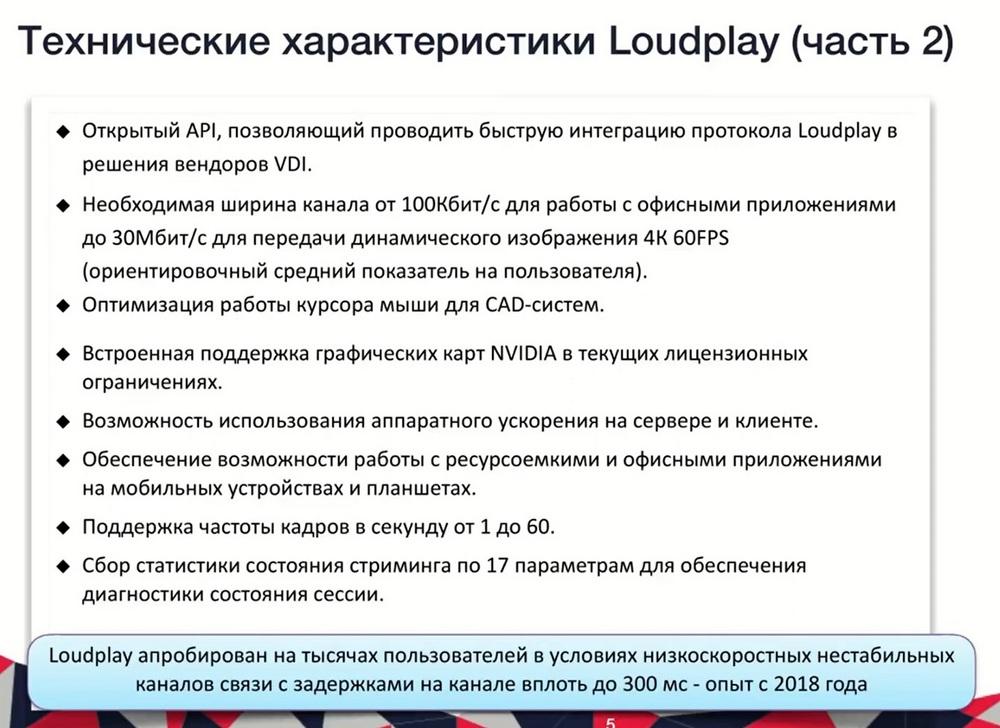
We have an open API, so we easily integrate into the solutions of our colleagues in the market. If this has not happened, if we do not officially announce any integration, then most likely it is simply because either we have not gotten around to it, or there was no commercial task. Because, in principle, if any commercial project arises, there will be no difficulty in integrating into any VDI solution in our market.
Therefore, the list of technological partners that we have is easily expanded if the customer has some special vision for additional functionality to the protocol. As I noted, the channel width varies from 100 kbps to 30 Mbps. At the same time, we provide the transmission of dynamic images in 4K at 60 FPS. For one of the customers of one of the projects, we were able to optimize the operation of the mouse cursor for AUTOCAD. This is a well-known problem, but thanks to Loudplay, we were able to solve this problem. This once again confirms our flexibility and ability to optimize the operation of the protocol. I have already mentioned the built-in support for NVIDIA graphics cards in the current licensing restrictions. I will highlight once again the possibility of hardware acceleration on the server and client. And it is clear that we can work with office applications from mobile devices and tablets, not only from computers. In the fall, we conducted comparative tests with RDP, with one of our partners. In January, we conducted a comparison with Citrix at the stand of one of the distributors. I can say right away that Citrix was without pre-settings, but in these conditions, Citrix looked a little better than Loudplay in inactivity and when working with a text editor.
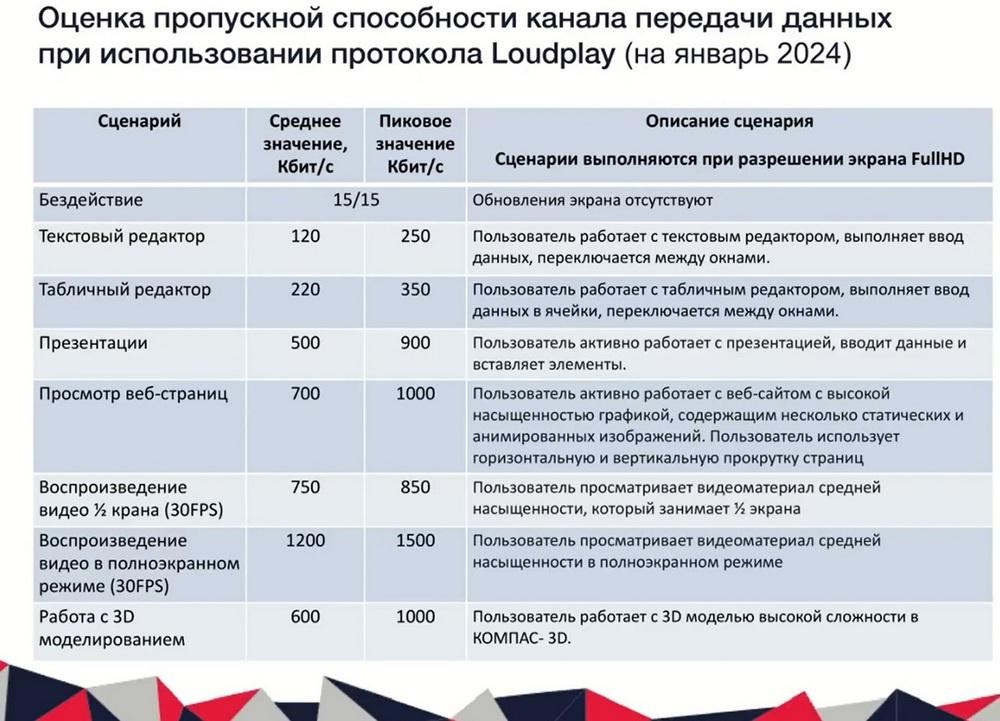
Starting with the presentation and further, Loudplay showed a significant advantage in channel utilization. We only show our values here, because we have not yet conducted the second test with Citrix. But as I told you about the test that was recently confirmed to us, Loudplay looks very competitive with Citrix settings already.
So if customers who are "sitting" on Citrix and are waiting for the same functionality from Loudplay as from Citrix, then we can provide it. I emphasize that Loudplay has such a label that Loudplay is a protocol only for 3D graphics and for high-loaded video content. In fact, this is not the case.
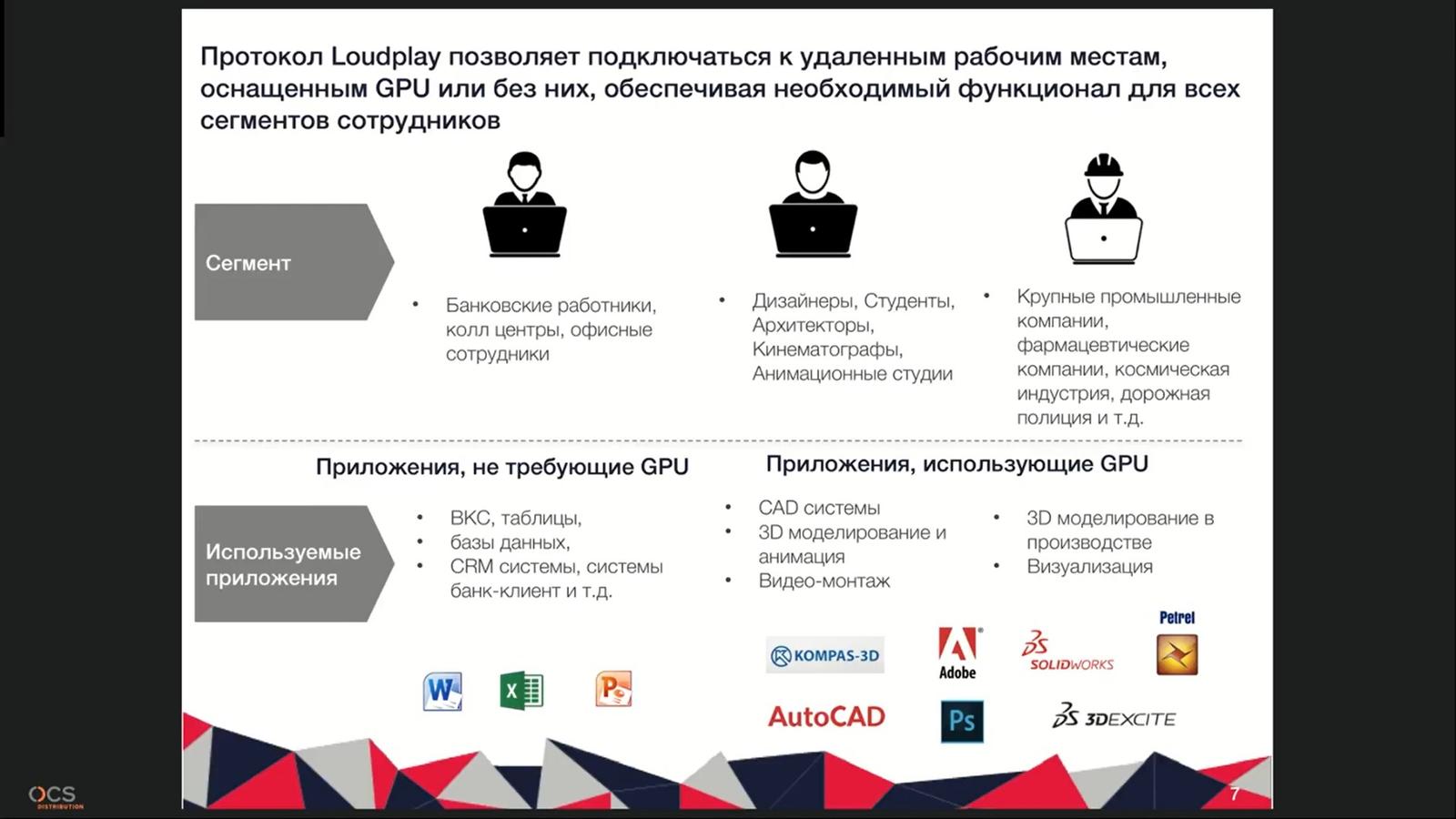
In this situation, we are descending from top to bottom from tasks with high graphics to optimization for working with office applications, so Loudplay's capabilities can be used in any solution, so taking into account the latest tasks that we are solving, including with terminal services, which will be available in the next release in June, Loudplay can already be offered with any VDI solution or terminal services, apparently, in the near future, when you want to make an offer to your customer.
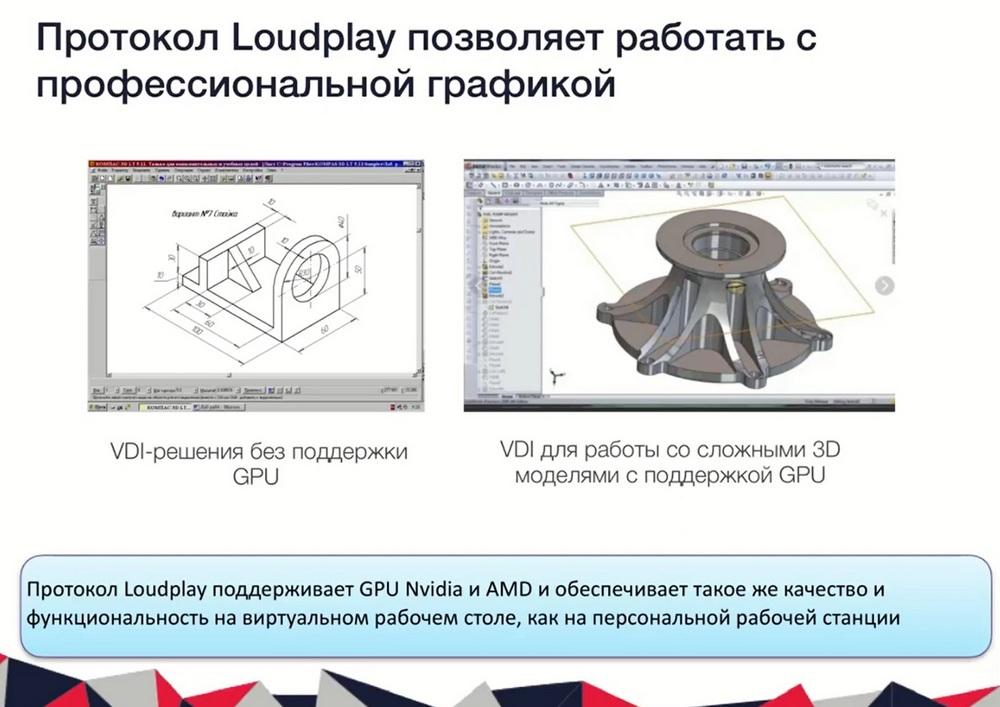
Nevertheless, I want to emphasize once again that, of course, we have no competitors in the Russian market now in working with 3D graphics. Live cases with excellent feedback, with an "access story" that we have not yet published, shows that the customer who purchased the solution with Loudplay is very satisfied with this solution and actively uses it in their work.
To date, we have signed contracts with the five indicated technology partners. We actively interact with everyone. Wuveon will be releasing version 5.0 in the near future. Loudplay is integrated there, we checked it several months ago, but we are just waiting for the official announcement of the solution so that it is all available to you and to customers.
Integration with Space was seamless, we actively interact with them, any changes are tested on an ongoing basis. There is also integration with HOSTVM. Everything works the same with ROSA and there are successful implemented projects. There is also active interaction with RUSTEK, even taking into account that they announced their merger with "Basis". We see this only as an expansion of opportunities.
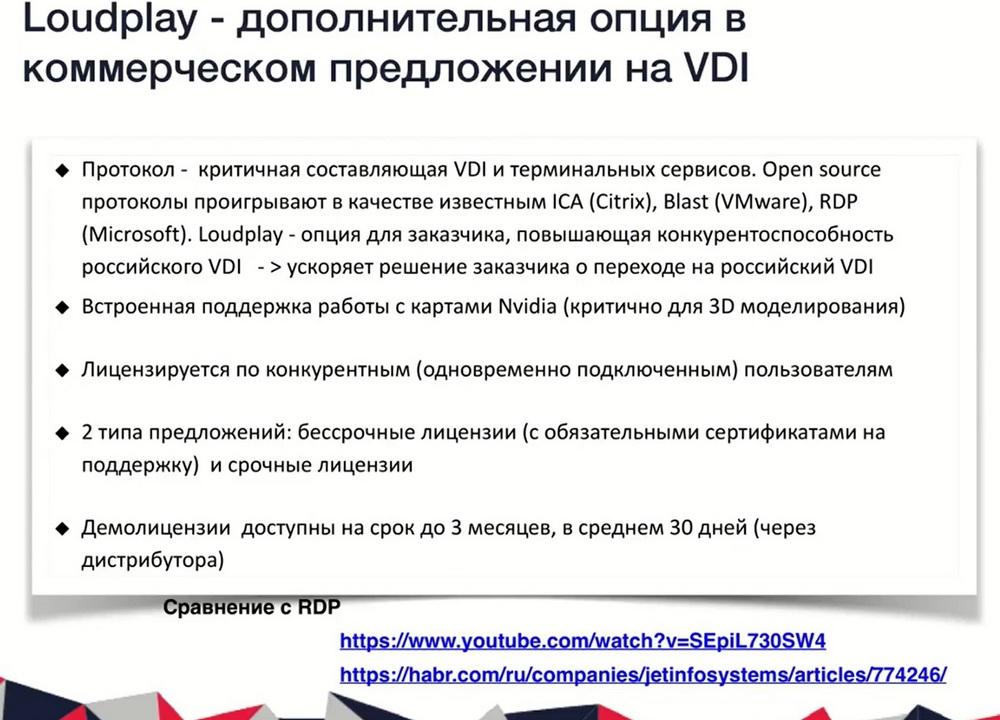
Why offer Loudplay? Looking at the history of VDI creation, Citrix was the undisputed leader in the market for a long time. But the technological breakthrough occurred when Citrix introduced ICA, when they adapted it, VMware lagged behind Citrix. But with the advent of the Blast protocol, VMware began to overtake Citrix in some markets. Therefore, the protocol, although a basic functionality, is nevertheless very critical to implementing the requirements that customers have for the functionality of VDI solutions. Definitely everything related to design bureaus and not only educational institutions, everyone who uses NVIDIA cards in their current life, there is a solution. I already said that. Licensed per concurrent user. Loudplay has its own licensing server. Available part numbers in two types. This is a perpetual license with mandatory support purchase and term licenses that include update and support capabilities for the term they are valid. Demo licenses are available through distributors, or directly from us, if you have a partner status of the appropriate level. The maximum term is three months, but we do not recommend taking more than 30 days, because we are developing quite actively now and we release new releases quite often. Therefore, we prefer to give no more than 30 days.
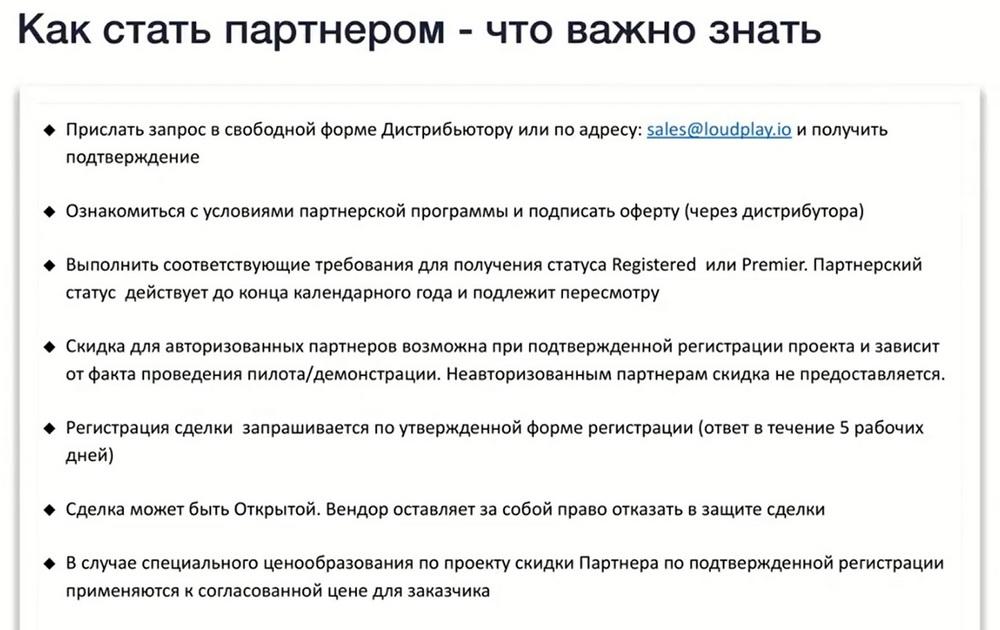
What do you need to become a partner? First, you need to get acquainted, so we expect a request either through distributors or directly to sales@loadplay.io, so that we can understand that we are dealing with a partner, and not just a customer or an interested individual. Next, you need to familiarize yourself with the terms of the partnership program and sign the offer. It is available from the distributor, upon request he will send it to you. We have two statuses - Registered and Premier. As we assume, Premier pays more attention to partnership and allocates more resources to sell our solutions.
The partner status is valid until the end of the calendar year and is subject to revision in either direction. Discounts for authorized partners also have two levels. It depends on the fact of registration, or on the pre-sale work or pilots that the partner implemented during the preparation of the project. Therefore, the earlier you register the project, the more we understand what is happening with it, the greater the discount you get. Unauthorized partners do not receive discounts. Deal registration is requested through an approved registration form. It is also available from the distributor. You will receive an answer in any case upon confirmation of registration or upon refusal. Refusal of registration is not explained, but it should be noted that some transactions may be open, despite the fact that there are various political moments not related to the partner that force us to indicate this point. Therefore, the deal may be open, we may also refuse to protect the deal if there are any facts of incorrect behavior in the market or customer policies.
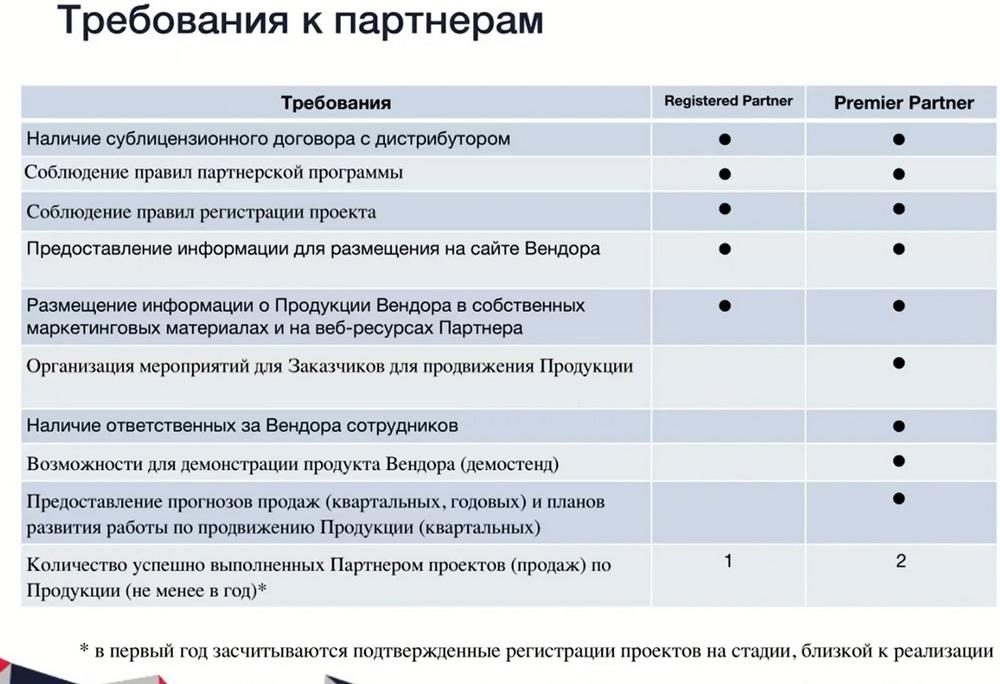
Requirements for partners. All partners need to make sure that there is a sublicense agreement. It can be a general plan, a general agreement with the distributor. It is important that the partner familiarizes himself with and complies with the rules of the partnership program, as well as the rules for registering the project, posts information on the vendor's website and posts information about the vendor on his own website. Well, then there are differences. The requirements for Premier are slightly higher. We expect that the Premier partner will organize some events or include information about our solution when conducting their own events with other solutions, in particular with our technology partners. There are responsible, maybe not dedicated employees, but responsible for our direction. There are technical possibilities for demonstrating the product, for conducting a pilot. We plan to communicate, make sales forecasts, either quarterly or on an annual basis, depending on the situation on the market and the success of promotion. By the number of successfully completed partner projects, we expect that if a partner has registered and has a minimum partner status, then it is clear that he expects to conduct at least one transaction per year, we expect two or more from a Premier partner.
At the start, when launching the partnership program, we understand that the partner may not yet have any implementing projects, so we count projects that are in a sufficiently developed and close to implementation stage.
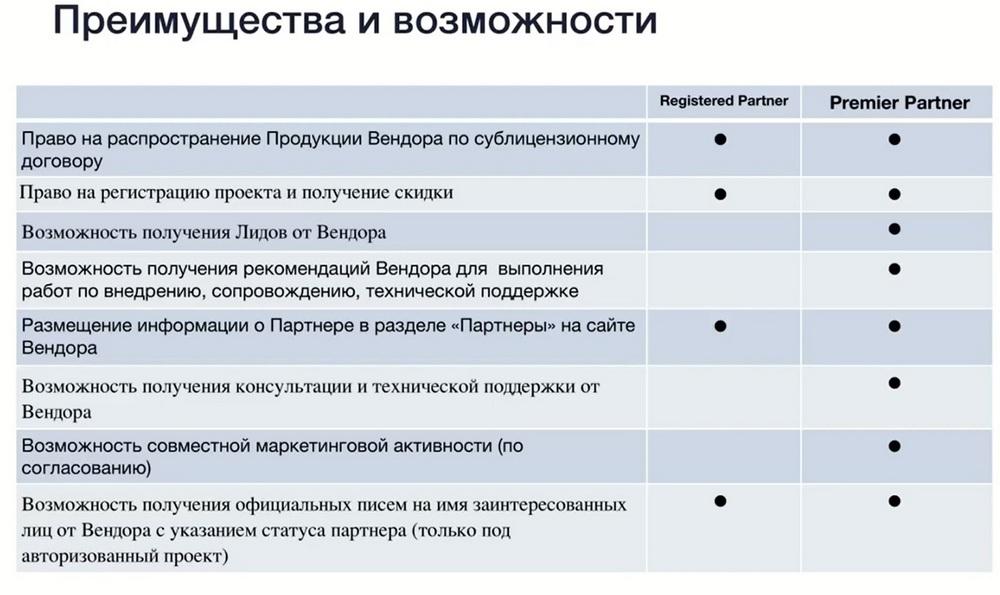
What are the advantages of partnering with Loudplay? The very fact of the right to distribute products, the right to register a project, receive a discount depending on the status, the possibility of receiving leads. We have a feedback form and when we receive requests from customers, we have the opportunity to transfer leads to our partners, and that we can transfer them only to those who have the appropriate competence. If necessary, if such a task is set by the customer or one of the partners, we can give some recommendations, again, if there is competence, for performing work on implementation, maintenance or technical support.
Both statuses involve placement in the partner section on our website. We can provide detailed technical advice on setting up directly with Premier partners. We conduct joint marketing activities with Premier partners, so our participation as speakers is also possible for such partners. But the formal part of receiving official letters for participation in the competition with the indication of the corresponding status is available for registered partners and for Premier partners.