The event of the company "FLAT", a Russian developer of software products in the field of corporate communications, is hosted today by Maria Bobtsova, Business Development Manager of this company. Program: • Introduction to the company and product portfolio. • Overview of Flat-Phone IP-telephones: technical and commercial information
Maria Bobtsova began her story with how the FLAT-PRO project appeared in their company. The company "FLAT" has been known on the Russian market for about 25 years as a developer of software solutions, such as call recording systems, notifications, solutions for implementing call centers, etc.
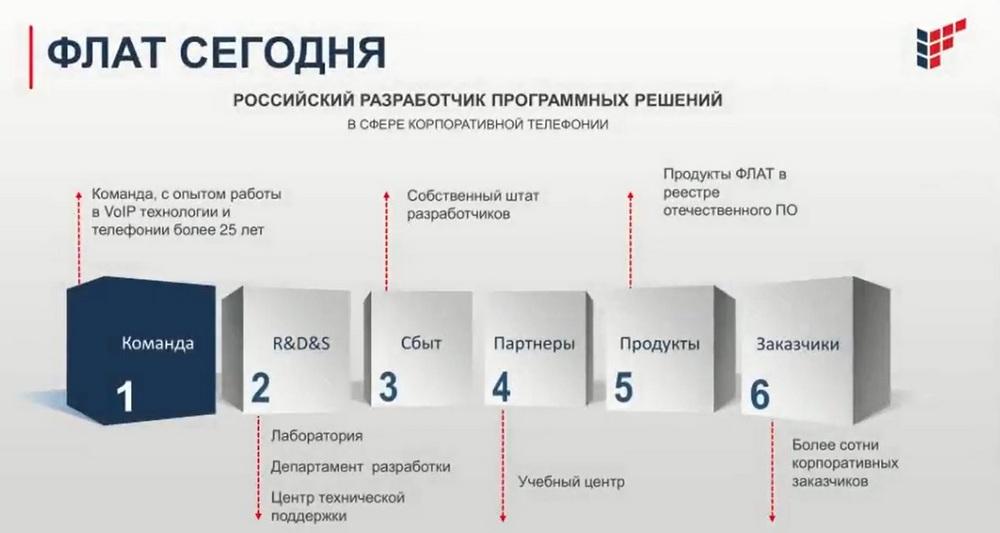
A year ago, the company "FLAT", having assessed all the prospects of the Russian market in terms of import substitution and customer needs, came to the conclusion that it is necessary not only to develop a partner network and a line of software products, but also to support software products with hardware solutions. Thus, the FLAT-PRO project appeared, i.e. the production of Russian equipment.
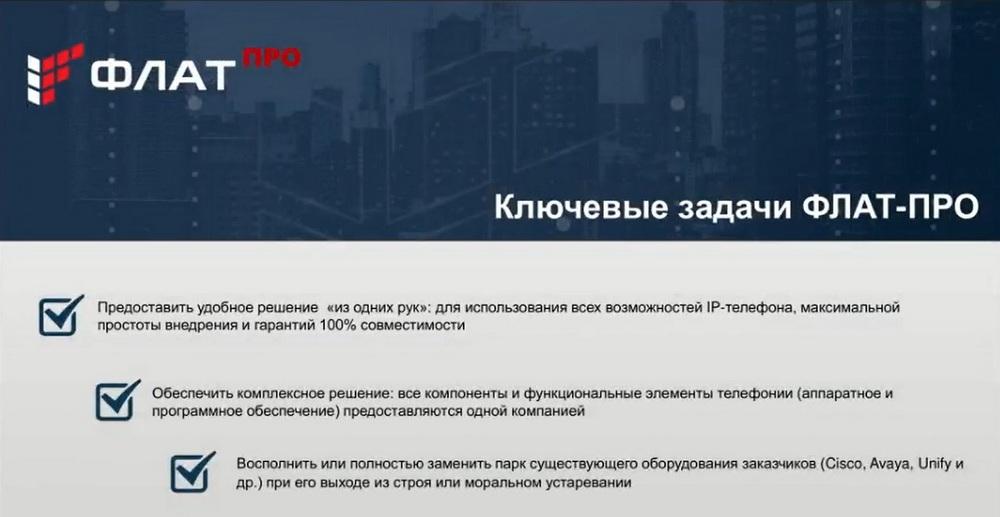
The main task of the direction that I represent is to provide users with reliable Russian hardware solutions, IP-telephones, from one source, there are plans to develop a hardware line of our own production in order to be able to completely replace vendors that have left the market in the future.
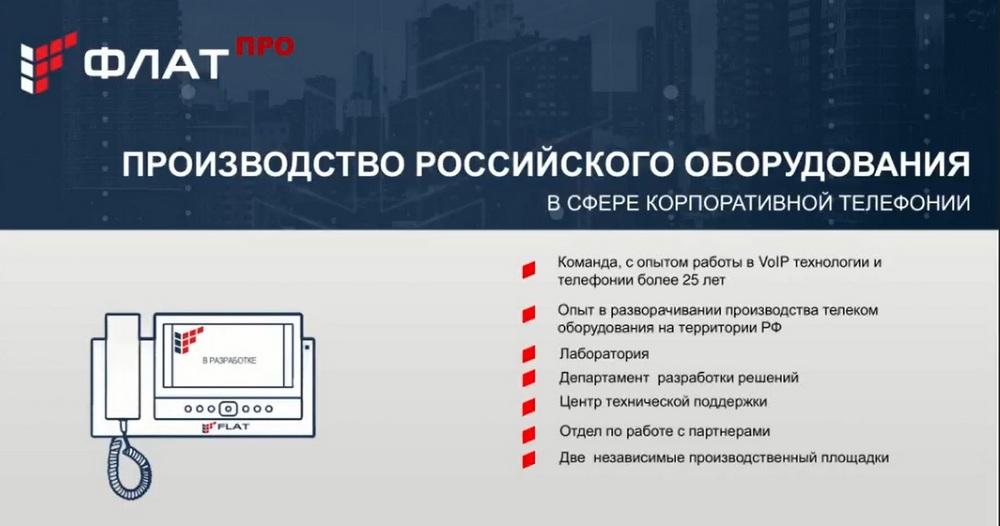
If last year everyone was still hoping that things would change dramatically and Western vendors would return, now it is becoming obvious that the situation will not change in the near future, and therefore it is necessary to switch to something. And in order to have something to offer the customer, the "Flat-Pro" team was formed, which included people with practical experience working at production sites in the Russian Federation.
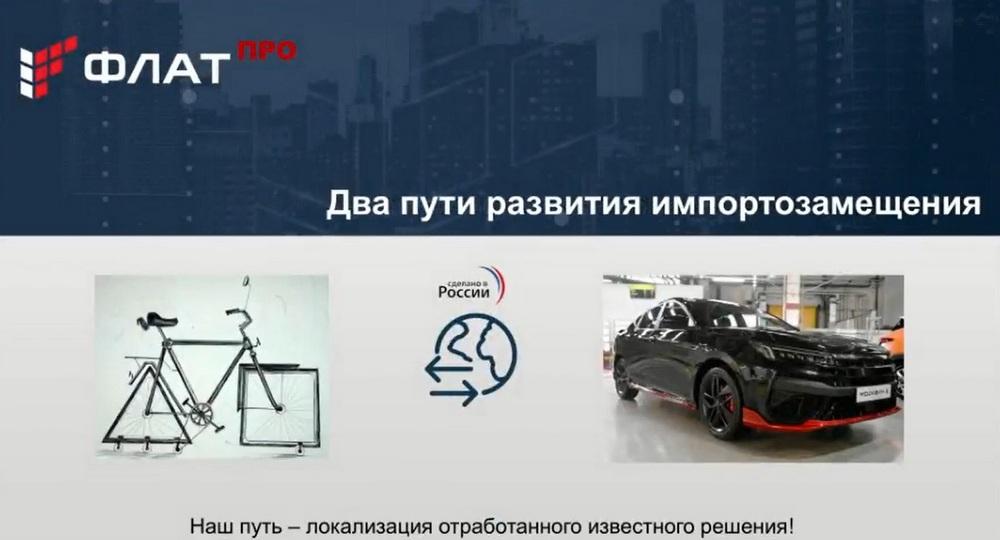
That is, this is a real development, production. The company was staffed with a development department, a technical support center. And at the end of last year, we launched our phones for sale. And today I am presenting what we have achieved.
One of my favorite slides, which I always show at the presentation, is a slide with the company's motto "Flat - the world of honest communications". The development of any new product requires from 3 to 5 years of real work. We didn't have that time, the market needs a solution right now. Therefore, we followed the classic scheme. We processed information about 25 design centers in China that position themselves as IP-telephone developers. These are the companies that declare that they are directly involved in the development and implementation of certain solutions. We compiled a sort list, which included 99 selection criteria for the supplier with whom we planned to work. These included requirements for functionality, plastic quality, design, the availability of our own development and rights to the phones that are offered on the market. Since it turned out that in China, out of 25 vendors who position themselves as developers, only 9 turned out to be real developers. While the rest OEM each other, someone steals something.
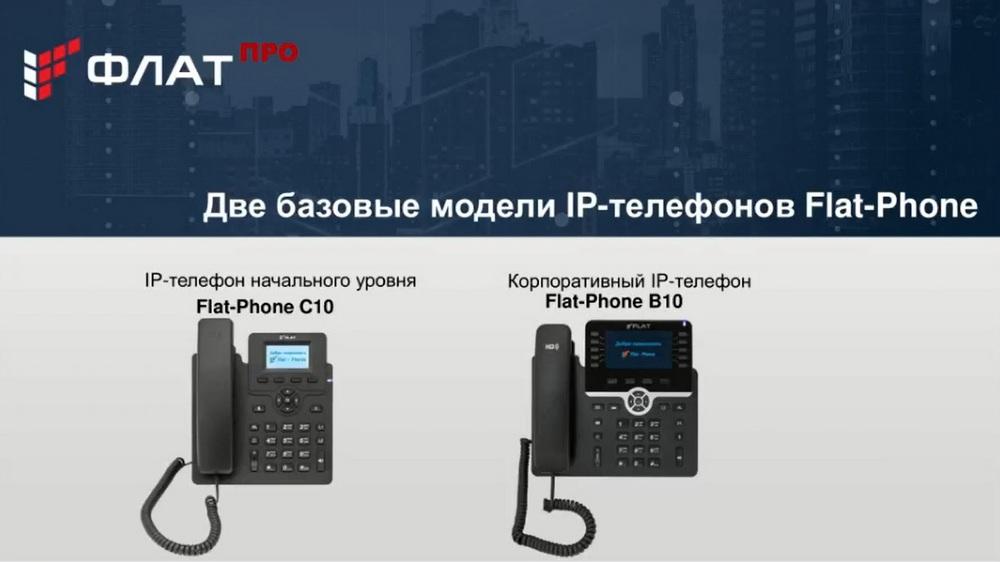
As a result of global work last summer, we signed a contract with the company "Din Star", and acquired the rights to two models of telephone sets. When we talk about the acquisition of rights, we mean the acquisition of rights to both software and design documentation. That is, the ownership of this product has completely passed into our jurisdiction. And then we ourselves develop, produce and develop these models. Today I present to you two models of Flat-Phone C-10 and Flat-Phone B-10 telephones. Flat-Phone C-10 is an entry-level telephone, but at the same time it allows you to provide full basic functionality. And the corporate-level Flat-Phone B-10 telephone is a more advanced model.
You can test the devices by contacting OCS, get a demo kit, or you can contact us directly.
Why these names? Because the letter C stands for Customer, and B stands for Business. And we also have an idea - the Advanсes series, this is an advanced series, which is currently under development. There are no hotel phones at the moment. We have not yet decided whether to make a separate line for them, we are evaluating the market. There are questions and nuances, and we do not plan to release them in the near future.
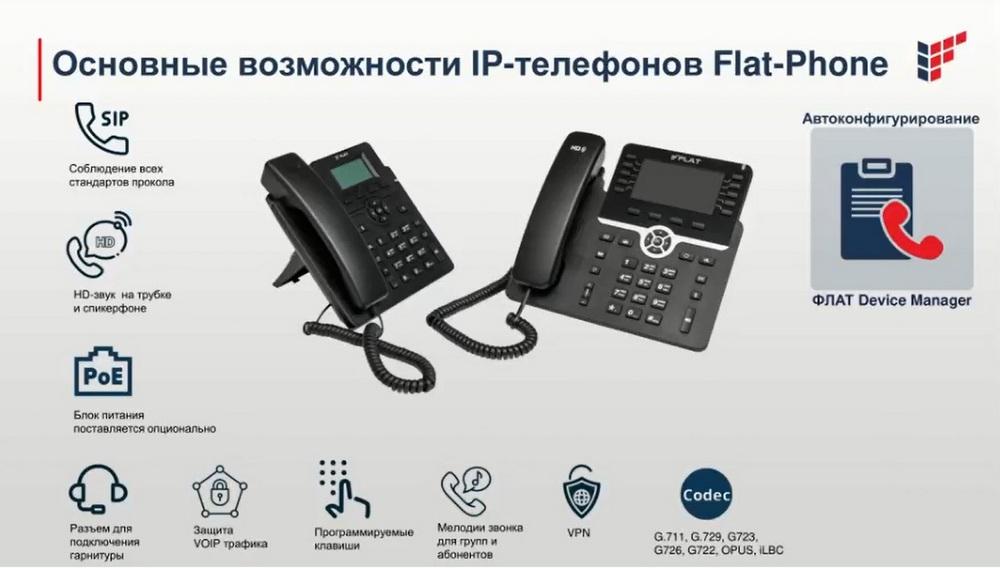
What our phones can do. The two basic models that we offer provide the full functionality that modern SIP-telephones should provide. This is support for SIP protocols. At the moment, from Russian phones, if we take the most complete line of codecs, including the 722nd broadband, the entire basic set of codecs that are available is present in our phones. Both the senior and junior models have connectors for a wired headset. You can also connect a wireless headset to the senior model. All phones are equipped with PoE. And there is the possibility of working with programmable keys, etc.
Regarding traffic encryption. We support working with TLC, uploading our own certificates, etc. There are no FSB certificates for telephones at the moment.
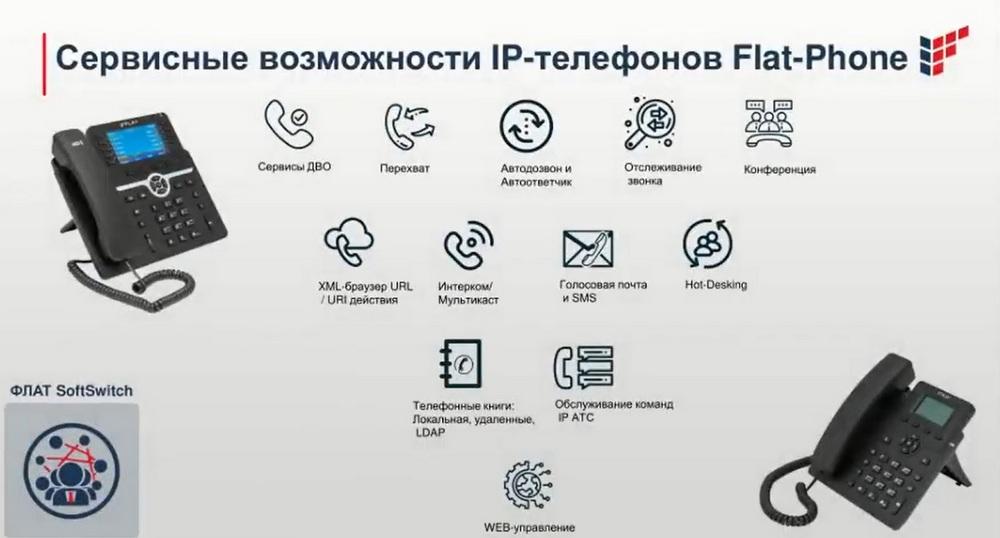
As for the functionality of the phones. This is a full DVO service, transfer, forwarding. Moreover, if we talk about call transfers, it is blind, with notification, without notification. Tested on different servers. From the point of view of telephones, all types of call forwarding are supported in full. Auto-dial and answering machine, both phone models support the ability to assemble a local conference. The junior model assembles up to 5 participants on its own, the senior model - up to 6 participants. At the same time, work from a network conference is supported. We have certainly tested all this on our own solutions. If we talk about the service that I have not yet seen on other phones, although it may be available to someone, this is the call tracking service. It works similarly to the Call-back service. If we talk about the callback service, then we ordered a callback, the station received the task, the subscriber we needed was released, it connected us, we received an incoming call at the entrance, and then there is a dialogue: "Are you calling me, no, are you calling me, and why?" 20 minutes have passed, no one remembers why. If we turn on call tracking, the phone's resources, upon the release of the remote subscriber we need, display information that you planned to call such and such a subscriber, he is free. Do you want to call him? And you are already consciously making a decision about the relevance of this call at the moment.
These small services and features, in addition to the standard local remote phone books, call logs, etc., are present in this phone.
Since November 2023, when we received the first samples of our phones from production, we have distributed about 30 sets for testing. The feedback is mostly positive. There are minor complaints. They note that we have too loud a sound. Some people find it uncomfortable, even when they turn the sound down to a minimum. One person finds the handset too light, another, on the contrary, too heavy, etc. But there are no serious comments yet.
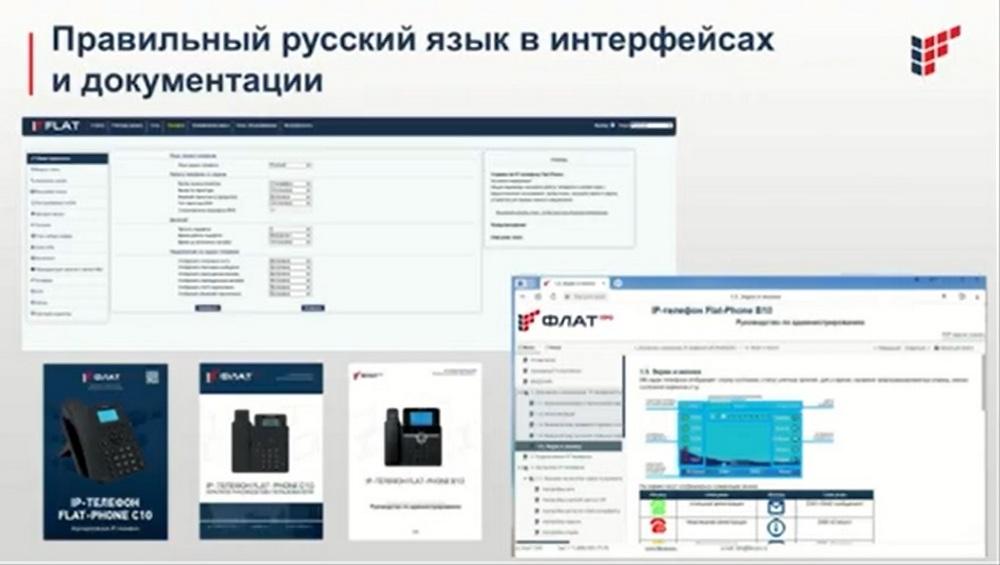
And we are ready to continue testing in order to receive feedback and respond to it. And what we are not ashamed of, what we have done from scratch and what users can pay attention to, is that we have completely rewritten the web interface and documentation. That is, this is not a translated localized web interface, where you can find Google-translated terms somewhere in the depths. This is a completely rewritten documentation. And it also differs in that it is web-based, i.e. it is a built-in web help, which has flexible navigation, it is not a pdf sheet of 280 pages, although the documentation is just about 280 pages. This is a web help with search, navigation, page indexing, which can be accessed directly from the phone's web interface. All phones have such a help, which provides a brief hint on the section and navigation item, and then, by clicking on the hyperlink, you get into the web help and can work with it. The documentation is available on our website, it is regularly updated, you can go there and read everything.
Then the presentation was continued by Sergey Kortyukov, engineer of "Flat-Pro". He presented the first line of phones.
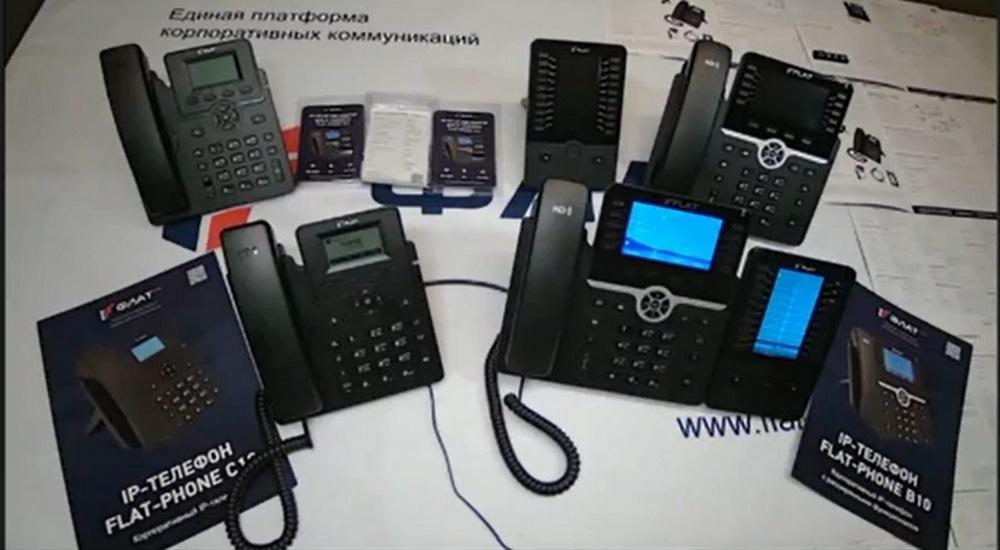
He started with the junior model of the basic Flat-Phone C-10 telephone. The design of the telephone is made in a corporate style. A weighting agent is built into the handset, thanks to which a high-quality device is felt in the hand. The phone looks decent and in terms of quality and design is not inferior to its competitors. The phone is powerful in terms of filling, it is pleasant to work with it. The phones boast fast loading-rebooting, a nimble web interface and instant response of buttons. On the back of the phone there are slots for installing a stand on the table. You can choose the installation at 40 and 45 degrees. Or you can turn the stand over and mount it vertically on the wall. There is a connector for a wired headset, a slot for a power adapter, two 100 megabit Ethernet ports. One for connecting the phone to the customer's network, the other for connecting to a computer. This model no longer supports 100 megabit connections. There is also a slot for a security lock. And a distinctive feature of this phone is that both models support PoE, which eliminates unnecessary wires and frees up unnecessary sockets.
On the front side there is a standard black-and-white five-line LCD display with a width of 2.3 inches. It supports five-level backlighting, as it is convenient for everyone: for someone brighter, for someone darker. The buttons are convenient for any hand. Both the joystick and the key dialers are soft, they will not allow you to miss. Since the phone supports both Cyrillic and Latin, both languages are printed on the keys.
We have a minimum set of functional programmable keys. They go around the case. This is a speakerphone, hold, etc. Keys that you do not use, such as cancel, for example, can be programmed to another functional button to which you are accustomed.
The handset and speakerphone are equipped with an HD-speaker with high volume. Well, it will be loud for someone, in further developments we will improve the sound. This model supports up to two accounts, and can assemble a conference of up to 5 participants on its own.
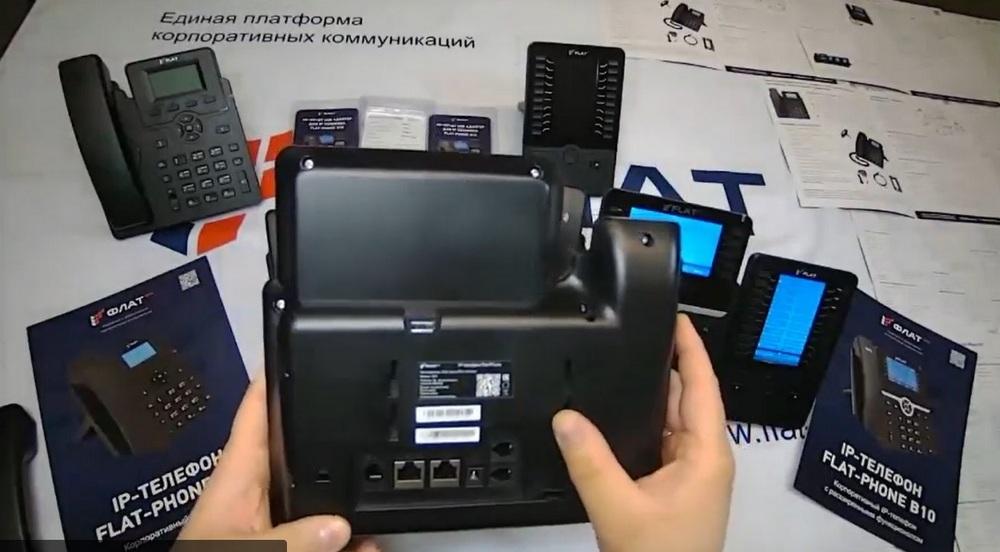
Now about Flat-Phone B-10. Let's start with the back of the phone. This model is not much different from the C-10 model. But the first difference is the presence of two Gigabit Ethernet ports. The second difference is the USB slot. In this slot you can connect a flash drive to which the phone will locally record calls on command. The phone can work with both local and server records. You can also put Wi-Fi, Bluetooth, USB adapter here. The phone can work simultaneously with both interfaces. And finally, this is a connector that serves to connect power to the expansion console. Two connectors for rigid coupling of the console and the phone. Initially they are closed with rubber plugs so that no dust gets in there. And on the front side around the screen there are 5 keys, each with a two-color LED indicator, green and red. And the screen expands to three screens, thus we get 30 keys. Switching between screens is carried out using the joystick (right-left).
Separately there are keys such as voice mail, redial, contacts, conference, which does not need to be configured to what we are not used to. Some keys have LEDs. These are the volume keys, microphone mute, hold call. When a person communicates with several subscribers at once, we see that someone is on hold, the subscriber on hold hangs up, the person sees that he has left, is in no hurry. continues to communicate with the current subscriber. And this can lead to a more productive, unhurried conversation.
The phone has large extensions, but we also have accessories to expand functionality. And the first is a USB-Bluetooth adapter flash drive. The name speaks for itself. It combines both wireless technologies. The adapter is small, compact and convenient. For those who need a wireless interface such as Bluetooth or Wi-Fi, it will be very useful. It is not visible on the phone. We connect it to the USB port on the back. When connecting the adapter, the phone performs automatic initialization, warns that the USB adapter is connected. And offers to configure one or another interface. You can use both. Those who need Bluetooth or Wi-Fi can configure them directly from the desktop.
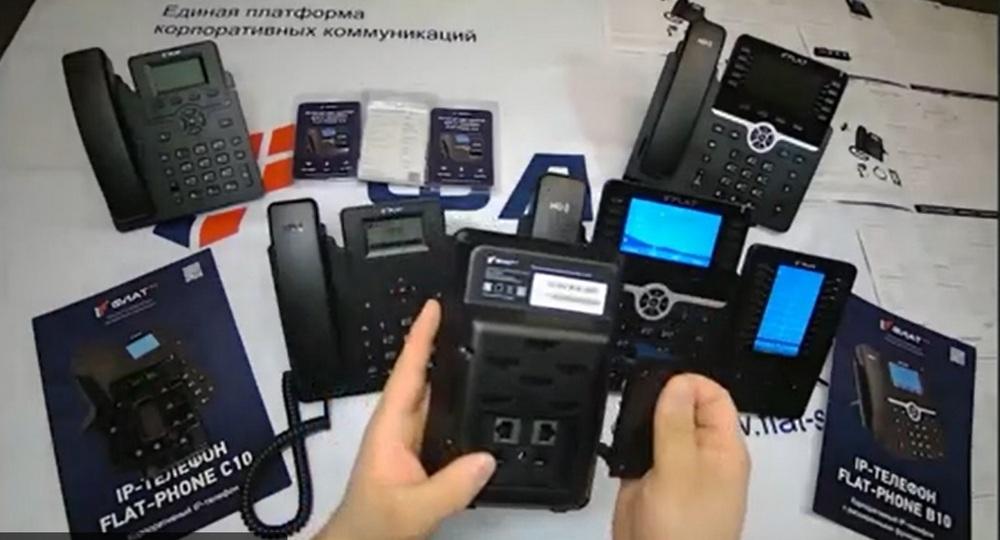
The second accessory is an expansion console. It also has, like the B-10 model, connectors for a stand at 40 and 45 degrees. It has two 100-megabit Ethernet ports, two ports for connecting power to the phone or from the phone to another console, a slot for a power adapter. The phone supports up to three expansion consoles connected in cascade.
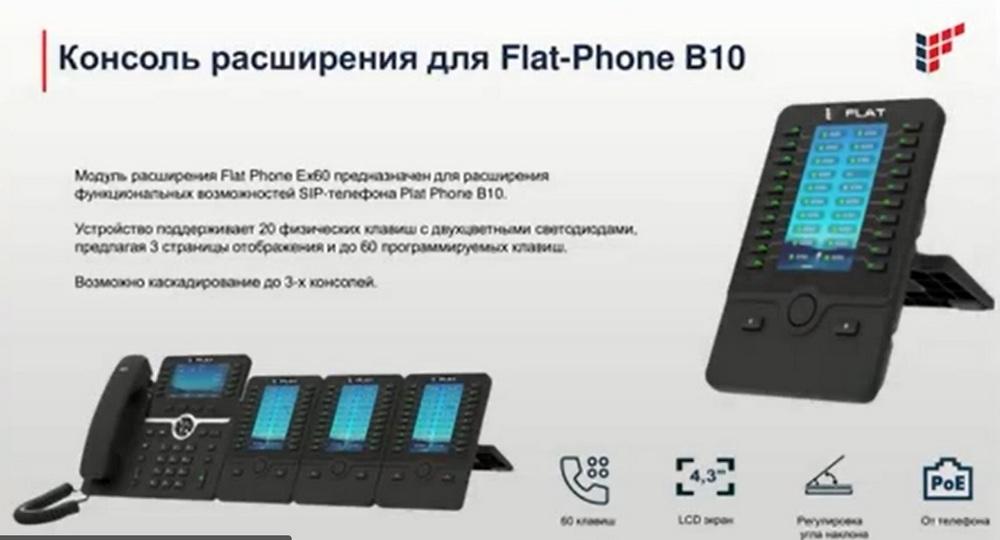
Also, if you need a Gigabit Ethernet port on your phone, but you also need consoles, then the consoles can work without connecting to the phone in the same customer network. At the same time, no MAC addresses need to be registered, only the MAC address needs to be registered in the phone.
On the front side, we are greeted by an LCD display, the same as that of the B-10 model. It is 4.3 inches, color. It also has 5-level backlighting. The console supports up to three screens. Switching between screens is carried out using the navigation arrows "right-left".
The functionality of the phone is great. I spent more than a month to study all the functionality. We are actively developing, developing new equipment, improving the functionality of products.
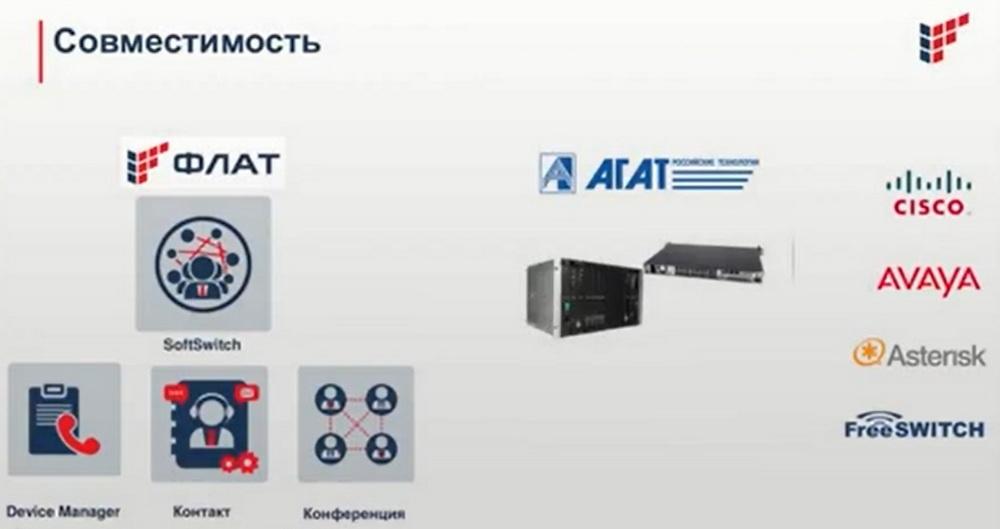
Now about production. Not all of it is in China. Having made the phones, the first thing we started working on next was compatibility. We certainly tested all solutions for compatibility with Flat-Phone solutions.
The telecommunications solution with which our phones were tested was the IP PBX Agat. And currently, Agat stations are recommended for use with our phones. Also, thanks to our colleagues and system integrators who have their own laboratories, compatibility testing has been carried out with Cisco platforms, AVAYA. There are no complaints in terms of compatibility. Regarding "Iskratel", we have planned tests. We talked to our colleagues. I think they will receive phones in the near future, and we will sign a compatibility protocol with them after they conduct these tests in their laboratory. Organizational issues are currently being resolved.
My task is to test our phones, pass a compatibility test with all Russian vendors that are represented on the Russian market so that customers receive working phones in their hands. We are always ready to adjust priorities for specific vendors. We are open to you in this direction.
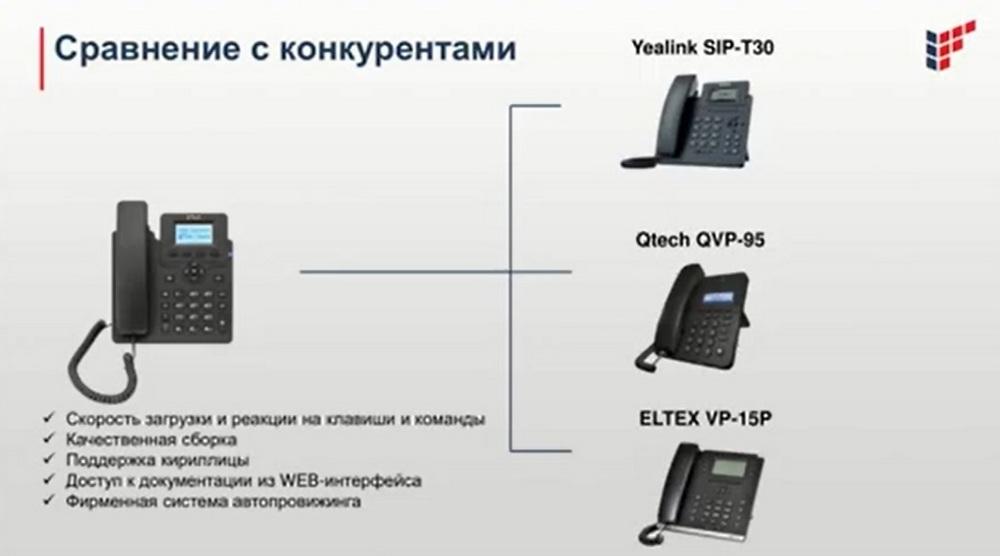
About competitors. I will not give head-on comparisons with competitors. If we take the requirements for the CTRU, then here we pass all the requirements without questions. Here are the competitive models from the point of view of which model to refer to when comparing.