The company "Basis" (part of the RTK-TsOD Group), operating in the Russian market of dynamic infrastructure management software, announces the release of the Basis Dynamix Cloud Control 5.6 update - a solution for managing clusters located in different data centers, as well as a major version 3.0 of the built-in module for deploying services in the cloud, Basis Automation Studio.

Key changes in the releases include a redesigned user access role model, an updated service deployment architecture, new resource management tools, and deeper integration of the platform with other solutions in the Basis ecosystem.
The Basis Dynamix Cloud Control platform is designed to manage private and public clouds built on various virtualization platforms — Basis Dynamix Enterprise, Basis Dynamix Standard, VMware vSphere, and RUSTEK — through a single portal.
The built-in role model in Basis Dynamix Cloud Control 5.6 has been replaced by a new flexible access control model, allowing administrators to assign rights precisely according to user permissions. The transition to the new model occurs automatically when updating the product installation: user rights migrate to the new structure without manual reconfiguration. Along with the new model, administrators received more convenient tools for working with roles, including cloning them — when copying, access levels, access rights, and filtering rules of the original role are transferred.
The new model includes built-in default roles, ready for use without additional configuration. It supports managing the lifecycle of custom roles for granular granting of necessary rights to various objects. When an account is archived, all associated roles are removed along with the access objects.
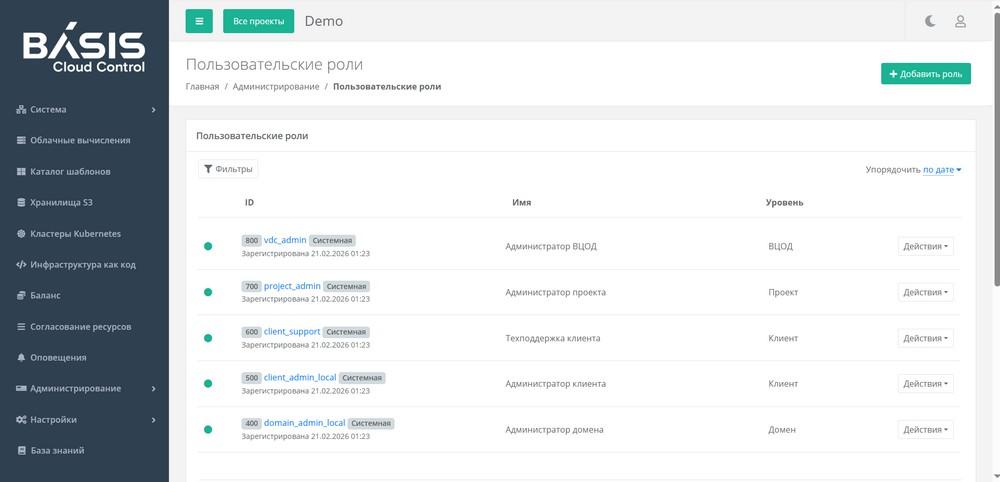
User role configuration
Deeper Integration with the Basis Ecosystem
In release 5.6, the functionality of Basis Dynamix Standard segments was significantly expanded. Users gained new capabilities previously available in other segments: support for networks, routers, load balancers, security profiles, and external data storage systems. The logic for building virtual networks became more flexible: a default route on the router is created automatically if the user has not specified their own. In configurations with multiple routers, deleting the last router port and disconnecting the network from the router are allowed.
For Basis Dynamix Enterprise cloud segments, support for a backup service based on Basis Virtual Protect — a Basis company solution for managing the lifecycle of virtual machine backups — was added in the new release. The administrator can connect the configured service to one or more Basis Dynamix Enterprise segments for which backup tools should be available.
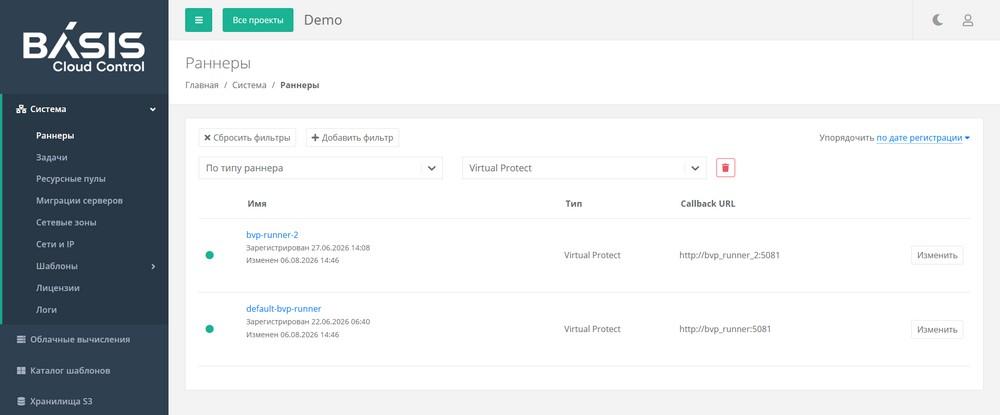
Integration with Basis Virtual Protect
Automatic synchronization of changes in the virtual infrastructure of Basis Dynamix Enterprise segments has been supplemented with snapshot operations — creation, restoration, and deletion. Background synchronization helps the administrator maintain consistency of the virtual infrastructure between the virtualization platform and the Basis Dynamix Cloud Control solution, which is important, for example, when performing service actions with servers and disks.
Finally, interaction between Basis Dynamix Cloud Control and the Basis Dynamix Enterprise virtualization platform has been implemented through the Basis Virtual Security account — a Basis company solution designed to protect virtual infrastructure.
Resource Management: vCPU Oversubscription and Limits at the VDC Level
In the new Basis Dynamix Cloud Control release, special attention was paid to controlling the volume of provided resources, ensuring predictable consumption, and optimizing costs. At the virtual data center (VDC) level, limits and a resource allocation approval mechanism have been introduced, giving administrators predictable control over consumption within individual VDCs.
For cloud segments on the Basis Dynamix Enterprise platform, management of the vCPU oversubscription ratio and mode has been implemented, allowing the administrator to flexibly regulate the density of virtual machine placement. The oversubscription ratio determines how many vCPU cores will be allocated per physical processor core and is specified separately for each physical server. In the absence of restrictions, Basis Dynamix Cloud Control will use any nodes with sufficient resources to launch virtual servers. When strict oversubscription mode is enabled, virtual servers will not be launched on physical nodes if they do not have enough free vCPU cores.
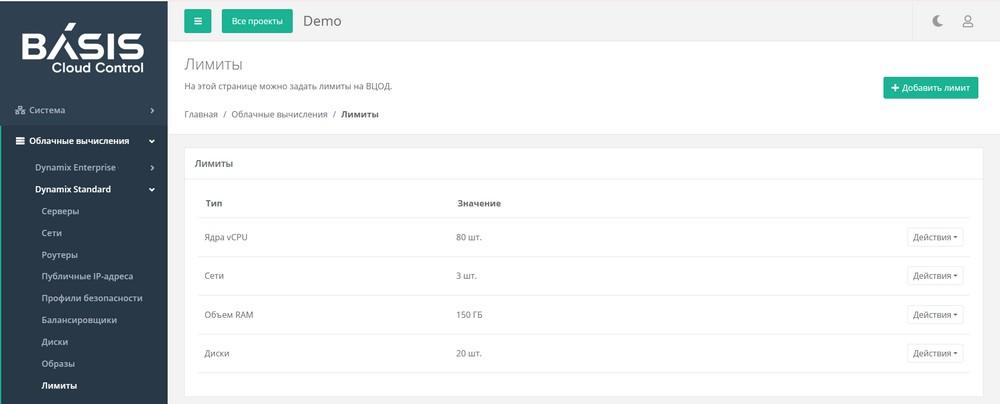
VDC limits configuration
New Features of Basis Automation Studio 3.0
Basis Automation Studio is a Basis Dynamix Cloud Control module that provides an environment for automating the deployment of applications and services. With its help, the platform administrator can manage the lifecycle of cloud services, work with templates and components, publish ready-made services on the storefront, and offer them to users.
Fault Tolerance and Horizontal Scaling
For Basis Automation Studio 3.0, one of the most important changes was the architectural shift — the module has been migrated to a fault-tolerant architecture in a Kubernetes cluster. Basis Automation Studio components, including orchestrator containers and the database, operate in a high-availability configuration: if a single node fails, the load is automatically redistributed to the remaining nodes, and platform operation is not interrupted. A distributed fault-tolerant storage is used for shared data, and Kubernetes operator tools are used for database management.
Along with fault tolerance, horizontal scaling has appeared: the number of instances of key services is set during deployment, which allows increasing platform performance under growing load without changing its architecture.
Working with Dynamic Data
Another important innovation in Basis Automation Studio 3.0 was the introduction of dynamic providers, which enable the creation of dynamic data types when ordering a service. Thanks to this, the module can access external systems and return actual data, calculated according to user scenarios in an isolated execution environment, to the order form instead of static fields.
Dynamic providers are displayed on the domain and project card. Within them, a programmatic interface for managing dynamic provider types has been additionally added to run user scripts.
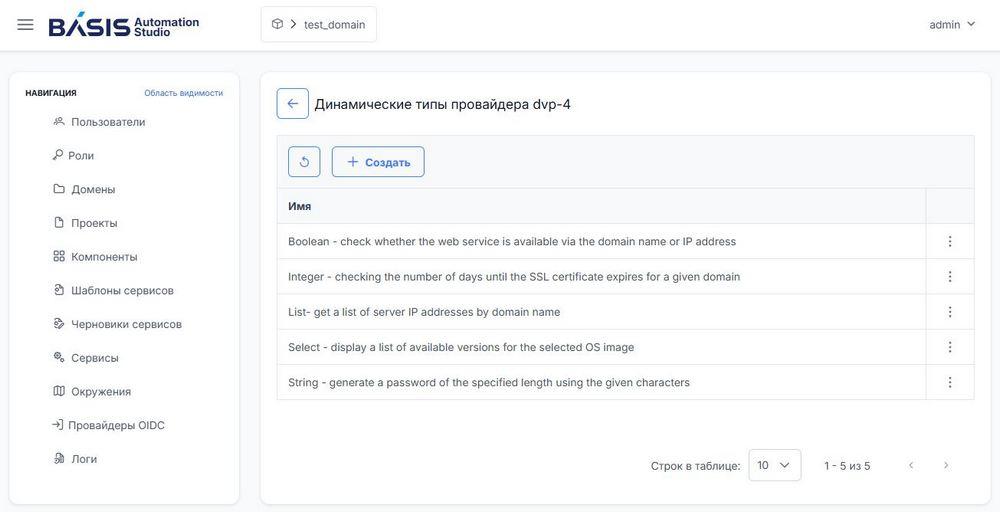
Creating dynamic provider types for calculating field values
As in Basis Dynamix Cloud Control, the role model in the Basis Automation Studio 3.0 module has been redesigned. Access rights are now set at the level of individual API methods, grouped by managed entities. Each role is tied to a scope: platform, domain, or project — which defines the maximum set of available actions. A user is tied to one scope, but can be assigned multiple roles, including standard ones — in which case access rights are cumulative.
“The priority directions for the development of our cloud platform Basis Dynamix Cloud Control remain the expansion of virtual infrastructure management capabilities and increasing the compatibility of the cloud solution with other products of the Basis ecosystem. In release 5.6, we made several significant steps in both directions. As for our solution for managing cloud services, migrating Basis Automation Studio to the new k8s architecture will allow moving workloads without interrupting product operation. In addition, for ease of use with the module, we have implemented dynamic providers and expanded the capabilities of the platform's graphical interface,” noted Dmitry Sorokin, Technical Director of Basis company.