Translated with AI from the Russian original.
Tatlin.Backup.L is designed for use in large banks, telecom companies, industrial enterprises, and government agencies.
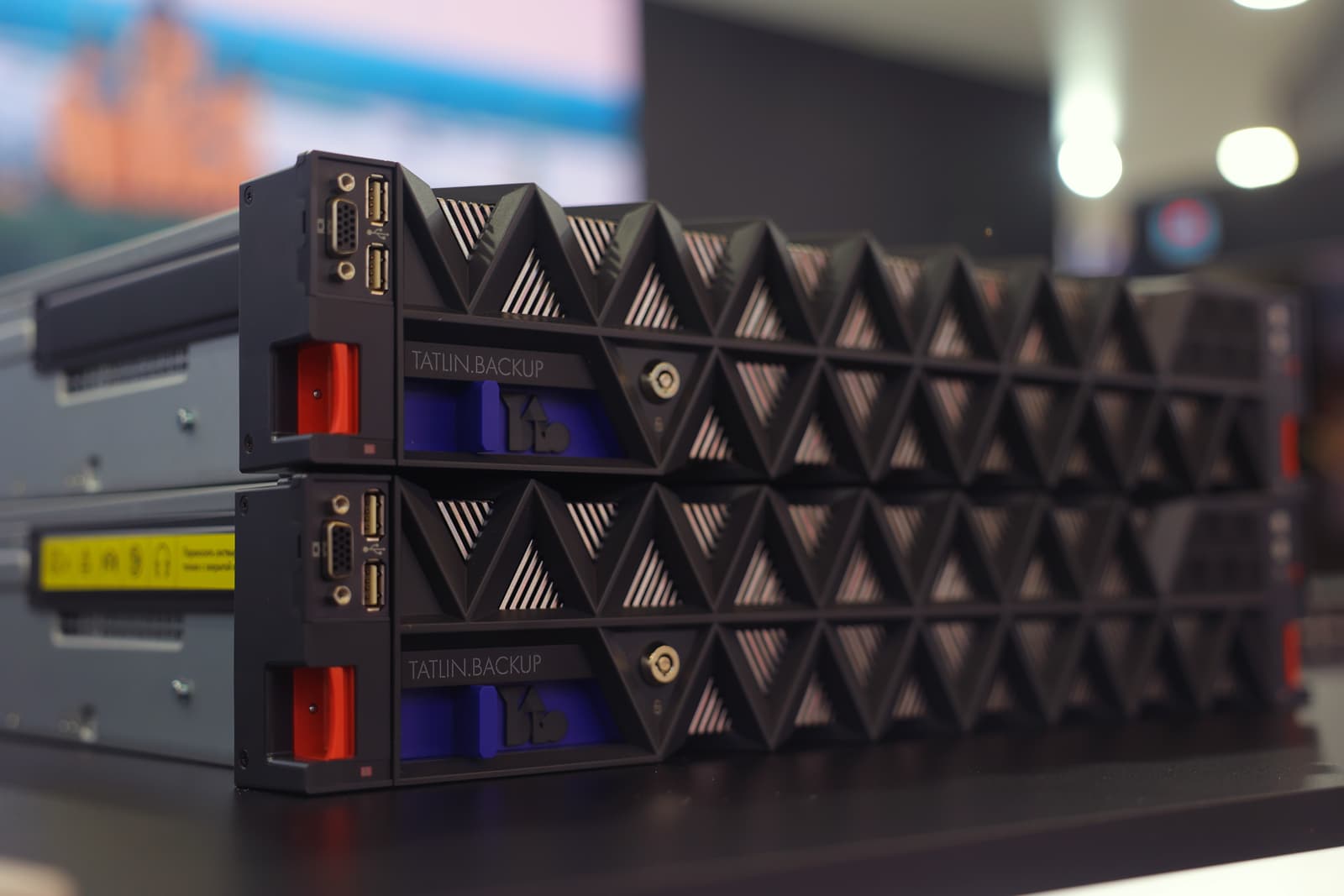
Yadro, a company part of "IKS Holding", presented a new flagship model of its data storage system (DSS) for backup – Tatlin.Backup.L – at the CIPR-2026 exhibition. This specialized solution is designed for corporate IT infrastructures with high reliability requirements and large volumes of stored data.
One of the key features of Tatlin.Backup.L is its high fault tolerance, ensured by two storage controllers operating in an Active-Passive high availability mode. Data protection is achieved through proprietary T-RAID technology, mechanisms for power loss and DRAM error resilience, as well as instant snapshots of three types, including undeletable ones.
Storage cost optimization is achieved through global multi-threaded inline deduplication and compression. This allows for more efficient data storage compared to general-purpose systems or servers. The system supports over 1 PB of usable disk capacity, and with a compression ratio of 6:1, the capacity can reach 6 PB.
The base write speed is 22 TB/h, and when using the T-BOOST protocol, it can increase to 45 TB/h. This is achieved by transferring only unique data blocks over the network.
Tatlin.Backup.L has undergone internal testing in Yadro's laboratory and customer site testing, confirming stable operation under high load. The system is currently undergoing registration in the Unified Register of Russian Radio-Electronic Products of the Ministry of Industry and Trade. Company representatives reported that the new model is already available for demonstration testing.