Basis, a Russian developer of solutions for managing dynamic IT infrastructure, has introduced Basis Automation Studio (BAS), a platform services constructor. The solution is part of the extended configuration of the Basis Dynamix Cloud Control cloud platform and will be particularly relevant for customers who want to automate the deployment of complex IT systems and platform services that use virtual infrastructure.
To solve this problem, Basis Automation Studio provides system administrators and customer architects with tools for designing, deploying, and maintaining platform services in a virtual infrastructure.
The constructor allows visual design of infrastructure based on ready-made components and connections between them, use of a catalog of virtual infrastructure and platform service templates, as well as an extensible library of typical elements and samples of popular software, including ClickHouse, Consul, Docker, MariaDB, and PostgreSQL.
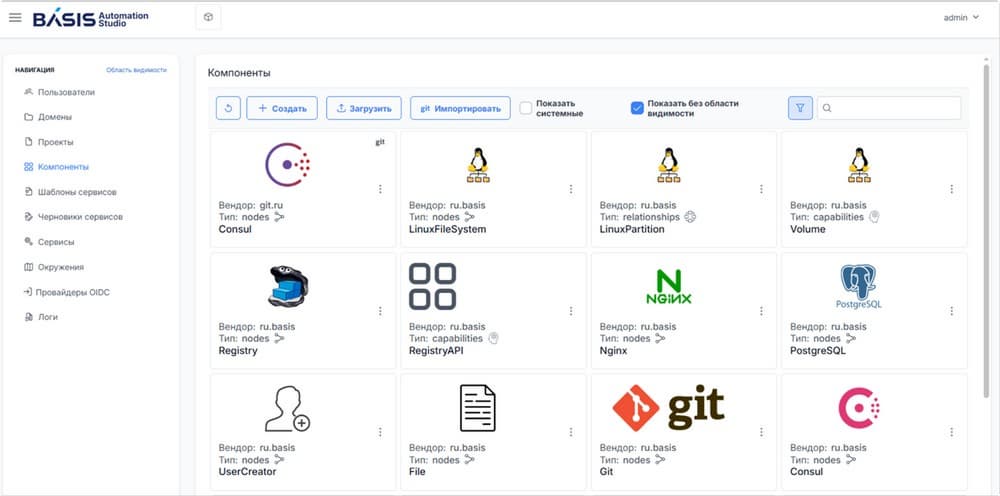
Basis Automation Studio supports standard cloud infrastructure tools and approaches, including TOSCA architecture, YAML serialization format, Ansible configuration management system, Python language, and Bash interpreter. These are used to describe cloud infrastructure and manage its components, deploy services, and configure them. After services are deployed, administrators can create day-2 operations for their maintenance, monitoring, updating, and ensuring operability. Ready-made services can be published on the self-service portal showcase, where they are available for one-click ordering by cloud infrastructure users.
For product administration and template development in BAS, a web interface is provided, including a visual service editor, as well as tools for managing rights and access control to infrastructure components.
Basis Automation Studio implements a hierarchical multi-tenant model that provides strict logical isolation of resources and granular access control. At each level of the hierarchy, access rights, roles, and permissions for interacting with the constructor and the services launched with its help can be independently assigned. For example, access can be differentiated between various departments (or other business units) of one company by grouping their projects and user accounts into special containers called domains. In this case, users and resources of one domain will be invisible and inaccessible to another, which helps the customer ensure confidentiality and data integrity within a scalable and branched IT infrastructure.
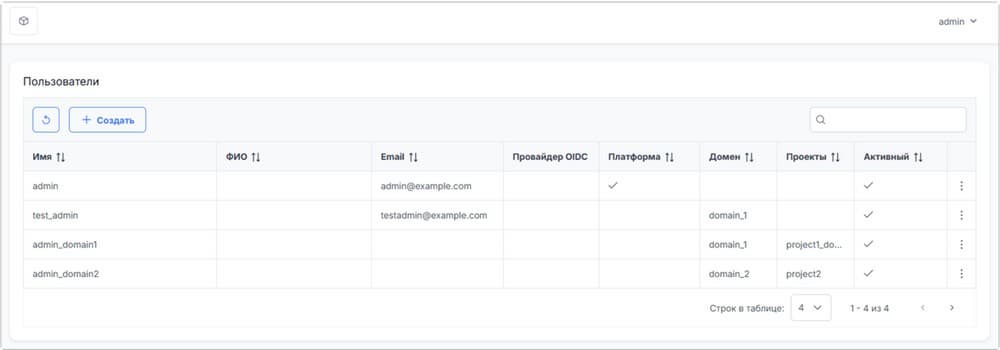
Additionally, Basis Automation Studio offers a role-based model for managing platform users. By default, the following roles are available: administrator with full rights to manage the constructor, architect for managing components and services, developer of components and services, project administrator, and user. If necessary, multiple roles can be assigned to one account within the constructor, in which case their rights are cumulative. As a result, the customer receives a simple yet flexible enough tool to ensure the security of the virtual infrastructure.
"The intensive development of the Basis Dynamix Cloud Control cloud platform, and in particular the emergence of the Basis Automation Studio platform services constructor, was our response to the growing market interest in cloud and hybrid infrastructures. The task of Basis Automation Studio is to facilitate the declaration of cloud infrastructure, as well as the deployment of business-critical IT systems and services within it, primarily through the automation of these processes. We plan to actively develop our product to meet the needs of Russian customers," said Dmitry Sorokin, Technical Director of Basis company.