
But first, it's important to understand that as soon as the word "asset" appears in a phrase, we must immediately realize that in practice, the unit of management is an object that:
1. Likely costs money and is purchased by the company.
2. Is necessary for the needs of a business unit or a specific person.
3. Can be a source of risks.
4. Has a life cycle.
5. Can generate revenue for the company.
In addition, effective IT Asset Management (ITAM) must answer several key questions:
1. How much does this asset cost, or what is its residual value?
2. From whom and when did we purchase it?
3. What is its current status?
4. Where is it physically located, and what is its movement history?
5. Who uses it, and what is its usage history?
6. Who is responsible for it, and what is the history of responsibility?
7. How much does it cost to maintain this asset?
8. What are the risks of using this asset within the organization?
9. What agreements are tied to this asset?
Once these answers are known, the management approach can change—it all depends on the organization's size, structure, and IT strategy. A small manufacturing company might use free software, track computer equipment in Excel, and not manage cybersecurity risks. A large telecom operator will use expensive software from major manufacturers, manage complex data centers, and conduct automated data collection on IT infrastructure and actual software consumption.
What AI has changed in ITAM
The first and main trend is, of course, the integration of artificial intelligence into analytics and management processes. As noted in the latest Flexera State of ITAM Report 2026, while in 2025 no respondents answered affirmatively to the question "Does your organization have sufficient transparency regarding AI spending?", in 2026, 31% did—which is good, but still very low.
The integration of AI into ITAM practice is currently happening in two key areas. Firstly, AI tools are used for the management processes themselves. This ranges from analyzing asset databases and identifying inefficiently used, incorrectly licensed, end-of-life, and unsupported hardware and software units, to populating asset cards based on scanning procurement documents or vendor agreements, processing requests for asset-related tasks, and analyzing the risk of changes. AI helps licensing and IT financial management experts automate their work, compensates for missing expertise, and accelerates analysis and internal audit processes.
Secondly, AI-powered tools themselves become objects of management. Companies need to systematically track tools with built-in AI, manage the access AI models have to corporate data, monitor subscriptions to paid AI services, optimize consumption, and avoid functional duplication. It is in this category that the Flexera State of ITAM Report 2026 notes the most significant shift in the responsibilities of IT asset management teams – while currently their main priority (78%) is maintaining accurate records of licensed software in use, next year they plan to focus on controlling AI consumption (47%, which is the maximum across 16 IT asset management areas).
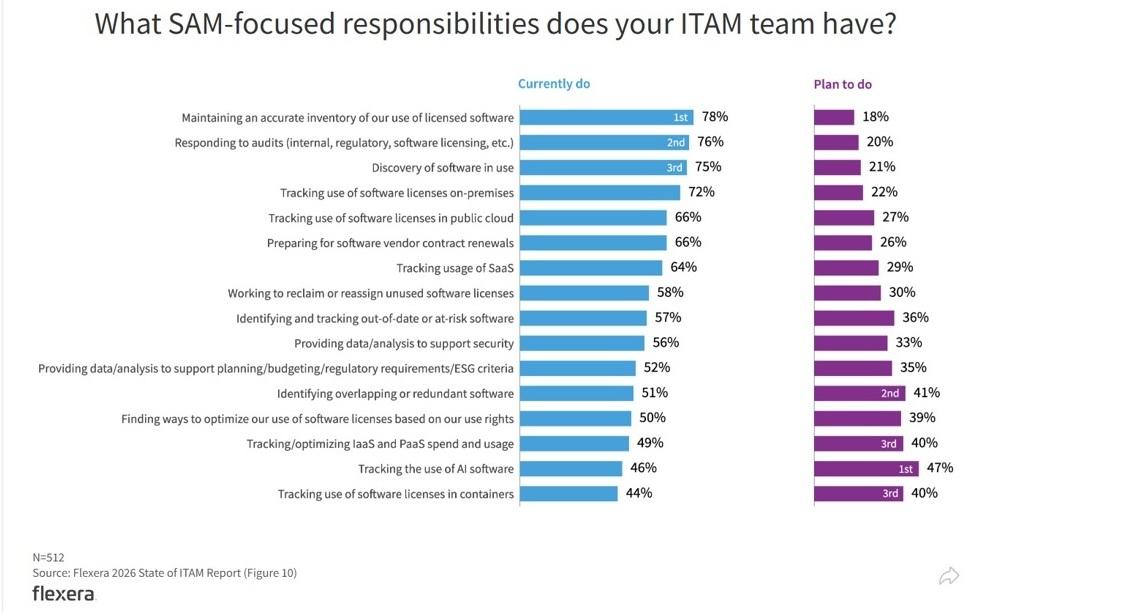
Shift in priorities for software asset management teams from maintaining current records to tracking AI usage. Source: Flexera 2026 State of ITAM Report.
In this sense, managing AI within the company becomes an important building block for formulating an IT strategy: according to the same report, it is there, in addition to the main opportunities, that the main risks, excessive expenses, and unjustified spending (59%) are currently concentrated.
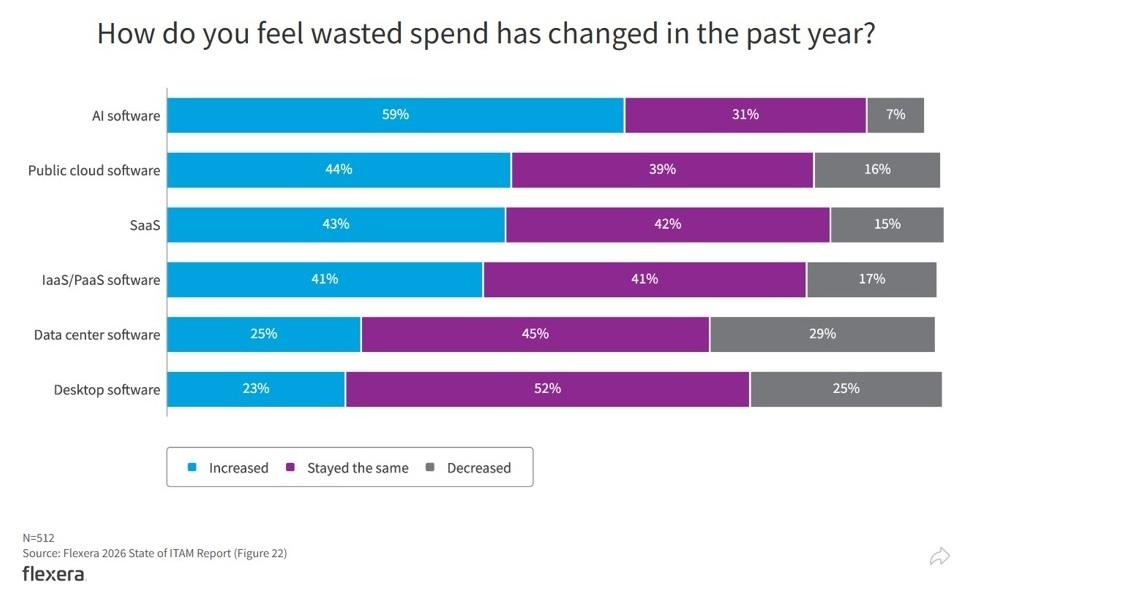
59% of respondents report an increase in unnecessary AI spending over the past year. Source: Flexera 2026 State of ITAM Report
Based on the methodology of the world-renowned management theorist Ichak Adizes, a company's strategy must answer 5 key questions:
● Why does the company exist, what is its purpose, market, customers, what is its business model?
● What will the company do to achieve its goals, satisfy its customers, and implement its business model?
● How will it perform the described actions?
● Who will be responsible for performing these actions and strategic initiatives?
● When are the results of strategy implementation expected?
The principles of the Adizes methodology are maintained in writing an IT strategy. In today's realities, the IT strategy (and, by the way, the company's strategy too) must directly describe what we are doing in the field of AI, what the goals are, how we manage it, who is responsible for it, and when.
Thus, if previously the IT asset management strategy had to be synchronized with the IT department's overall strategy (for example, one cannot plan to use free software in the IT asset management strategy if the IT strategy states that the company intends to implement ERP and focuses on SAP), now it must also take into account all the same aspects related to AI.
What has changed in IT asset management practices in Russia in recent years
Russian business is in a unique situation regarding IT management. On the one hand, everything written above is relevant for all Russian companies.
On the other hand, part of the context has changed radically. A huge number of Western hardware and software manufacturers have left the market. They were the key forces for years, encouraging companies to implement IT asset and software license management practices and tools. Previously, major vendors such as Microsoft, IBM, SAP, VMware would conduct audits and issue huge bills to companies for improperly used or unlicensed software, while Dell and Hewlett Packard fought against gray market supplies and focused on quality.
Now, Western software manufacturers are no longer in the market, and there is no one to conduct audits. Russian companies partially continue to use the same software platforms and products as before, but either do not pay for technical support and licenses themselves, or use cracked versions, or resort to gray schemes to access the latest updates. But what is absolutely certain is that vendor audits no longer concern them.
At the same time, most Russian software manufacturers, especially those who were not major players in the market before the departure of Western companies, have not yet fully developed client audit practices. License control mechanisms may be built into the product, but they do not consciously force clients to put things in order. The situation is roughly the same with hardware.
The absence of the threat of external audits has removed one of the powerful levers for implementing IT asset management processes and tools, reducing the need for licensing specialists and asset managers. Now, the only driver for ITAM remains the business's desire to bring order and maintain systematic accounting, which means optimizing costs for acquired IT assets, managing suppliers, and controlling risks, but more from a cybersecurity perspective.
Should we relax?
Despite the fact that an audit from, say, Microsoft no longer threatens Russian companies in the foreseeable future, there are two important factors that compel a number of companies to continue monitoring the use of foreign software.
Firstly, companies whose business is built on exports and interactions with foreign counterparties are forced to comply with the trade legislation requirements of the countries with which they trade. There have been cases where a large foreign buyer froze purchases because a supplier in Russia did not pay for software licenses. The logic of, for example, American trade legislation is as follows: if an American company buys a product from any supplier using American software, the cost of that software is "embedded" in the price of the purchased product. And if the supplier uses this software but does not pay for it, it turns out that the buyer is paying for the illegal use of American software. It's complicated, but the logic is clear, and the business risks are absolutely real.
Secondly, the legality of using any intellectual property protected by copyright is generally regulated in the country not so much by vendor license agreements, but by articles 7.12 of the Code of Administrative Offenses of the Russian Federation on the violation of copyright and related rights, and for more expensive software, by article 146 of the Criminal Code of the Russian Federation. This means that relevant police officers, upon receiving a statement or complaint, can visit a company using unlicensed software, and the officials responsible for its use and procurement, and at the very least, fine them. Yes, the fine will not go directly to the vendor but will settle in an account like "C" – but, believe me, it will not make it any easier for the company.
Conclusion
Like any practice, IT asset and software license management is actively evolving. The focus of management worldwide and in Russia continues to shift towards the adoption of cloud and AI-powered tools, and AI tools themselves are actively used for both automation and in-depth analytics, which is important to consider when formulating an IT strategy.
At the same time, the situation in Russia leaves its mark on ITAM. There is less pressure from Western vendors, but more chaos from import substitution, in-house developed products, and the replacement of large Western solutions with combinations of smaller free and paid tools from smaller manufacturers. And one cannot relax on this path either, because the risks of fines and under-licensing are replaced by cybersecurity risks and inefficient procurement.
Evgeny Vasiliev, IT Service Management Expert,
Consultant at Adizes Business Consulting
(ex-Russian office of Adizes Institute)