Translated with AI from the Russian original.
Event by Uniview, a global supplier of professional video surveillance systems and solutions. As the first Chinese company to create a network video surveillance camera, the vendor continues to develop advanced technologies for the industry. During the meeting, participants learned more about the company's history, project protection policies, and available Uniview solutions. The meeting was also attended by Egor Bokarev, lead engineer, and Slava Zhao, UNV brand manager.
The event was opened by Egor Bukharev, lead engineer at Uniview.
In 2005, we were a division of Huawei and Tricom, and in 2011 we started our own development path.
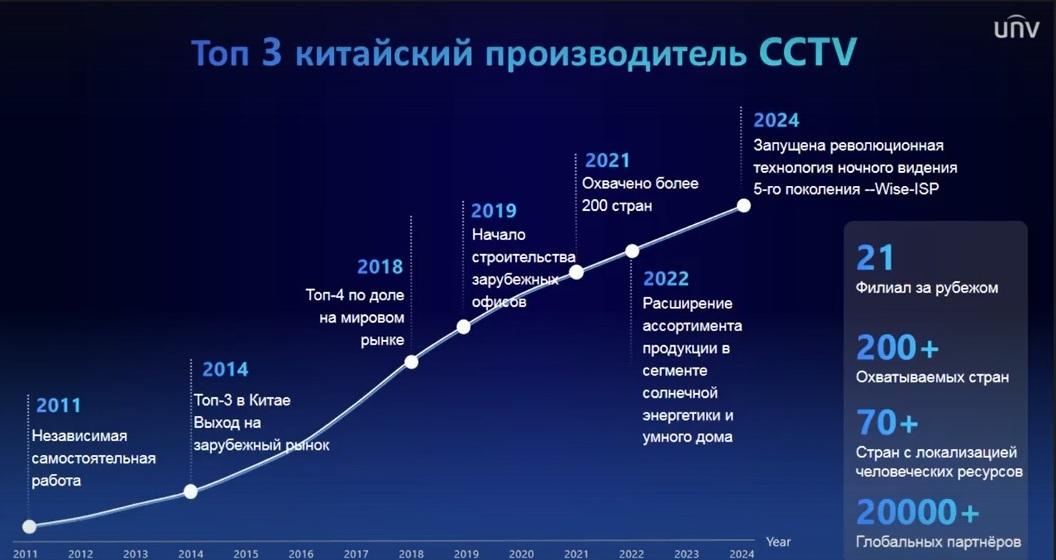
In 3 years, we already occupy 3rd place in China. In 4 years, we already occupy 4th place in the world. In 2021, Uniview sold its products in more than 200 countries around the world. In 2024, Uniview launched a new 5th generation night vision technology - Wise-ISP.
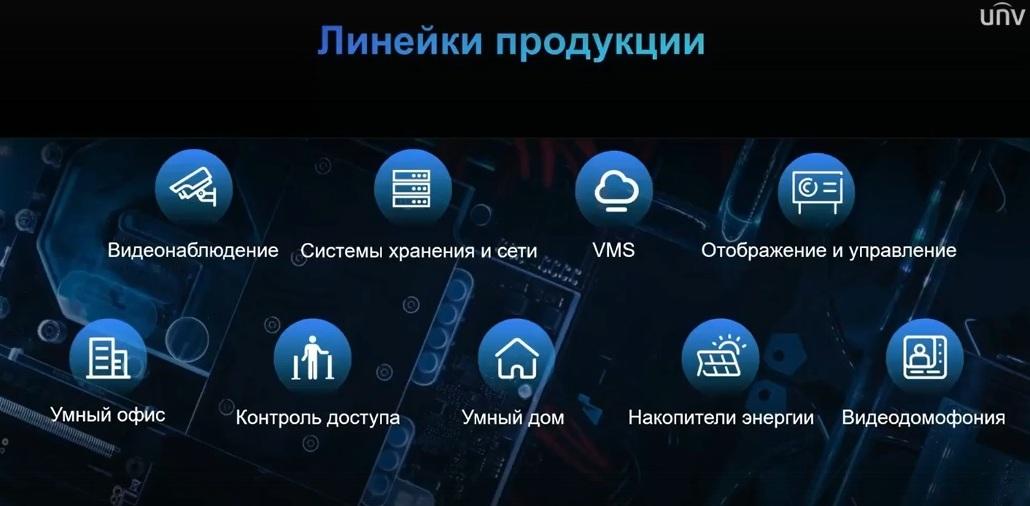
Today we will talk more about video surveillance, touch a little on storage systems and networks, I mean networks in the form of switches, display and control.
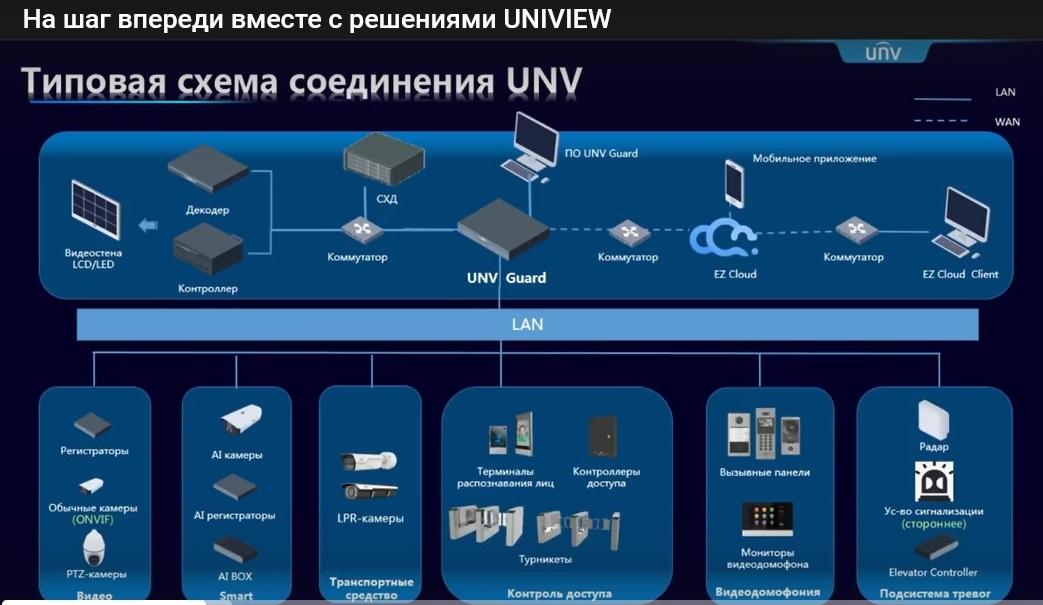
Also access control, smart home. Energy, yes, by the way, since 2024 Uniview has also become a company that deals with energy and develops its own solutions for energy storage, solar panels. And plus, of course, we have video intercoms, which will be presented, I hope, this year in the form of end devices.
Like any vendor, Uniview also has a certain categorization by the level of its products. We have the Easy series and the Prime and Pro series.
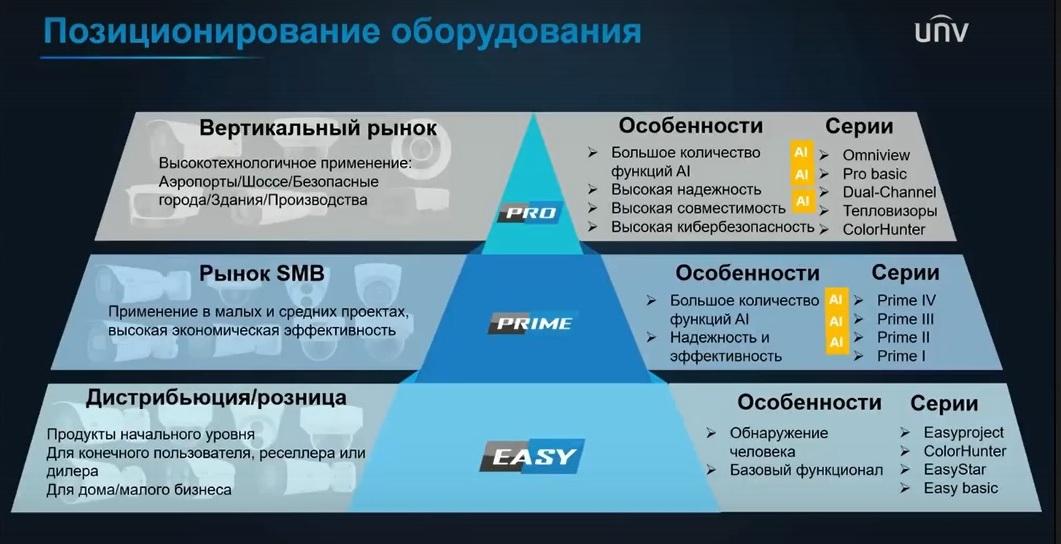
The Easy series is designed for distribution, for retail, for the end user. The Prime series is recommended for small and medium-sized businesses. This applies to both cameras and recorders. And the Pro series is designed for large vertical solutions, for large projects with their own specific features.
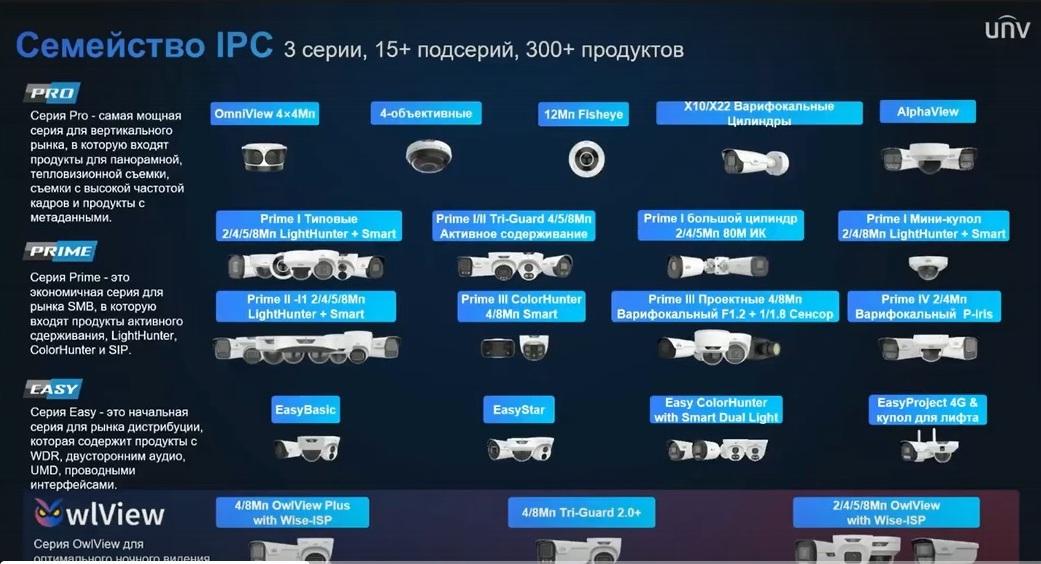
Let's talk about cameras. We have more than 300 products and more than 15 sub-series. The presentation of our camera line is large, it is recommended to watch it separately.
Pro series. This is a heavy solution, flagship products. These are OmniView cameras that stitch together an image from several sensors on board. These are full-fledged Fisheye, which themselves decompose the image into different streams. This is the AlphaView camera, which has face recognition, license plate capture, and perimeter protection on board. All the analytics that we have on cameras are in the Prime and Pro series, namely from intelligent analytics. They are embedded in the camera, they can be operated, including in the web interface, or in our free software, which is supplied without restrictions, by the number of channels per computer. You can connect up to 512 local channels, viewing 96 channels of live video or in archives.
Prime series for small and medium-sized businesses. This is probably the most economical solution. This is Starlight color image. In the Prime series, our cameras have all sorts of form factors, if we talk about standard ones. They do not have internal designs as such, they are all outdoor, that is, they are positioned at a temperature of minus 40 degrees. We supply them to Russia, with the exception of case models, which are recommended to be installed in a thermo box. They are also present in the Prime series. If we talk about the Prime series, varifocal models are only materialized, we do not have manual varifocals. Some models of the Prime series may have an increased frame rate, 50-60 frames per second, some models have backlighting of the natural visible spectrum, which can work not only in the visible spectrum, i.e. turn on the LEDs of visible backlighting, but also work in triple mode. Accordingly, the combination of these backlights will show the performance of this camera in terms of perimeter protection.
What is perimeter protection? This is an analytical function on board the camera. We call it Smart Inclusion Prevention, intelligent intrusion prevention. Suppose we have tested some territory where a person should not enter, or a line that a person, or a car, or a non-motor vehicle should not cross. And the camera will only trigger on these objects. For example, the camera can look at night in black and white mode, shoot a scene, and as soon as a person, or a car, or a non-motor vehicle crosses the line or enters the zone, the visible spectrum backlight turns on, shoots the incident in color, and as soon as a person, or a car, or a non-motor vehicle leaves the alarm zone, the camera switches back to black and white mode and hidden video surveillance. In this way, we get a color incident, which is very important for subsequent processing, and, including, the absence of light pollution, if the camera was shooting all the time in color, illuminating itself with LEDs of the visible spectrum.
The Prime series also includes wide-angle models. That is, it is not only a panorama in the classic Fisheye design, but also wide-angle cameras with a 1.6 mm lens, which allows us to shoot an image in 180 degrees without distortion in 16x9 format.
According to analysts, the Prime series includes perimeter protection, line crossing, entry into the zone, exit from the zone, intrusion, face capture, and people counting. In some models of the Prime series, there is another analytics, this is working with color capture. That is, when a person, a car or a non-motor vehicle violates something, enters the zone, crosses the line at the time of the incident, the camera records the color of the upper part of the person's clothing and the lower part of the person's clothing, that is, in most cases shirts and pants, and the car's color, and the non-motor vehicle - the color of the rider's outerwear - the cyclist. All these metadata are saved, and then, when searching for an incident through the recorder, we simply choose what we expect to see. That is, we are looking for, for example, a person with blue pants, and in a fraction of a second we get all the results. Thus, the search time is significantly reduced, you do not need to view either 5, or 10, or 15 minutes, but all this can be detected in literally a second. Therefore, we say that cameras should shoot in color, record in color, because this significantly improves the quality of the search, including in the archive.
Easy series, Easy Basic series, Easy Star, Easy ColorHunter does not tell you anything yet. There is a large separate presentation on cameras, where all this is told. But, in any case, even in the Easy series, there is some analytics, not very strong accuracy, as in the Prime series and in the Pro series. The Easy series has Ultramotion Detection analytics, an ultra motion detector, which allows you to record the incident when a person, a car, or a non-motor vehicle appears in the frame, which does not violate anything, but simply appears. There are also models of the Easy Project series. These are interesting models from the point of view of non-standard use. For example, you can use it as a photo trap, take it away and put it somewhere in the forest. The model has a solar panel and a 4G module. We do not like either Wi-Fi or 4G, because still the video surveillance systems that we are talking about are professional, and we would not like to allow a third operator in the form of data transmission to external servers, but at the same time we also have such models.
And, most interestingly, in 2024 a series of cameras with Wise-ISP technology appeared. We called it wlView and in the near future these cameras will also be sorted by Easy, Prime and Pro lines. They are already present in each of these lines. And in the near future they will be included in a separate category. At the moment, what is wlView? These are camera models that allow you to shoot in color in the complete absence of any lighting. Some wlView camera models do not have a single backlight. These cameras have a huge matrix, it is at least 1.8 inches, up to half an inch, and have a large aperture. The hardware is good, but at the same time these cameras fall into the Easy series, that is, into the budget series.
On the next slide I will show what wlView is, how it shoots.
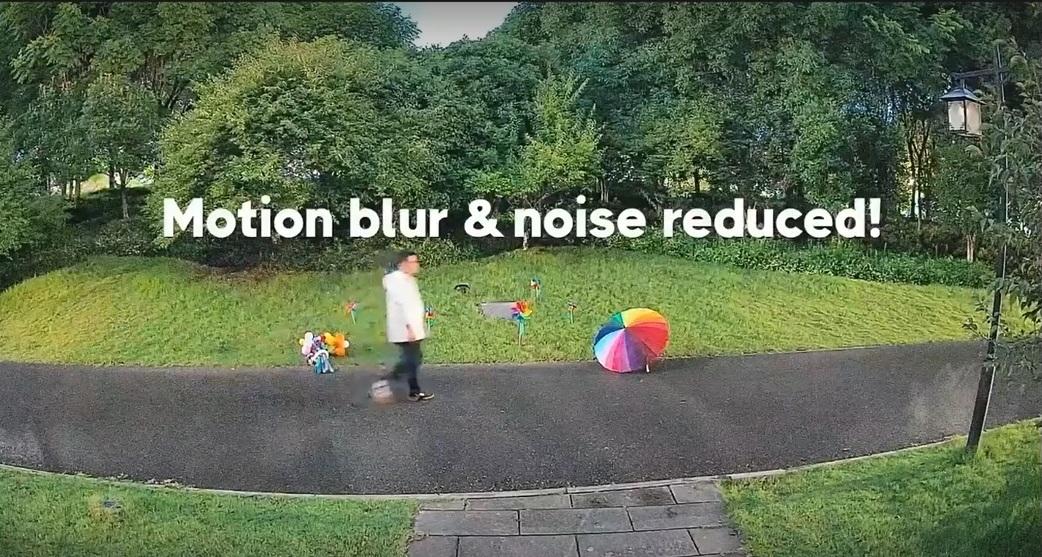
Wise-ISP camera, which shoots absolutely without backlights, as such, at any time of the day. And very high quality.
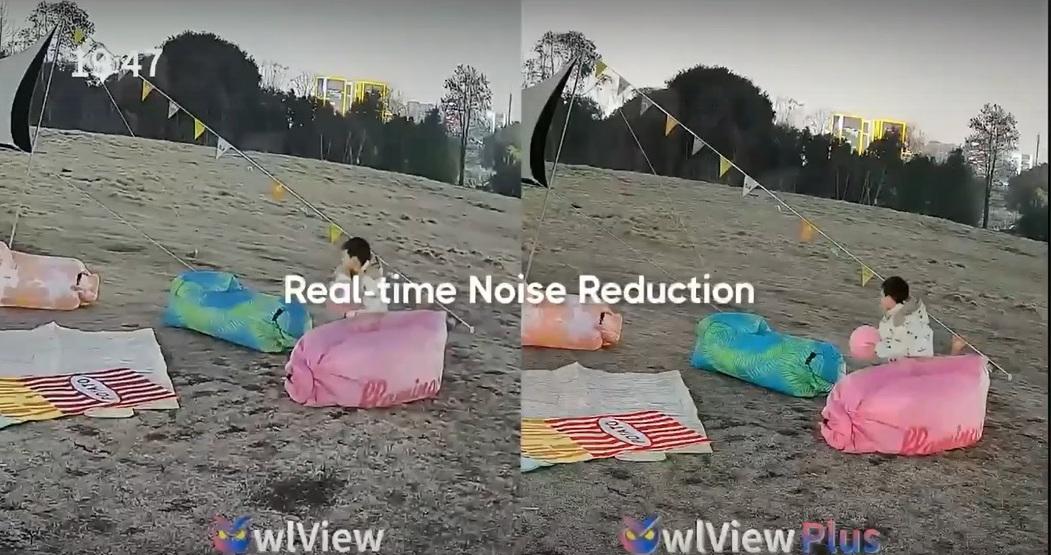
Do not forget that this is absolute darkness. And in six months, the company has already released the second generation of wlView, that is, wlViewPlus. That is, now you have seen the difference between the first generation of wlView and wlViewPlus.
The PTZ camera family has a similar categorization: Easy, Prime and Pro.
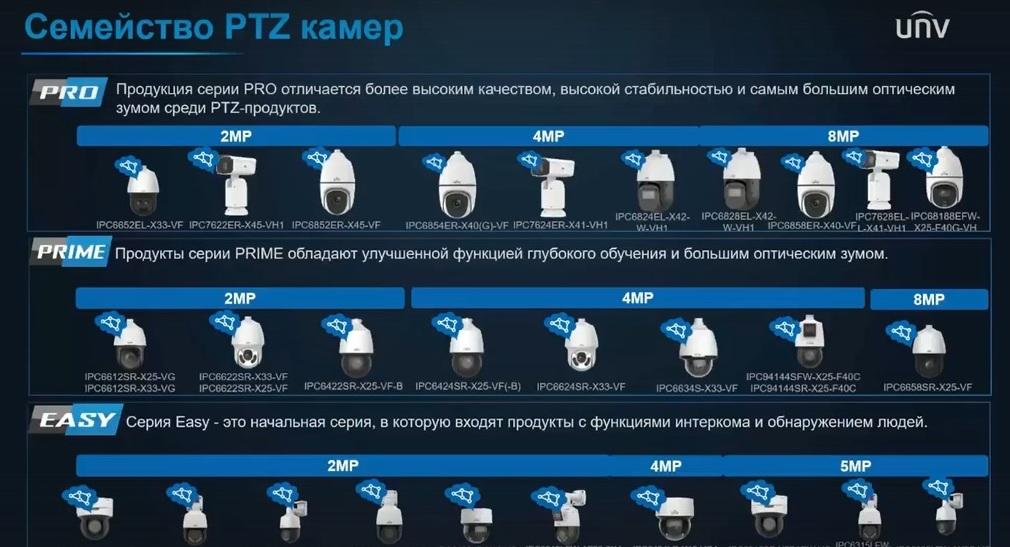
These are cameras with artificial intelligence, with perimeter protection, with face capture, with auto-tracking of people, cars, non-motor vehicles. We cut out everything that is not interesting to us, that is, potential dangers: these are people, cars and mopeds, bicycles. There will be no reaction to dogs, of course. There is also no reaction to rain.
If we talk about the Easy series, it should be noted that this is the initial series, which includes products with intercom functions and people detection. There are many models. They are all compact, they are all outdoor. The cameras have, as a rule, a matrixed lens 4x or 5x, with the exception of a couple of models that have a more or less normal 16x or 25x varifocal. The series also includes cameras with two cameras, the so-called DualLens. These are fixed cameras that are located in the case and, in fact, in the PTZ module. Why two modules on one camera? The fact is that the camera, which is engaged in auto-tracking, or goes on tours, loses the scene where it should originally look. But the wide-angle module, which is located on the fixed part of the camera, is constantly looking in one direction, does not spin anywhere, and therefore the scene remains as it was originally, you do not lose it. But the PTZ module can already do more interesting things, detail, zoom, auto-tracking and so on. Such DualLens cameras are available in the Easy Prime and Pro series, that is, everywhere.
If we talk about the Prime series, then this is the most standard camera that we see on the streets of our cities. This is, as a rule, a 6-inch model with normal varifocals, up to 33x. Models from 2 to 8 megapixels are present. The Pro series has the largest cameras, these are 8-inch, if we talk about the standard design, plus system-positioned ones. Such models already need full image stabilization, because with a slight breeze and with a good zoom, the image will shake. Of course, all these models also have image stabilization. Some models of the Pro series have windshield wipers. Windshield wipers can work both in manual mode on the operator's command, and on the rain sensor, which is located on the front of the camera.
Let's talk about recorders. Here there is a similar categorization: Easy, Prime and Pro for home, for family, for small and medium-sized businesses, or for vertical movements.
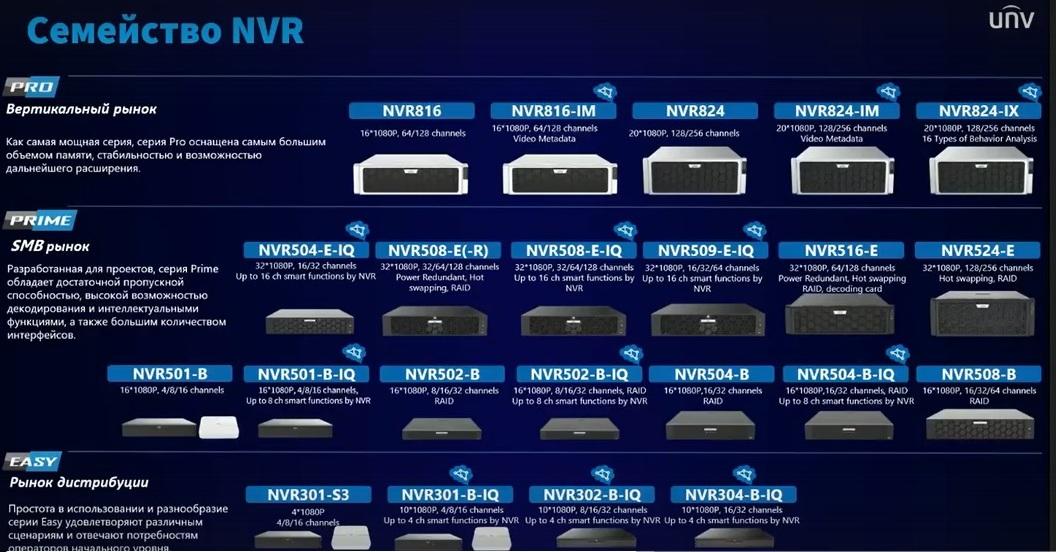
If we talk about the distribution market, then it is from one to four hard drives, from one to thirty-two channels. Recorders can be with PoE or without PoE. Some models can be in plastic, and some can be in metal.
The Prime series has, perhaps, the largest line. The models have from one to 24 hard drives. Again, from 4 channels, but here already up to 256 channels. Accordingly, where is it possible to build some raids with the required number of hard drives, how many do they have? 4, 8, 16, 24. All sorts of raids, of course, they also build. The initial series of the Prime series has the suffix B in the name. Basic line with basic functionality with excellent image coding qualities. The E series is a little bit higher than with the suffix B. These models already have more productive hardware. Some models, starting with eight-disk ones, have the ability to reserve power supplies. They have a hot-swap function for hard drives. This is the E series.
And the Pro series - the largest, the most expensive models. Here, too, specific features appear, as in the Pro Camera series. These are recorders for working with video metadata and working with behavioral analysis. I want to draw your attention to the fact that there are some models with the IQ suffix. This means that these recorders can work with any other, other people's cameras. And they have analytics on board. Analytics, which I talked about, perimeter protection, and including face capture and recognition. That is, the database will be spinning on the recorders. I don't know how it is now in Russia with face recognition from the point of view of legality, whether it is necessary to register all this, but with all this, such functionality is available. You may not use the face recognition function when you compare a photo with a person who gets into the camera. They are impersonal, just snapshots and face capture will fall into your recorder.
The entire series is derived precisely from IQ recorders, intelligent recorders.
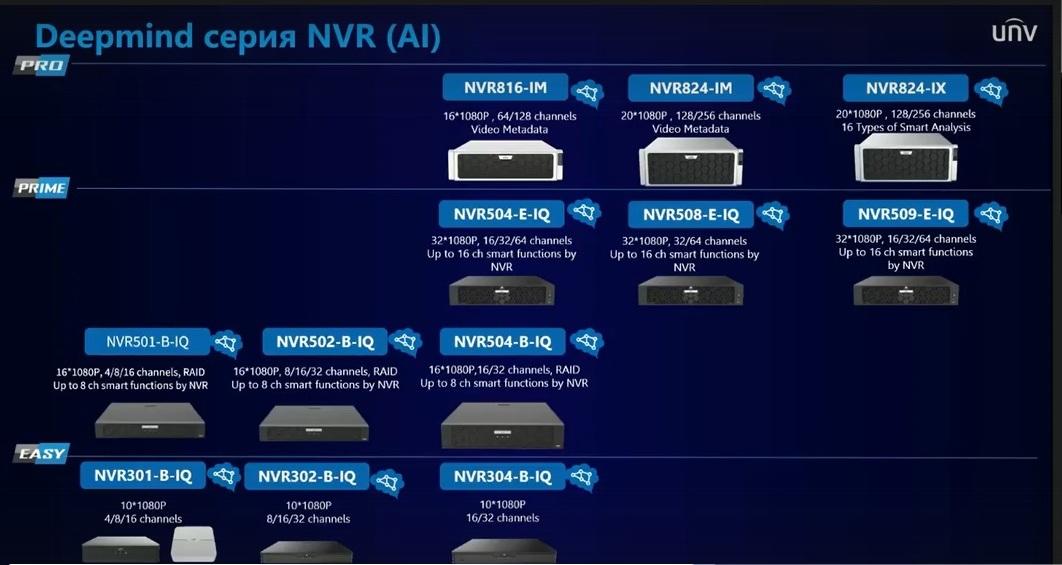
We called it the Deepmind series. That is, these are the same recorders that you saw on the previous slide, they are just put into a separate line. We called it Deepmind, which means a smart recorder. In the Easy series, recorders can also recognize faces, not for the full number of channels. Perimeter protection is also not for the full number of channels. In this diagram, we want to visually present the scheme of existing video recorders with analytics on board. One level in the Easy series, B-IQ, two levels B-IQ and E-IQ in the Prime series and one level in the Pro series. Each level has the same coding capabilities for the corresponding series. Just in case, Uniview has some bookmarks from the point of view of hardware. As you can see, there are models for 9 hard drives, which is not the standard. The standard is 1, 2, 4, 8, 16, 24 and 32 hard drives. We have models that have 9 hard drives, including, and this can be a good bookmark in the project.
Again about recorders.
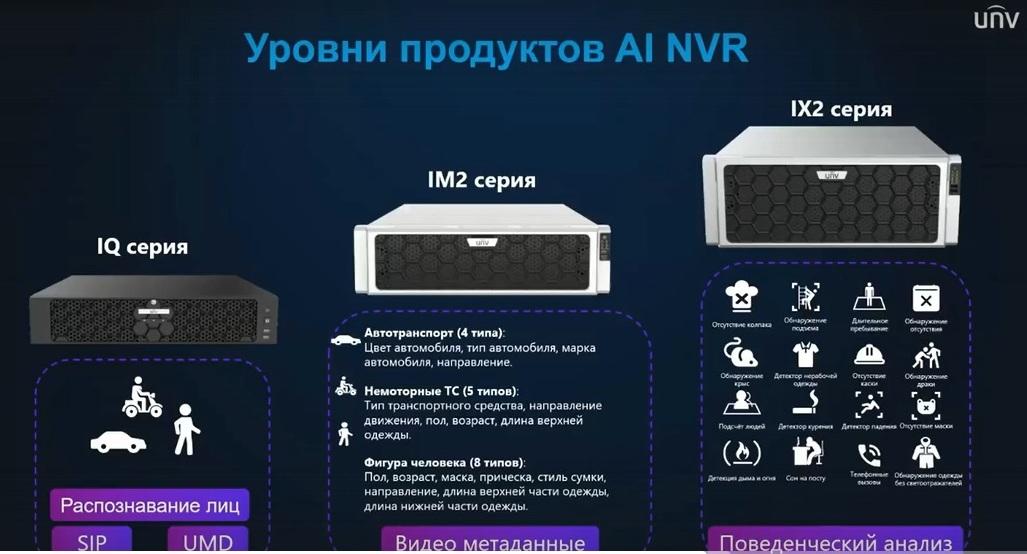
Their capabilities are clearly shown here. IQ series: face recognition, perimeter protection, smart intrusion prevention (SIP) and ultra-motion detection (UMD) are supported. The IM2 series is the PRO series of recorders, this is working with video methods. It is simply not drawn here, but there is also face recognition, perimeter protection, ultra-motiondetection is also present, but on a much larger number of channels than in the IQ series and allows video metadata to highlight some interesting attributes of a person, a car and a non-motor vehicle that you see on the slide, for subsequent quick search in the archive.
And the IX2 series is a series of recorders with high performance, there is also face recognition, UMD, perimeter protection. But plus there is also behavioral analysis. There are 16 of them drawn on this slide. However, in fact, according to the latest information, there are about 130 different analytics that the recorder supports. And there is a list of all the analytics of behavioral analysis, which you can read if you are interested. Here, in these 16 pictograms, the basic analytics that are considered the most popular are highlighted.
Just in case, Uniview also supports "old believers" who still have analog equipment, and who do not want to pull cameras, pull new wires.
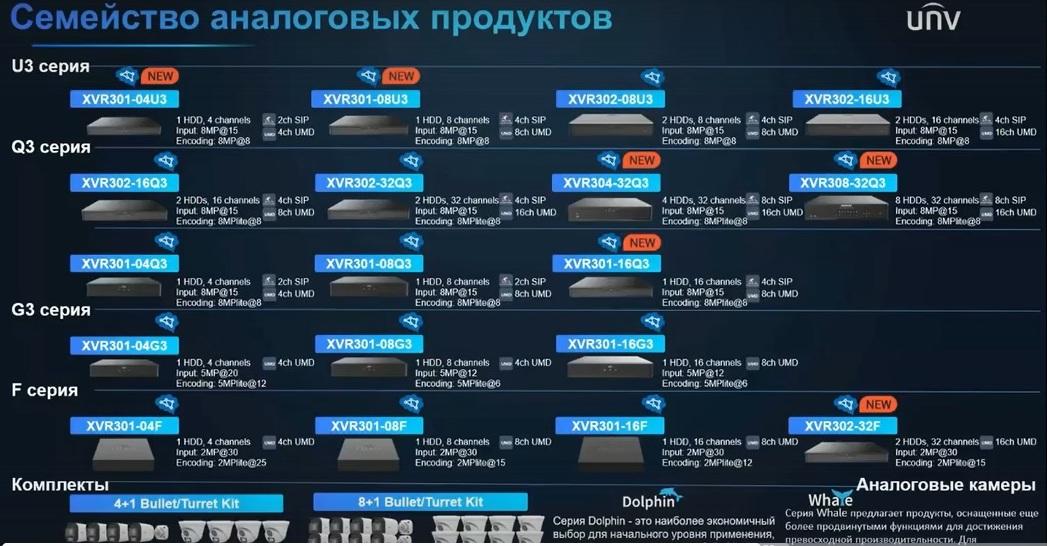
We have hybrid video recorders that allow you to connect from 4 to 32 cameras via coaxial cable from one hard drive to eight. Also, on all hybrid recorders there is an icon, such a polygon, which indicates that the recorders know how to do something with video analytics that are on their own board from a regular analog video stream. We also have analog multi-format cameras and plus kits.
For display systems. These are monitors, interactive panels, LCD video walls and controllers.
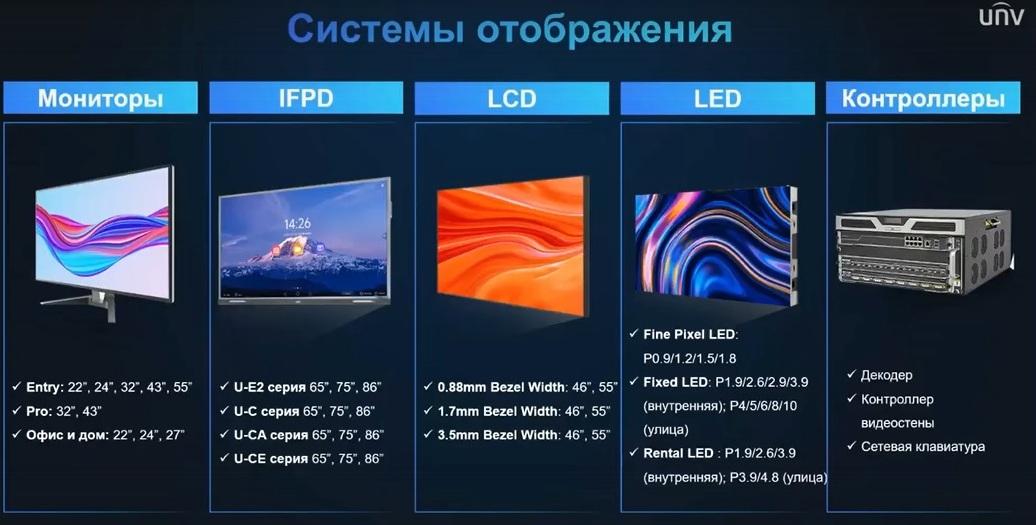
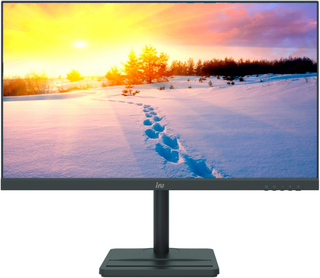
If we talk about ordinary monitors, there are monitors separately for video surveillance systems. They can work 24 hours a day, 7 days a week. They have an additional reduction in the level of blue for the operator's eyes. That is, these are the things that relate to TV. There are monitors for home and office, we call them IT monitors, they are a little simpler, with a smaller diagonal, basic models that are present on the market. The question of price in competition with other suppliers.
We have interactive panels from 65 to 86 inches. They are conditionally divided into two parts. The first is interactive panels for showrooms, for offices, for home. And the second part is interactive panels for the education system. They are a little different from each other. For the education system, they differ in that some interfaces are located directly in front, for quick control of them. For the educational series, some programs are already supplied by default and in the base, which are on this Android, this is Android 13, all models have installed educational programs, all sorts of rulers, drawing figures and so on.
LCD video walls are almost seamless. They will be significantly cheaper than with the same amount of area than for a video wall. But still they will have some thickness between the panels. And, you see, we have 46 and 55 inches with a pitch of 0.88, 1.7 and 3.5 millimeters. 0.88 is not the thickness of the panel edge, it is the sum of two edges standing in the panel one above the other, left and right, that is, this is the maximum width that will be shown in black, that is, this is the distance from the visible extreme LED of one panel to the first LED of the next panel.
LED video walls are built a little differently, they are a little more expensive, but they are considered more high-class devices in video display systems. They are used to build large video walls, flight control centers, etc. They are both internal and external. Internal LED video walls start with a pixel pitch of 0.9 mm, then more, and reach outdoor video walls with a pixel pitch of up to 10 mm, with a brightness of 10 thousand candelas per square meter, i.e. very bright outdoor panels. There are also models for rent, when you need to quickly assemble a video wall, quickly disassemble it, load it into cases and transfer it to a new place. There are also controllers and decoders. Controllers process standard signals from n-th number of some HDMI, DVI, Display Port devices to n-th number of LCD panels that can be connected to this controller. That is, the customer tells you how many independent input sources, sources of information, he will have, and how many monitors he needs to turn on and display all this. Accordingly, you will fill these controllers with cards. The chassis will insert one or another type of cards that the customer requires. As for decoders, they allow you to work specifically with video data streams from a video camera or from a video recorder. Here we do not work with standard HDMI signals, display ports and so on. Here we take a stream from the camera or from the recorder, and already decode it into an image on the standard output interface on board the decoder itself. We also have network keyboards in the control system controller.
Now storage systems. Disk enclosures are disk shelves that we can attach to PRO series recorders. This is the first. Or to IPSAN, which stores video data to extend their archiving time and increase the disk array. They are different: single-controller and with two controllers.
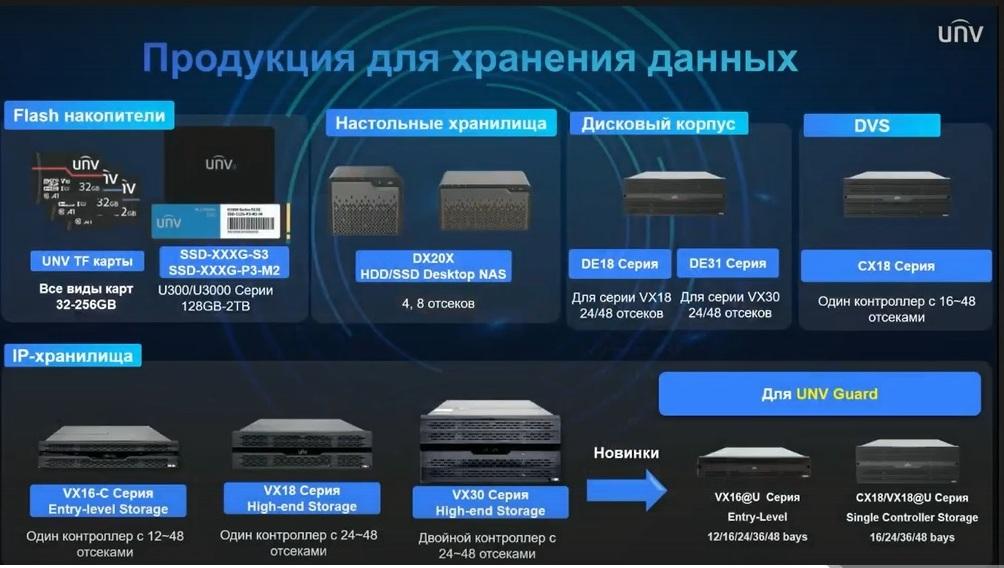
In conclusion, I will tell you about the software that we developed last year for video surveillance systems. Models of servers are recommended for it, which assume the use of a video surveillance system as a management platform.
About switching. There are all sorts of models here.
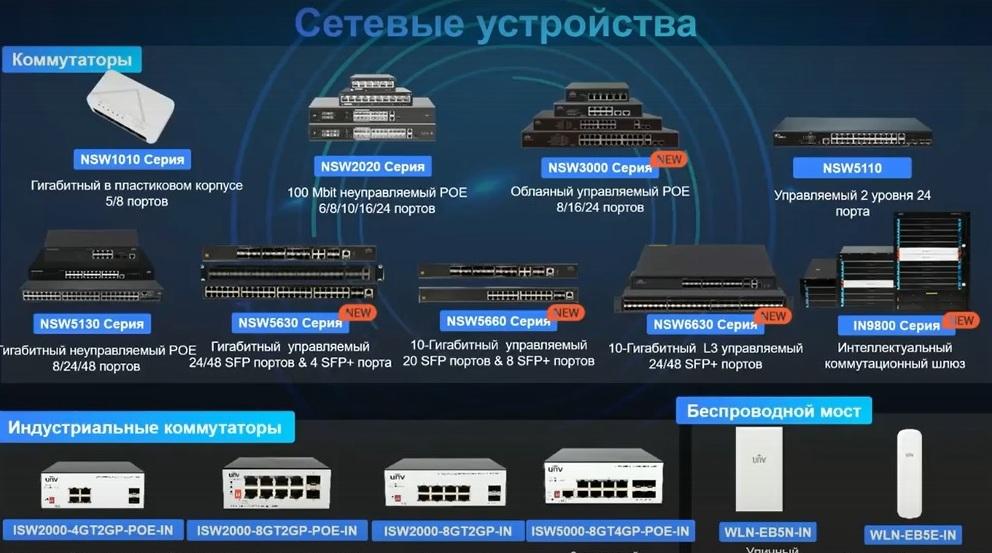
Since we support network topics more, these are, as a rule, PoE solutions. They can be outdoor, they can be indoor. If we talk about something interesting, Uniview has a cloud solution for video surveillance systems as well. That is, any camera, any recorder can be "thrown out" using a mobile application, and then watch what is happening. So, our switches can also be added to the client's cloud, the end user, who will monitor their lower-level devices through a mobile application or through software on a computer, see the bandwidth of the switch ports, reset these ports, that is, see all the equipment that is located below this switch. This is a cloud switch, it does not need an IP address, it does not need direct access, all this is done using a mobile application. Also, recently we have more professional switches, not only for PoE, not only for video surveillance systems, but also for large data storage systems as well.
These are L2, L3 level switches, aggregation switches and core switches. If we talk about core switches, then they are made in the format of a chassis, where we insert the necessary cards with the necessary interfaces that are used on the object. Uniview has wireless bridges that allow, conditionally speaking, to connect a camera located on one bank of the river with a recorder located on the other bank. The big plus is that with such a connection you do not need to configure wireless bridges, an access point, it is all configured at the factory. In Russia, this can be done with the help of third-party vendors, but at the same time you need to climb into each access point, configure ports and so on. Uniview has done this at the factory, so turn it on and use it. A quick solution for such tasks. Up to 3 kilometers is supported, of course, in direct visibility.
Intelligent access may be available this year. Now I have nothing specific to say about the models yet.
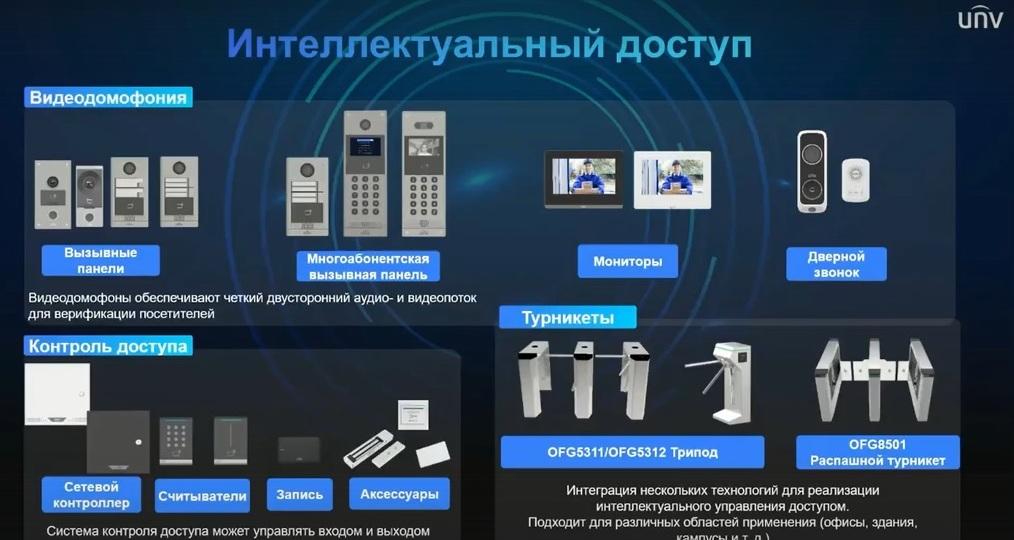
We have multi-subscriber call panels. This is for apartment buildings, designed for a large number of subscribers. There are call panels for a limited number of subscribers, from two to six. From the point of view of a user of an apartment building, on that side the user has monitors that will display everything that is happening on the street, that is, where the call panel is looking. Plus, of course, all this through a mobile application can also be duplicated in the user's phone. As for the access controller, there are quite a few models of network controllers with the required number of connected doors, inputs and outputs. There are also some models specifically for passage, for turnstiles. You can see different versions of such models in the lower right corner of the slide.
provided by the press service ofUniview