An event by OCS distribution company, as well as the Russian developer of system and infrastructure software STC IT ROSA and the Russian developer of high-performance solutions, calculation complexes and visualization systems Forsite. At this event, speakers from the companies talked about how to create a fully functional and efficient VDI solution using Forsite servers based on Russian software Rosa Virtualization and LoudPlay.
Topics discussed at the meeting:
- Key competencies and main areas of work of Forsite;
- Functionality of the ROSA Virtualization platform;
- Problems faced by the customer and the tasks facing the integrator;
- Discussion of a comprehensive solution provided for the Ural Advanced Engineering School.
Today's event was started by Mikhail Mitroshin, technical specialist, STC IT ROSA. Today we will talk about a very significant project related to the organization of virtual workplaces based on domestic developments.
Let me name the main advantages of virtual workplaces. Firstly, it is the ease of administration of both hardware and software. It is one thing to maintain a fleet of professional computers, where in fact each machine has to be repaired separately and updated separately. The same applies to software. And secondly, it is, of course, increased security. The fact that data can easily leak from personal computers makes it much more difficult to steal it from a thin client. There are also a number of less significant advantages. And until recently, the bulk of the virtual workplace market was occupied by products from foreign companies. But today we are ready to offer you a comparable in functionality own solution, to show how it was implemented at the Ural Federal University.
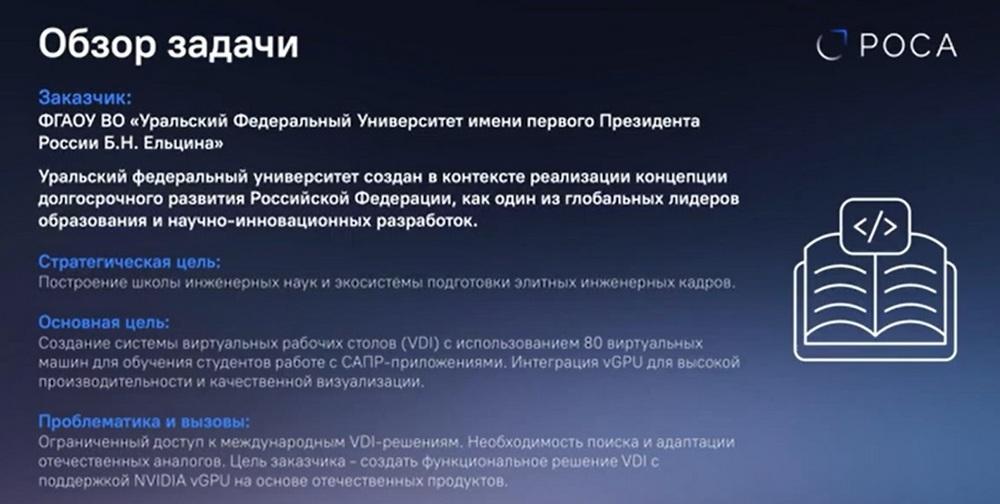
The main goal that the university faced was to build a VDI infrastructure for training students at the School of Engineering Sciences or Advanced Engineering School (AES). The specificity was that the training included work in CAD, that is, in computer-aided design systems. Thus, full-fledged 3D graphics should work on thin clients, i.e. Siemens NX is used there. Just imagine 80 workplaces, each of which needs to install CAD and each of which needs to be filled with the necessary content for the next lesson. The task is very difficult. And this is where VDI comes to the rescue. Templates of virtual machines are created. And at the right moment, the student gets access to such a machine filled with exactly what he needs at the moment. But there are two subtleties. The solution must be domestic, firstly. And secondly, it must support NVIDIA's vGPU technology. vGPU is a technology for sharing the power of a 3D video card between multiple virtual workplaces. That is, the card is placed on the virtualization host, and its power is used in several virtual workplaces. It turned out that a suitable solution exists and it is based on the virtualization system from ROSA. We will talk in detail today about its capabilities. First, a few words about STC IT ROSA.
Our company is a domestic developer of infrastructure software. Our portfolio includes operating systems for both general and special purposes, both for ordinary computers and for mobile phones. Recently, the "R-FON" phone appeared with our Chrome Mobile operating system, a Linux family that is a twin brother of the Linux that we make for ordinary x86 computers. That is, it is not Android at all and not a relative of any existing systems. This is our Linux system installed on mobile phones. Our software also includes information environment management systems, both physical and virtual. Anticipating your questions, I will say that we have something to offer to replace, including Active Directory. That is, to build an entire IT infrastructure at any enterprise, at any customer. But one of the main places among our products is occupied by the virtualization system. I will tell you a little more about it, and for now I will hand over the floor to my colleague, chief engineer of Forsite, Roman Lutsenko, who began his story about how they implemented the project at the Ural Federal University.
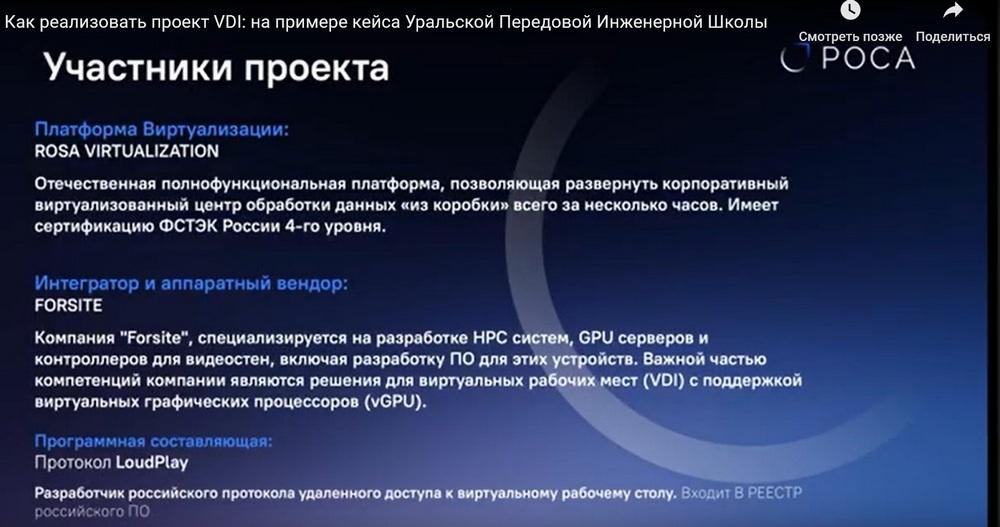
Our company Forsite was founded in 2005 and initially specialized in solutions with high-performance GPUs. Further development of the company led it to work in three areas: graphic workstations, visualization systems - video walls and high-performance clusters and VDI, as a kind of them. The first project with vGPU technology was implemented in 2014, then still available from Citrix. Loud Play also participated in this project, this is a Russian development company specializing in solutions in two directions. Own cloud gaming platform, operating in industrial operation since 2018 and the LoudPlay protocol for virtual remote desktop solution offered to customers in technological partnership with leading developers of VDI and terminal services in Russia.
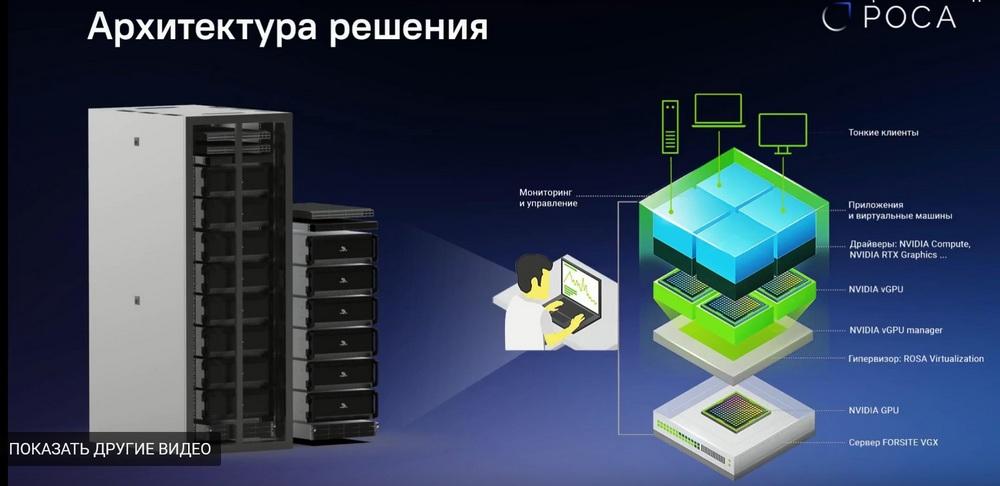
The VDI cluster was built completely from scratch, we were only provided with connection points to the university network. The solution was built on FORSITE VGX servers with two vGPU NVIDIA A40. Huawei solutions were used as network switches, assembled in a rack to increase fault tolerance.
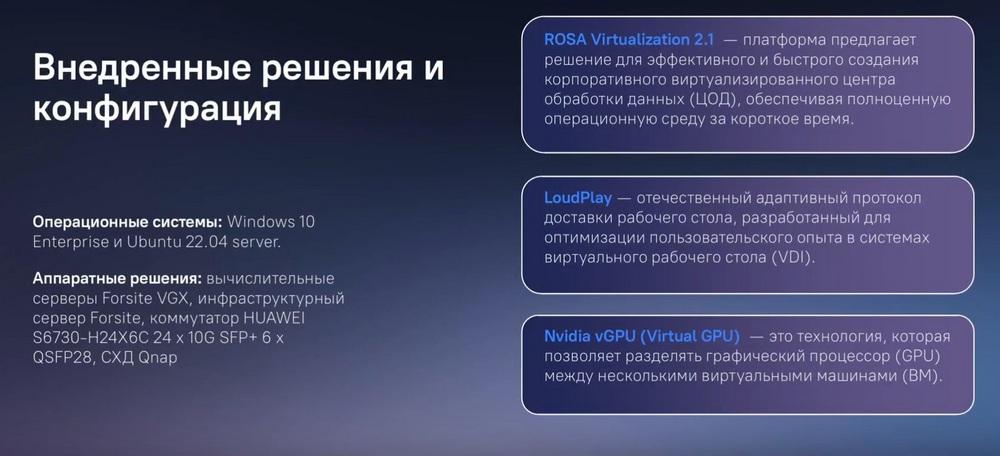
ROSA Virtualization
ROSA Virtualization - this product has already been released in three versions, we are now expecting the 4th release. The version number will be 3.0, because before that there were versions 1.0, 2.0, 2.1. The product has a valid FSTEC certificate until 2027, which confirms its compliance with the 182nd order on measures to protect information in virtualization systems. In fact, this means that the system can be used in any state information systems that do not contain state secrets. That is, the 17th and 21st orders, they all fit under this, that is, working with personal data, it's all there. ROSA Virtualization is well suited for replacing popular virtualization systems VMware, Microsoft and Hyper-V. It is based on high availability clusters, that is, the system is stable. In case of failure of individual components, virtual machines continue to run on the remaining components. The system supports various types of storage, external, connected via Fiber Channel, iSCSI, NFS and internal protocols. Both server virtualization and workplace virtualization, i.e. VDI, are supported. Migration of virtual machines from your existing infrastructure to our new one is provided. The system is well scalable. Unified management is provided for thousands of virtual machines in various clusters. Configuration with metroclusters for emergency establishment is supported. Backup is possible both with built-in means and with the domestic certified cyberbackup product of Cyberprotect. The system is compatible with antivirus solutions from Kaspersky and Doctor Web. Finally, Russia has all the necessary components for building a virtualization system. You will not need any third-party software product. We take your hardware, our distribution and get a virtualization system. No Internet access is required during installation and launch. You can safely install all this in an isolation environment that does not have access to the outside world.
Using vGPU solves several problems. The main one is graphic acceleration in virtual machines, which allows you to work correctly in CAD systems. It also allows you to encode/decode various video streams on dedicated vGPU resources, which reduces the load on the processor when delivering the desktop to the end user. A bonus of this technology is dynamic balancing of the performance of the graphics system. That is, if cards are divided between users into several virtual machines. That is, dividing into parts guarantees a lower performance bar, but does not limit the upper one. Accordingly, in order to get a desktop with a good picture quality, we used the LoudPlay protocol - this is a domestic adaptive desktop delivery protocol designed to optimize the user experience in virtual desktop systems (VDI). It works with various client devices, providing high picture and video quality.
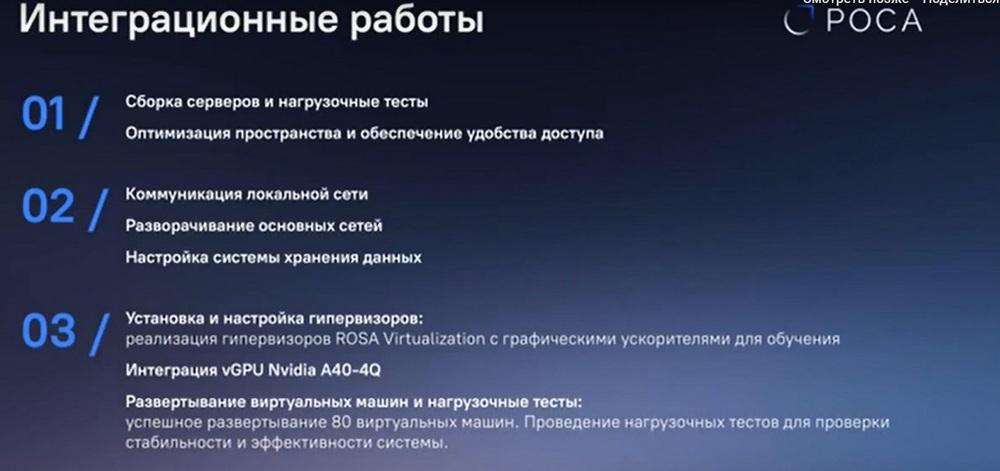
Accordingly, in addition to the sale itself, our company carried out implementation on the customer's territory. Installation and technological works were carried out at the facility, during which the VDI infrastructure was configured, storage systems, networks, servers were configured, hypervisors and the management system were installed and configured. An image of the system was made with optimized performance settings for both standard resources and GPU. Tests were also carried out for fault tolerance in order to see how the system will behave in critical situations.
What configuration of virtual machines was chosen? During the first contact with the customer, his main needs were clarified, what he ultimately wants to receive. Based on this data, a configuration of virtual machines was proposed, which included 6 virtual processors, 16 GB of RAM, 200 gigabytes of code storage and an NVIDIA A44Q profile, which includes 4 GB of video memory. This configuration has been repeatedly tested by both our company and various customers who use AutoCAD, Kompas and similar CAD systems. Accordingly, we also provided this configuration to the customer for verification of their load testing, and the customer confirmed that this performance completely satisfies them.
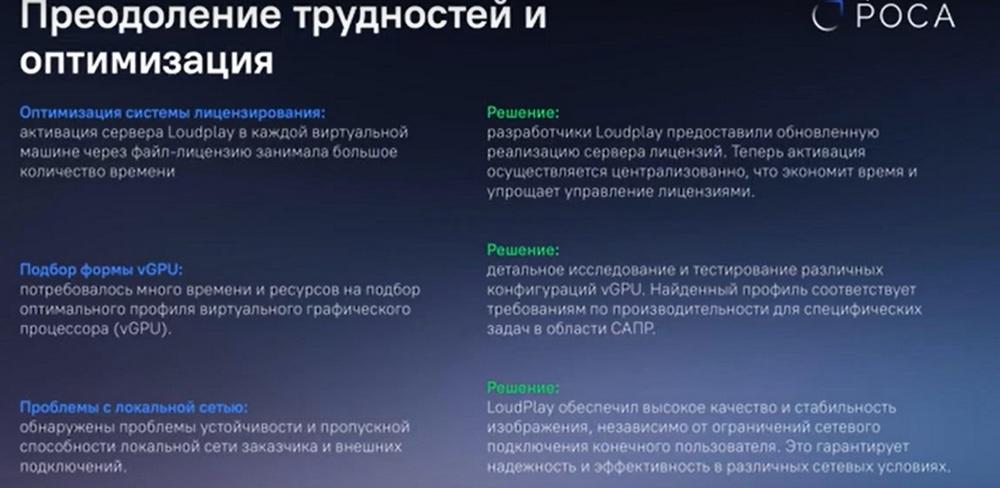
What did we encounter during the work? The first is that with LoudPlay, each virtual machine was licensed separately with a license file, which complicates the deployment and configuration of virtual machines with a larger number. Therefore, Loud Play quickly refined its licensing system and provided a license server that distributes licenses over the local network, and, accordingly, you do not need to throw files into each machine.
Profile selection and GPU
We already have a lot of experience in these solutions, but it is still better to carry out load tests, because each customer may have some additional conditions different from others. Accordingly, after the testing, we selected the 4Q profile, which would meet the performance requirements of the customers. And when we transferred the equipment to operation, administrators connected to the system from the outside, and it turned out that some users had an unstable Internet connection. And this is where the flexibility of LoudPlay came into play, which can dynamically adapt to various conditions, this flexibility came in very handy, we selected parameters for sufficiently poor connection quality, as a result we got a good picture with low delays, and users were able to work better.
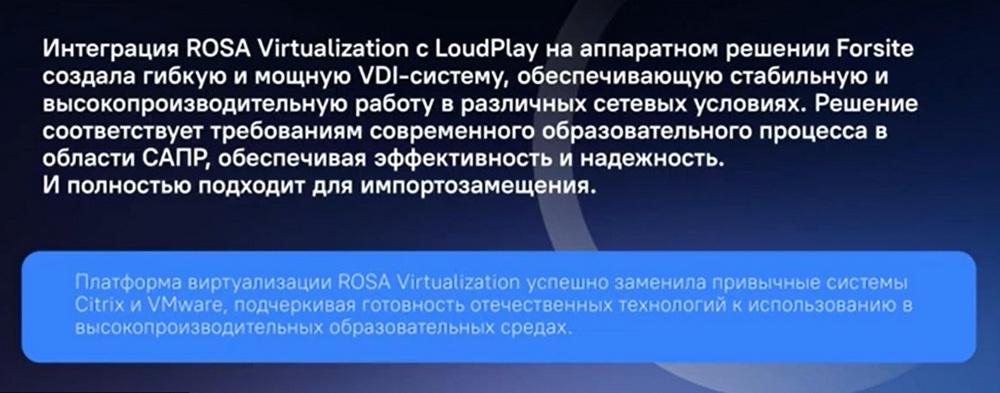
Why did we choose ROSA Virtualization?
We have already conducted a survey, about a year ago, which platforms of Russian vendors can work with vGPU and with the LoudPlay protocol. The most, probably, optimal solution from our side seemed to us that it is ROSA Virtualization. which provides both ease of use and high-performance actions in various conditions. It was this set that seemed optimal for this project to us. Accordingly, the system was initially designed to be quite fault-tolerant. Even if one server was lost, the user lost a maximum of 8 virtual desktops, which in principle also suits the customer as a fault tolerance mode. Storage systems and network connections were also reserved.
Then the floor passed to Mikhail Mitroshin, technical specialist, STC IT ROSA. According to him, the project that they carried out jointly with Forsite allows them to use these developments in new projects. And it is especially important that the solution is suitable for customers with increased requirements for virtual workplaces, in particular for those whose workplaces are used for employees of engineering specialties. And this is practically all design bureaus.
We have our own test zone, you can always request remote access to it to see how it works, check how the technologies are implemented, to feel the result of our joint research live.