What problem it solves
In companies where AI services are developed by multiple teams at once, accelerators are usually assigned to individual departments. Hence the typical picture: part of the equipment sits idle while a neighboring project waits for available capacity. Given the cost of modern GPUs, this represents direct losses.
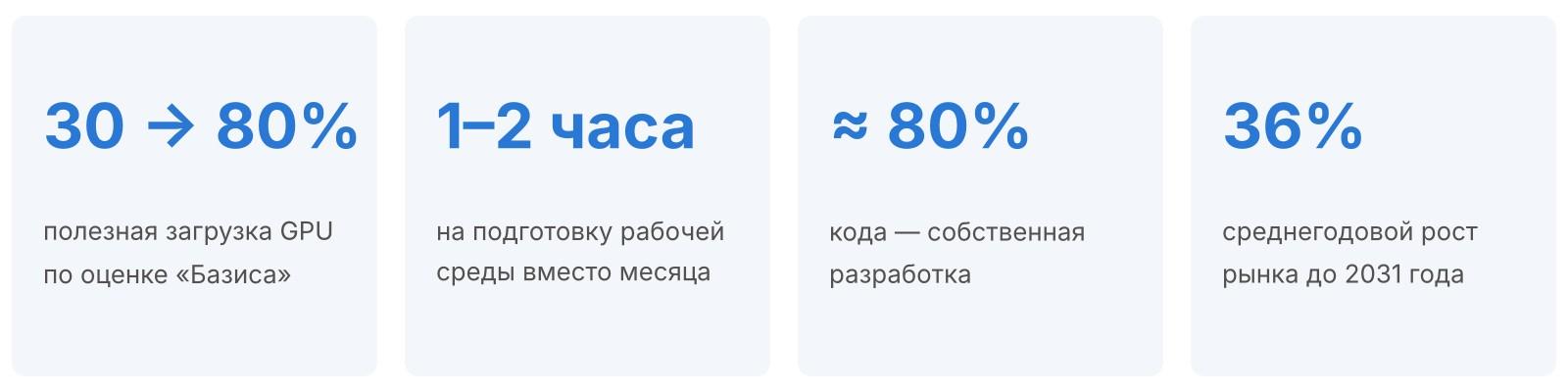
Basis AIR organizes shared use of the fleet: cards are combined into a common pool, and access to it is regulated by quotas and priorities. According to the company's estimate, the useful utilization of accelerators grows from 30% to 80% — more than two and a half times.
Glossary
Orchestration — automated distribution of tasks across available computing resources.
Inference — applying an already trained model: answering user requests, recognition, generation.
MIG — hardware partitioning of a single compatible accelerator into several isolated instances.
Air-gapped environment — infrastructure without internet access.
How it works
There are two components in the architecture. Basis AIR Control Plane is the management center: this is where departments, projects, and roles are described, and rules for access and resource allocation are set. Basis AIR Cluster is installed in each GPU cluster and is responsible for on-site workload scheduling. Clusters can be located at different sites and in different subnets, while being managed from a single interface.
You can work with the platform via a web interface, API, and command line. Teams submit tasks for execution and monitor their status.
What the platform can do
Separately, the company highlights the effect for the employees themselves: automated resource provisioning and access configuration, according to the developers, reduce work environment setup time from a month to 1–2 hours.
Independence and security
• Standalone product. Basis AIR does not require other Bazis solutions. It works with Basis Digital Energy and with other compatible Kubernetes-based platforms.
• On-premise data center and air-gapped environment. The platform is deployed in the customer's data center, including environments without internet access.
• Data stays in place. Only service metadata and operational metrics — task statuses, node health — are transferred between the cluster and the management center. Datasets and trained models are not included in this exchange.
• Proprietary code. About 80% of the code is developed by Bazis. The company calls the product the first import-independent standalone solution of its class.
Why managers need this
Data on actual consumption answers a question usually decided by guesswork: whether more accelerators need to be purchased. Reports show which workloads fit on existing equipment, and where capacity is genuinely lacking.
“The economics of corporate AI projects largely depend on how fully computing resources are utilized. If GPUs are assigned to individual teams, part of the equipment will sit idle while other projects wait for available capacity. We built Basis AIR as a standalone product for various infrastructure platforms so that customers could deploy it within their own technology stack while maintaining freedom of choice”
— David Martirosov, CEO of Bazis
The market: small, but fast
iKS-Consulting estimates the Russian market for AI and GPU infrastructure management software at 430 million rubles in 2026. The forecast for 2026–2031 is an average growth of 36% per year.
Points to keep in mind
Figures on GPU utilization and workspace preparation time are developer estimates. Before implementation, they should be tested on your own workloads: if accelerators are already evenly utilized, the gains will be smaller.
About the company
Bazis is a Russian developer of software for managing dynamic IT infrastructure, virtual desktops, and cloud services. The company was formed in 2021 by combining the assets of Tionix, Digital Energy, and Skala Softver, and is controlled by the RTK-TsOD group. Since December 2025, its shares have been traded on the Moscow Exchange under the ticker BAZA. Its products are included in the register of Russian software and certified by the FSTEC of Russia.
Learn more about the products on the company's website: basis.ru.
erid: 2VtzqwfVkni
Advertisement. OOO “Bazis” INN 7731316059