The company "Basis", a leading Russian software developer for dynamic infrastructure management (part of the RTK-TSOD Group), has released a new version of Basis Digital Energy - a platform for managing the full lifecycle of Kubernetes-based clusters. Release 1.7 adds the deployment of clusters from user templates, expands scenarios for working with the Basis vCore hypervisor, and provides the ability to manage the artifact repository directly from the web interface.
The product provides users with tools for building, testing, and deploying applications as a single managed service. It implements the DevSecOps approach, controlling security at all stages of development and testing to identify risks early and reduce the likelihood of vulnerabilities in finished services.
The updated Basis Digital Energy now features a template mechanism: an administrator saves a ready-made cluster configuration and then deploys similar clusters from it in just a few steps. This reduces the proportion of manual operations when building infrastructure and lowers the risk of errors during redeployment, providing the customer with faster and more predictable launch of new clusters.
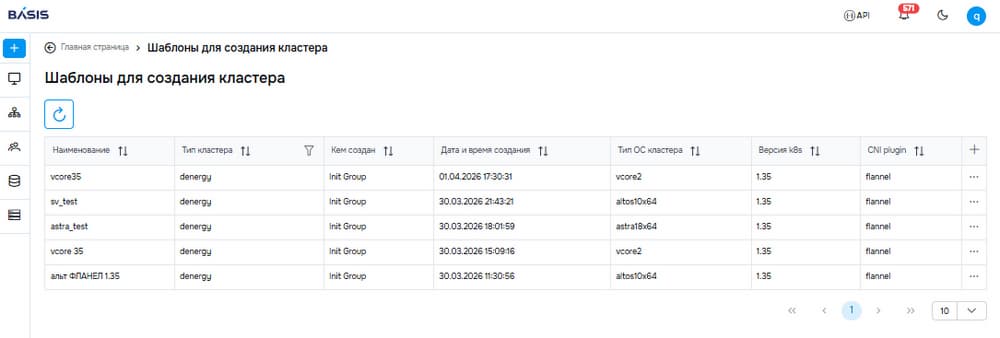
Saved templates for creating a cluster
Special attention in the release is given to administrator comfort when working in closed circuits. A section for managing the iStore system artifact repository has been added to the Basis Digital Energy web interface: the platform administrator can view and edit lists of images and helm charts, as well as track user actions through the operation log. The iStore repository allows applications and Kubernetes clusters to operate without Internet access, which is important for isolated environments.
One of the important changes in the release is the expansion of Basis Digital Energy's scenarios for working with vCore – Basis's proprietary hypervisor, which is part of the company's unified product ecosystem. It is now possible to deploy the Basis Digital Energy platform itself on it, as well as create managed clusters. For clusters on physical servers (Bare Metal), it is now possible to set custom node and load balancer names – both when creating a cluster and when adding new nodes and load balancers.
Release 1.7 also expands application installation capabilities. A user catalog has appeared, through which custom applications from custom helm charts can be installed into the cluster, in addition to the set of certified tools. APISIX – an API gateway for routing, protecting, and managing traffic in a Kubernetes cluster – has been added to the catalog.
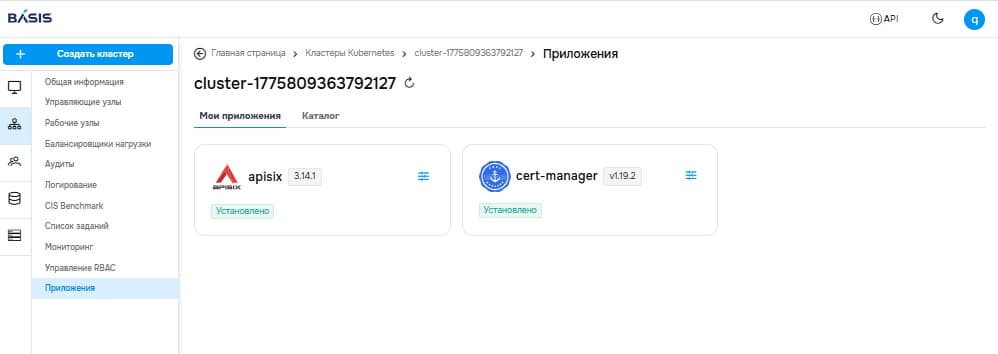
User application catalog of Basis Digital Energy
The platform's flexibility and efficiency under load have also been increased. The Basis Digital Energy administrator now has the option to choose whether to install a cluster monitoring service, and the background process for monitoring node and load balancer status has been optimized. To reduce the load on the database, the auditing mechanism has been redesigned: record storage has been moved from the database to file storage.
"According to iKS Consulting analysts, the Russian containerization segment will grow by approximately 25% year-on-year for the next 5 years, and this is one of the reasons why we are investing significant resources in the development of Basis Digital Energy. Another equally important reason is the customers' need for a solution for working with containers as part of a virtual infrastructure, which also includes server and VDI solutions. That is why we are developing our products as a unified ecosystem," noted Dmitry Sorokin, Technical Director of Basis.